
The Ladder of Evidence: How Forensic Botany Solved the Lindbergh Kidnapping
When the Lindbergh baby was kidnapped in 1932, the only clue left behind was a crude wooden ladder. Discover how an obsessed wood detective used tree rings, microscopic planer nicks, and a missing attic floorboard to solve the "Crime of the Century."



The Stolen Eaglet
The winds of the Sourland Mountain region howled with a bitter chill on the evening of March 1, 1932. Inside a newly constructed and isolated estate near Hopewell, New Jersey, the legendary aviator Charles Lindbergh and his wife Anne Morrow Lindbergh rested on the ground floor, entirely unaware that a nightmare was unfolding just above them. At approximately nine in the evening, an intruder ascended to the second floor nursery. The target was the couple's twenty month old infant, Charles Augustus Lindbergh Jr., affectionately dubbed the Eaglet by an adoring American public. When the family nurse, Betty Gow, entered the room shortly after, she found the crib empty. A cold draft blew through the open window, chilling the silent room.
The crime scene yielded meager and confusing clues. A ransom note demanding fifty thousand dollars rested on the radiator casing beneath the window. It was written in jagged, poor English, signed with a bizarre symbol of interlocking blue circles and punched holes. Muddy, indistinct footprints stained the nursery floor, but the most imposing piece of evidence lay abandoned in the mud seventy feet outside the house. It was a crude, handmade wooden extension ladder, broken at the joint where the lower sections met. The local police and federal authorities scoured the area, but fingerprint analysis of the ladder yielded absolutely nothing. The perpetrator had worn gloves or used cloth to wipe the timber clean. The kidnapper had vanished into the freezing night, leaving behind a baffled nation and a silent wooden witness.

A Trail Gone Cold
For weeks, the Lindbergh family endured an agonizing waiting game, negotiating through intermediaries in the desperate hope of seeing their child again. A retired Bronx school teacher named John Condon stepped forward to act as a go-between, communicating with a shadowy figure who called himself John. Late one night at St. Raymond's Cemetery in the Bronx, Condon handed over fifty thousand dollars in marked gold certificates to the mysterious stranger, receiving only a vague promise that the child was safe on a boat named Nelly. The boat did not exist. The crushing reality of the situation surfaced on May 12, 1932, when a truck driver's assistant named William Allen stepped into a wooded grove just four and a half miles from the Lindbergh estate. He discovered the badly decomposed remains of a toddler, hastily buried in a shallow grave. The skull had been fractured by a massive blow to the head.
The discovery turned the stagnant investigation into a frantic hunt for a child killer, but leads were practically nonexistent. Investigators possessed the serial numbers of the gold certificates, waiting for the bills to surface in circulation, but months turned into years with no major breaks. The police had completely exhausted the forensic value of the ransom notes and the muddy footprints. The broken wooden ladder sat in an evidence locker, heavily handled and seemingly useless. The authorities desperately needed a new way of looking at the crime, a perspective that did not rely on blood or fingerprints, but on the very cells and fibers of the murder weapon itself.

The Wooden Witness
Arthur Koehler read about the abandoned ladder from his kitchen table in Madison, Wisconsin. As the chief wood technologist at the United States Forest Products Laboratory, Koehler was a xylotomist, a scientist who specialized in the cellular structure, growth patterns, and microscopic identification of timber. Where a police detective saw a few pieces of dirty lumber, Koehler saw a biological fingerprint waiting to be deciphered. He viewed the homemade ladder as a daring challenge and wrote to the investigators, offering his highly specialized skills. Over a year after the kidnapping, the authorities finally shipped samples of the ladder to his laboratory.
Koehler completely dismantled the ladder to perform a wooden autopsy. He carefully numbered, calipered, and measured every one of the nineteen constituent parts to a hundredth of an inch. He placed ultra thin shavings of the wood beneath his microscope, identifying four completely different species of timber used in the crude construction. The upright rails contained both Douglas fir and North Carolina pine, while the rungs were carved from ponderosa pine, held together by birch dowels. Koehler determined that the ladder was built for a single, malicious purpose, as the ponderosa pine rungs showed absolutely no signs of prior wear. The builder was a man with access to a random assortment of leftover lumber, possessing the rudimentary skills of an amateur carpenter. The timber had its own story to tell, and Koehler was determined to translate it.

The Dorn Mill Connection
The most promising clues were hidden on the two bottom rails of the ladder, crafted from North Carolina pine. When lumber is processed at a mill, it is fed through a machine planer equipped with spinning cutter heads. If a knife blade in that cutter head has a tiny nick or defect, it leaves a repetitive microscopic ridge on the surface of every board it dresses. Using oblique lighting to cast deep shadows across the wood, Koehler identified a distinct pattern of irregular gouges on the rails. By mathematically measuring the distance between these identical nicks, he calculated the exact speed at which the lumber was fed through the machine. The marks proved the board had been planed by a machine with eight knives on the top and bottom heads, and six knives on the sides.
This specific mechanical configuration was incredibly rare. Koehler launched a relentless nationwide survey, sending letters to nearly sixteen hundred lumber mills across the eastern United States. The microscopic measurements led him directly to the M.G. and J.J. Dorn Mill in McCormick, South Carolina. Koehler personally visited the mill and confirmed that their planer produced the exact same revolution marks found on the kidnap ladder. From there, he tracked the commercial paper trail of forty six specific carloads of North Carolina pine shipped from the Dorn Mill to northern retail yards. His meticulous hunt ended at the National Lumber and Millwork Company in the Bronx, New York. The timber used to build the ladder had been sold in a neighborhood located just miles from where the ransom money was currently being spent.

The Ransom and the Carpenter
The investigative net rapidly tightened in September 1934, two and a half years after the abduction. A gas station attendant in the Bronx grew suspicious of a customer who paid for fuel using a ten dollar gold certificate. The attendant wrote the vehicle's license plate number on the margin of the bill, leading police directly to the home of Bruno Richard Hauptmann. Hauptmann was a German immigrant and an unemployed carpenter who resided in the Bronx. When investigators raided his property, they uncovered a massive hoard of physical evidence. Concealed behind framing lumber and shellac in a tin can inside his garage was over fourteen thousand dollars of the marked Lindbergh ransom money.
Hauptmann adamantly denied any involvement in the kidnapping or the murder. He offered a convoluted alibi, claiming that a deceased business partner named Isidor Fisch had left the money behind in a shoe box before returning to Germany to die of tuberculosis. Police and prosecutors completely rejected the story, noting that witnesses described Fisch as a destitute man who could barely afford his weekly rent. A search of Hauptmann's home also turned up a notebook containing a crude sketch of a ladder, along with the telephone number and address of John Condon, the ransom intermediary, written in pencil on a closet wall. But the most damning piece of evidence was yet to be discovered, resting quietly in the dark, dusty space above Hauptmann's ceiling.
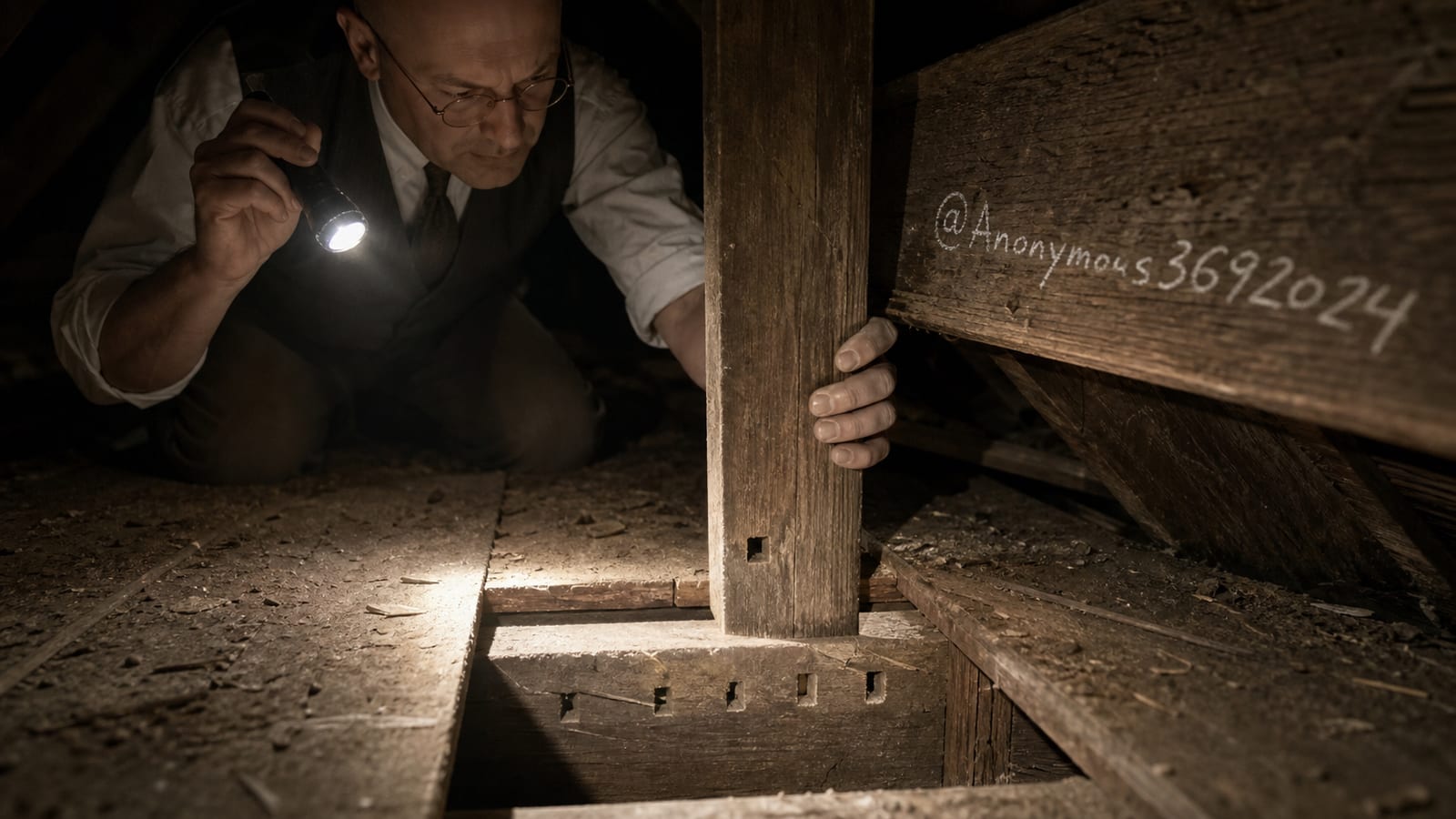
The Secret of Rail Sixteen
Following the arrest, Arthur Koehler instructed detectives to search Hauptmann's residence for any missing lumber or signs of previous woodwork. In the attic, investigators noticed that a section of the North Carolina pine floorboards had been recently sawed away, leaving a jagged gap and a pile of fresh sawdust on the plaster below. Koehler requested that Rail Sixteen, the upper left hand section of the kidnap ladder, be brought to the attic. Unlike the other rails, Rail Sixteen had been heavily hand planed on both edges and contained four square nail holes that served absolutely no structural purpose in the ladder.
Koehler placed Rail Sixteen over the exposed joists in the attic floor. The four square holes in the ladder rail aligned perfectly with four empty nail holes in the wooden joists beneath them. They shared the exact same spacing and the exact same diagonal slant. Koehler then applied the science of dendrochronology, the study of tree rings. He smoothed the ends of Rail Sixteen and the remaining attic floorboard, comparing the natural grain. The biological pattern matched identically. Both boards possessed exactly twelve annual growth rings of the same width, curvature, and prominence. The convex pitch streaks flowed seamlessly from the attic board directly into the ladder rail. Koehler concluded that the mathematical probability of two random pieces of wood sharing these identical biological and structural traits was one in ten quadrillion. The ladder had been built using the very bones of Hauptmann's home.

The Hand Plane Demonstration
The prosecution of Bruno Richard Hauptmann began in January 1935 at the Hunterdon County Courthouse in Flemington, New Jersey. The media quickly branded it the Trial of the Century. The defense team, led by Edward Reilly and Egbert Pope, desperately tried to discredit the botanical evidence. Pope mockingly declared to the judge that there was no such animal as a wood expert, arguing that timber identification was not a recognized forensic science like ballistics or fingerprinting. Arthur Koehler took the witness stand to prove him wrong, bringing the physical reality of the crime directly into the hands of the jury.
During the search of Hauptmann's garage, police had recovered a weathered, two and a half inch hand plane with a severely nicked blade. Koehler clamped a fresh piece of pine into a vice attached directly to the judge's bench. He firmly pushed Hauptmann's hand plane over the wood, creating a smooth surface marred by tiny, raised ridges. He then placed a piece of thin paper over both the newly planed wood and the rungs of the kidnap ladder, rubbing a soft pencil back and forth to create a topographical map of the surface. The ridges left by the nicks in Hauptmann's tool aligned flawlessly with the ridges found on the murder weapon. The microscopic scars of the blade silenced the defense's mockery, transforming a piece of lumber into an irrefutable, undeniable eyewitness.

A Legacy Rooted in Timber
The jury required less than twelve hours of deliberation to return a verdict of guilty in the first degree. The visual weight of the wood evidence, combined with the matching ransom money and handwriting comparisons, formed an inescapable trap. Bruno Richard Hauptmann was executed in the electric chair at the New Jersey State Prison on April 3, 1936. The conviction brought a grim sense of closure to the nation, prompting the United States Congress to pass the Federal Kidnapping Act, which empowered the FBI to pursue abductors across state lines.
Despite the overwhelming physical evidence, the case remains a fertile breeding ground for conspiracy theories. Armchair detectives continually point to the lack of fingerprints on the ladder and the tragic suicide of Violet Sharpe, a Lindbergh maid, as proof of a massive inside cover up. Some even suggest the aviator himself orchestrated the crime to hide a tragic medical accident. Yet, modern forensic scientists continually uphold Koehler's findings. A tree cannot be bribed, coerced, or cross examined into a lie. The cellular truth of the timber remains an unbending testament to the crime. If the wood remembers the blade that cut it, how many other perfect crimes are simply waiting for someone who knows how to read the scars?

Archival Case Gallery

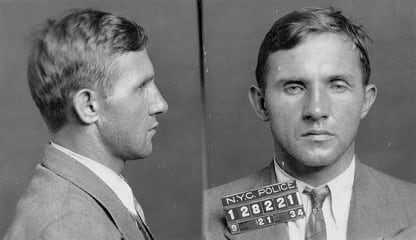
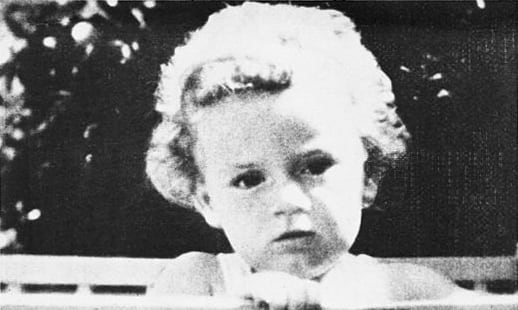
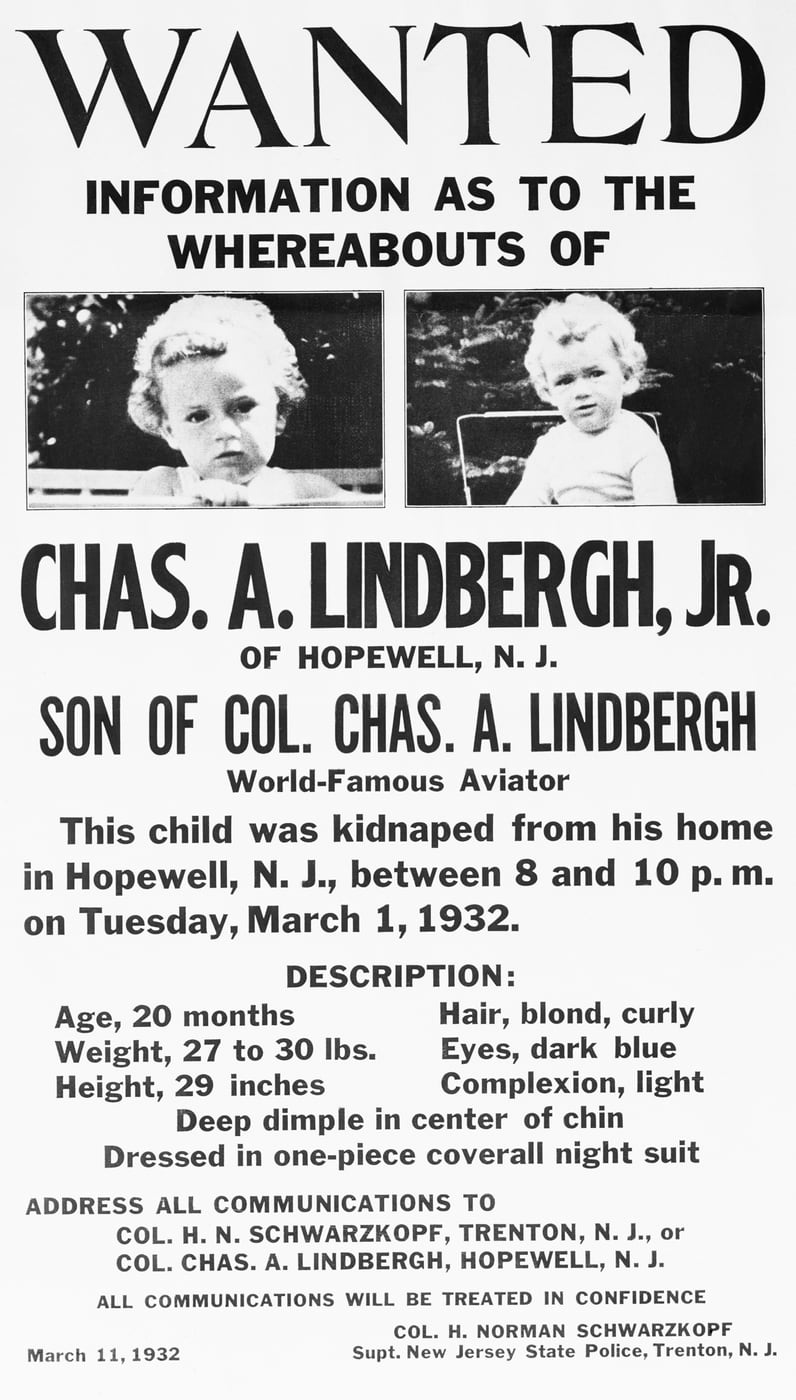
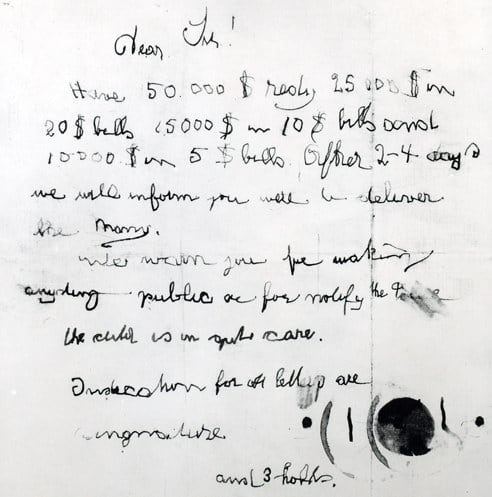
Real case gallery: Bruno Richard Hauptmann archival portrait and mugshot, Charles Augustus Lindbergh Jr., the Lindbergh baby poster, and the ransom note. Sources: Wikimedia Commons public-domain files and FBI archival evidence.
Sources & Case Notes
Last updated: May 8, 2026.
Primary sources / case notes: FBI Lindbergh kidnapping case history, USDA/Forest Service material on Arthur Koehler and wood forensics, Hunterdon County courthouse context, and public-domain archival images through Wikimedia Commons.
Source links:
- FBI Lindbergh kidnapping case history
- USDA Forest Products Laboratory Koehler wood-forensics report
- Office of Justice Programs Lindbergh kidnapping overview
- Hunterdon County historic courthouse context
Correction policy: Send corrections, source notes, or image-rights concerns through Contact & Media Inquiries.
Image credits: Feature and gallery use public-domain Hauptmann, Lindbergh, ransom-note, and case-document images where available. Body images are non-graphic period documentary recreations created for Anonymous369 Media.
Content warning: Discusses child kidnapping, death, trial evidence, and execution; non-graphic.
Editorial standards: Read how Anonymous369 Media researches, corrects, and credits factual cases on our Editorial Standards page.
Continue the Case File
These investigations reward careful reading. Step back if you missed the previous file, or keep going to follow the next case in the archive.
Previous file: The Shark Arm Mystery: How a Severed Clue Exposed Sydney's Underworld Next file: The Somerton Man: How DNA Named Australia's Unknown Beach Corpse