
Why Cat Attacks and Hospital Fire Exposed Blackeberg’s Rot in Let the Right One In
Blackeberg was supposed to be the perfect modern suburb. Discover how its sterile concrete geometry and social isolation turned ordinary citizens into a defenseless feeding grid.


Let the Right One In Complete Movie Lore: File 3 of 5
The Concrete Grid of the People's Home
The neighborhood of Blackeberg is an architectural manifesto of absolute rationality. Built during the post-war expansion of Sweden’s Folkhemmet, or "People’s Home," the suburb was meticulously engineered to eradicate the inequalities, superstitions, and chaotic designs of the past. Uniform concrete apartment blocks are connected by identical pedestrian underpasses; clean, linear courtyards isolate the domestic spaces; streetlights illuminate every paved path with a sterile, amber glow. It is an environment designed under the assumption that human nature can be perfected through proper municipal planning, public transit, and state-subsidized comfort.
Yet, this hyper-rationalized design contains a fatal vulnerability. By intentionally stripping the landscape of historical depth, cultural memory, and religious structures, the architecture has left its populace entirely secularized and spiritually undefended. The community has no language for the uncanny, no ritual for the monstrous, and no defensive baseline against a predator that does not register on a census bureau report. The concrete walls do not keep the monster out; instead, they function as a labyrinth of uniform corridors that isolate the prey, ensuring that when an individual vanishes into the shadows of an underpass, the surrounding system continues to hum along without noticing the missing component.
The Fragile Network of the Local Pub
On the margins of this sterile paradise exists a fragile ecosystem of human wreckage. Virginia, Jocke, Gösta, and Morgan are the unintended waste product of the perfect suburb. They are single, middle-aged, and tethered to the local tavern by a shared need for alcohol and human proximity. Their relationships are built entirely on low-level, domestic dependencies. They borrow small sums of money, share apartments, and bicker over trivia to keep the crushing silence of the suburban winter at bay. They are not grand cinematic heroes or villains; they are ordinary, lonely citizens who have drifted into the blind spots of the welfare state.
This insular network is the exact mechanism Eli exploits. The monster does not need to hunt widely; it simply needs to tap into an existing chain of human proximity. When Jocke separates from the group to walk home across a frozen bridge, his isolation is total. The state provided him with a paved path and a bridge, but it could not provide him with a community that watches the road. His sudden death beneath the ice is a quiet, bloodless subtraction. His friends notice his absence only as a mild disruption to their drinking routine, demonstrating how easily a parasite can harvest a population that has already been atomized by modern living.
The Domestic War in Gösta's Flat
The biological reality of the infection manifests with sudden violence inside Gösta’s cramped apartment. Virginia, having survived a brief, incomplete feeding session by Eli, crawls to the only refuge she knows. Gösta’s home is a sanctuary of domestic clutter, dominated by dozens of cats that serve as a substitute for human family. The moment Virginia crosses the threshold, the domestic peace shatters. The animals do not see their familiar neighbor; their primal instincts detect an invasive, apex predator masquerading in a human coat.
The subsequent attack by the cats is a crucial thematic turning point. The scene exposes the immediate, physical rejection of the infected individual by the natural world. The cats launch themselves at Virginia’s face and limbs, clawing and biting not out of malice, but out of a desperate biological defense. The state-engineered apartment becomes an active combat zone where the domestic and the feral collide. Virginia’s screams are the sounds of a woman realizing she has been evicted from her own species. Her body is changing, her blood is thickening, and the very animals that once provided her with comfort now recognize her as an existential threat to the household.
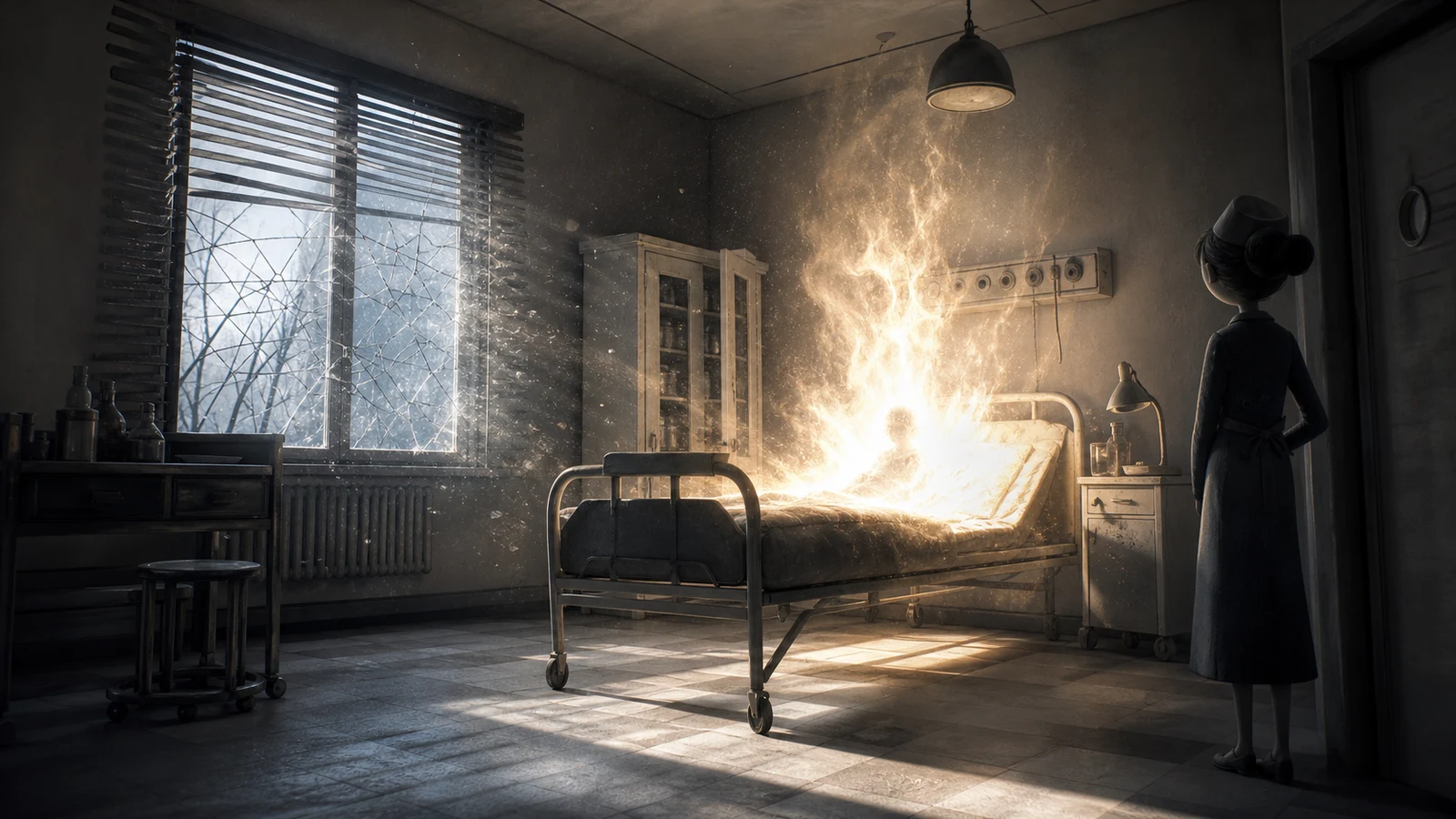
Original Anonymous369 Media generated section image for Virginia’s hospital-room self-destruction.
The Incineration of Patient Zero
Virginia’s final act takes place within the sterile confines of a municipal hospital room, an environment designed to heal and regulate the human body. Her skin is pale, her throat burns with an unquenchable, alien thirst, and her psychology is rapidly fracturing under the pressure of her new biological prime directive. She looks at the nurse who tends to her with a mixture of terror and predatory hunger. She understands the math of her survival: to live through the night, she must become like Eli. She must find a proxy, hunt her friends, and feed on the blood of the community that birthed her.
Instead of submitting to the cycle, Virginia chooses a sovereign act of self-termination. When she demands that the nurse open the window blinds, she is using the architecture of the state to execute herself. As the morning sun breaches the glass, it does not warm the room; it acts as a kinetic, cleansing weapon. The transformation from infected tissue into an instantaneous explosion of blinding white flame is the ultimate realization of her condition. Her body combusts with a violent, terrifying intensity, shattering the hospital window and filling the sterile room with thick ash. It is the only clean choice made by an adult in Blackeberg—a refusal to let the infection spread further into the grid.
The destruction of Virginia leaves her social circle completely hollowed out. Gösta is traumatized, Jocke is dead under the ice, and the remaining locals are left to wander through the snow, entirely unable to comprehend the nature of the violence that has decimated their ranks. The system will quickly patch over their absences, renting their apartments to new tenants and clearing the ash from the hospital ward. The concrete blocks of Blackeberg remain upright, uniform, and completely silent, waiting for the next cold winter night when the right one asks to come inside.
Read Let the Right One In Files in Order
Let the Right One In Complete Movie Lore is built as a five-file sequence. Start with Håkan’s acid canister, follow Oskar’s true crime scrapbook, move through Blackeberg’s institutional rot, enter Eli’s survival system, then finish at the bathhouse execution grid that sends the cycle back to a new feeder.
- File 1: The Feeder - Håkan’s Utility Profile: A Plastic Acid Canister Reveals Håkan’s Brutal Legacy in Let the Right One In
- File 2: The Prey - Oskar’s Internal Metamorphosis: How a True Crime Scrapbook Fueled Oskar’s Descent in Let the Right One In
- File 3: The System - Blackeberg’s Institutional Rot: Why Cat Attacks and Hospital Fire Exposed Blackeberg’s Rot in Let the Right One In - current file
- File 4: The Cycle - Eli’s Ancient Stasis: Why Cardboard Windows Expose Eli’s Survival System in Let the Right One In
- File 5: The Climax - The Bathhouse Execution Grid: How the Swimming Pool Climax Trapped Oskar in an Eternal Cycle
Previous file: How a True Crime Scrapbook Fueled Oskar’s Descent in Let the Right One In
Next file: Why Cardboard Windows Expose Eli’s Survival System in Let the Right One In