
A Plastic Acid Canister Reveals Håkan’s Brutal Legacy in Let the Right One In
Before Oskar ever carried the puzzle box, Håkan carried the acid canister. Discover how Let the Right One In exposes the brutal, short lifespan of a vampire's human feeder.


Let the Right One In Complete Movie Lore: File 1 of 5
The Inventory of an Expired Caretaker
The horror of Håkan does not reside in supernatural shadows, but in the heavy, rhythmic sloshing of a blue plastic canister. He sits inside a cold sedan on the margins of Blackeberg, wrapped in a drab, oversized winter coat that emphasizes his physical decay. He is an old man engaged in grueling, repetitive physical labor. He does not possess the predatory grace of the creature he serves; he is clumsy, heavy-footed, and perpetually exhausted. His tools are not gothic artifacts, but items bought from a local hardware store: a plastic funnel, a common butcher knife, rubber tubing, and a container of industrial acid.
This crude inventory exposes the domestic reality of a vampire’s survival system. To live through the century, an ageless predator requires a human proxy who can navigate the bureaucracy of renting apartments, buying groceries, and clearing the perimeter. Håkan functions as the physical buffer between Eli and a modern, secular bureaucracy that has no framework for the undead. Yet, every time Håkan lifts the knife or adjusts the funnel, his hands shake. His labor is a race against his own biological clock. He is an aging machine trying to maintain an unyielding, timeless architecture, and the discrepancy between his brittle bones and Eli’s eternal youth is reaching its breaking point.
The Geometry of Secular Isolation
The concrete housing blocks of Blackeberg were engineered during the Swedish Folkhemmet expansion to maximize rationality, safety, and community transparency. Every courtyard is visible; every underpass is lit by sterile streetlights; every apartment layout is standardized to eliminate the dark corners of the old world. It is within this hyper-rational grid that Håkan must hunt. The environment itself works against him. The snow retains footprints; the cold air carries the sound of scuffling boots; the nearby pedestrian paths are continuously traversed by ordinary citizens walking dogs or returning from commuter trains.
Håkan’s presence in these spaces highlights his profound social alienation. He belongs to no family network, holds no visible employment, and has no presence in the local social registers. He has become a ghost before he is even dead, his identity entirely consumed by the domestic demands of the apartment with the cardboard-covered windows. When he stalks a victim through the woods, his heavy breathing gives him away before he can strike. The modern world has no room for his archaic violence, and the architecture of Blackeberg turns his clumsy attempts at murder into loud, conspicuous disruptions that inevitably draw the eyes of the community.
The Cold Economy of a Vampire's Household
Inside the apartment, the relationship between Håkan and Eli is stripped of all romantic or gothic myth making. The rooms are barren, smelling of dust, unwashed linen, and old blood. There are no grand declarations of loyalty; instead, there is the silent, heavy pressure of an ongoing transaction. When Håkan fails to secure blood during his first hunting attempt, Eli does not offer comfort or understanding. The response is a cold, physiological withdrawal. Eli curls on the floor, shivering, treating Håkan not as a companion who has risked his life, but as an unreliable appliance that has failed to deliver its basic output.
Håkan’s jealousy regarding Oskar is the desperation of an employee who sees his replacement training on the horizon. When Oskar begins appearing at the playground, Håkan watches from the window with a look that is more weary than angry. He recognizes the pattern because he was once the boy on the climbing frame. He knows the exact sequence of grooming, the subtle shifts in attention, and the ultimate trade-off that awaits the child. His anger toward Eli is the futile resentment of a man who has given his entire life to a system that will discard him without a second thought the moment his utility drops below the baseline.
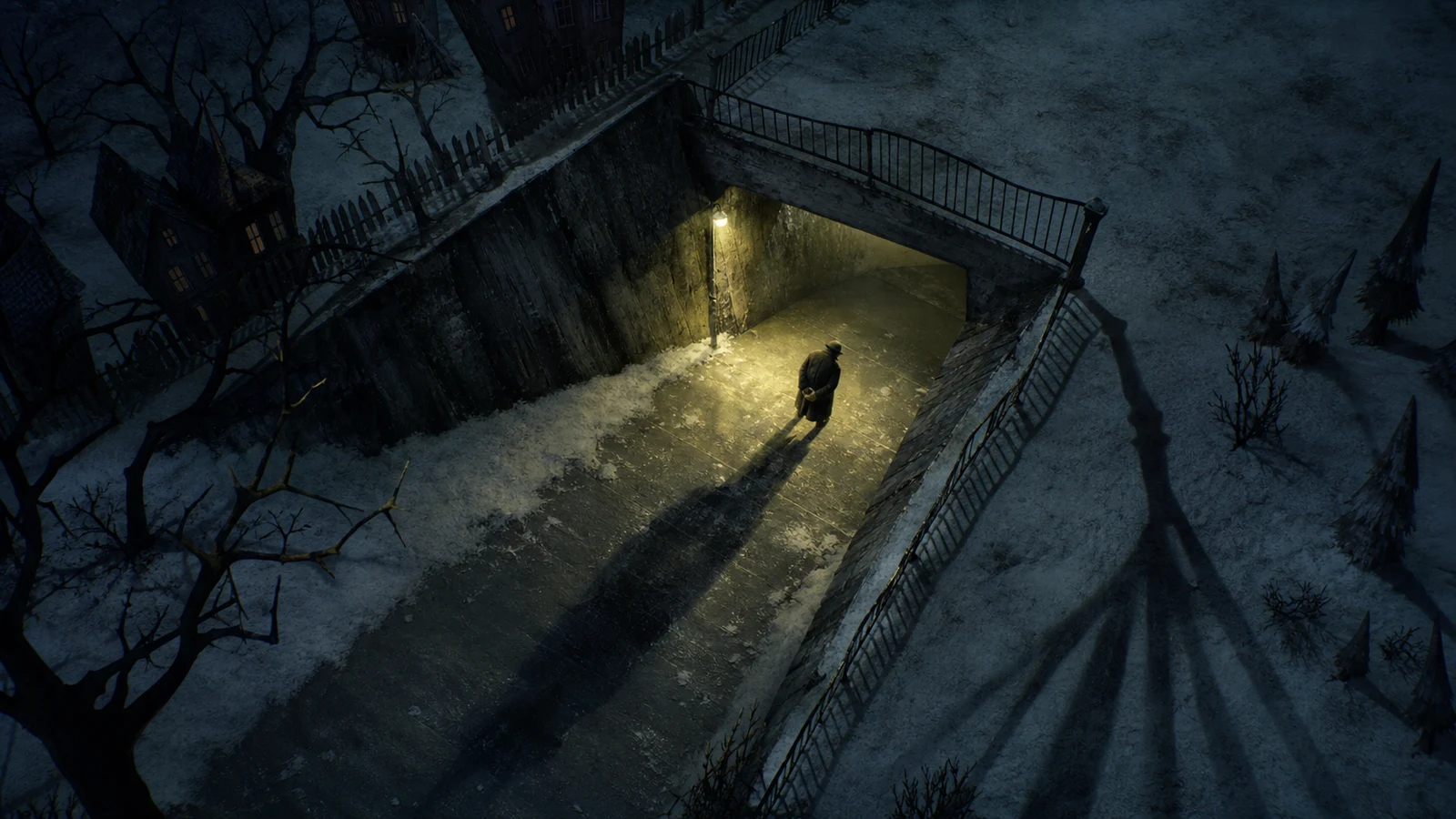
Original Anonymous369 Media generated section image for Håkan’s failed hunting grid.
The Forest Ambush and the Price of Failing the Grid
The turning point of Håkan’s profile occurs in the frozen woods, where the mechanical failure of his routine becomes absolute. The hunt is messy. He traps a teenager, hangs him from a tree branch, and prepares to use the funnel and canister. But human nature is unpredictable, and the suburban environment is never truly empty. The sudden appearance of a dog walker breaks his concentration. Håkan flees, leaving his tools behind, scrambling through the snow like a panicked animal. He has violated the core rule of the survival system: he has made the monster visible.
His subsequent attempt to harvest blood in a locked school facility is an act of pure desperation. He knows that returning to the apartment empty-handed is no longer an option. When he is trapped by the local teenagers and the police are called, his final decision is not driven by a heroic desire to save a loved one, but by the terrifying logic of the contract he signed decades ago. The concentrated hydrochloric acid he carries in his kit is his final utility asset. By pouring the chemical directly onto his own flesh, he executes a manual factory reset on his identity. He destroys the face that could link the police back to the apartment, ensuring that the machine remains operational even as the component is crushed.
The Erasing of the Tool at the Hospital Window
Håkan’s narrative terminates in a sterile hospital room, where his features are hidden beneath a thick mass of white gauze. He has no face, no name, and no future. He exists only as a lingering liability. When Eli appears outside the window, scaling the concrete wall with spider-like efficiency, it is not a rescue mission. It is a final harvesting. Håkan tilts his head back, exposing his throat to the glass panes. He gives up the last fluid his body possesses, offering his life force to sustain the creature for a few more days.
The moment Eli finishes feeding, Håkan plummets into the darkness below. His death is unceremonious, a quiet thud in the snow that the hospital staff will clean up by morning. The plastic acid canister, the funnel, and the heavy winter coat are gone, leaving no trace of the man who carried them for years. As Eli walks away from the courtyard, the vacancy in the survival system is officially open. The morse code that will soon echo through the train carriage is the same language that once bound Håkan to the canister, proving that in the ecosystem of the parasite, the feeder is always temporary, but the hunger is forever.
Read Let the Right One In Files in Order
Let the Right One In Complete Movie Lore is built as a five-file sequence. Start with Håkan’s acid canister, follow Oskar’s true crime scrapbook, move through Blackeberg’s institutional rot, enter Eli’s survival system, then finish at the bathhouse execution grid that sends the cycle back to a new feeder.
- File 1: The Feeder - Håkan’s Utility Profile: A Plastic Acid Canister Reveals Håkan’s Brutal Legacy in Let the Right One In - current file
- File 2: The Prey - Oskar’s Internal Metamorphosis: How a True Crime Scrapbook Fueled Oskar’s Descent in Let the Right One In
- File 3: The System - Blackeberg’s Institutional Rot: Why Cat Attacks and Hospital Fire Exposed Blackeberg’s Rot in Let the Right One In
- File 4: The Cycle - Eli’s Ancient Stasis: Why Cardboard Windows Expose Eli’s Survival System in Let the Right One In
- File 5: The Climax - The Bathhouse Execution Grid: How the Swimming Pool Climax Trapped Oskar in an Eternal Cycle
Next file: How a True Crime Scrapbook Fueled Oskar’s Descent in Let the Right One In