
How a True Crime Scrapbook Fueled Oskar’s Descent in Let the Right One In
Oskar didn't just find a friend in Eli; he found an escape from the human race. Discover how a hidden scrapbook of local murders prepared a bullied boy to become a monster's next handler.


Let the Right One In Complete Movie Lore: File 2 of 5
The Anatomy of a Schoolyard Prey
Oskar Eriksson stands before a frosted mirror, his pale skin blending into the sterile white tile of his mother’s apartment. He presses his fingers against his lips, mimicking a silent scream, or perhaps testing the threshold of his own endurance. He is a boy who has been systematically emptied of authority. At school, his existence is defined by the rhythm of footsteps tracking him down concrete corridors. The bullying he suffers at the hands of Conny and his sycophants is not a series of isolated incidents; it is a predictable, daily extraction of his dignity. The whip mark across his thigh, delivered by a switch on a frozen playground, is simply the physical manifest of an environment that has marked him as fundamentally disposable.
The tragedy of Oskar is that his isolation is perfectly camouflaged by the modern welfare state. He is clothed, fed, and housed within a clean, heated apartment complex. Yet, the social architecture around him functions like a sensory deprivation chamber. His mother loves him with a heavy, smothering anxiety that lacks any real perception; she sees his quietness as compliance rather than a desperate retreat. When he returns from school bruised and hollowed out, she passes him plates of food, entirely unaware that her son is mentally calculating the weight of his own erasure. Oskar’s internal world has become a vacuum, and in the laws of survival, a vacuum always demands to be filled.
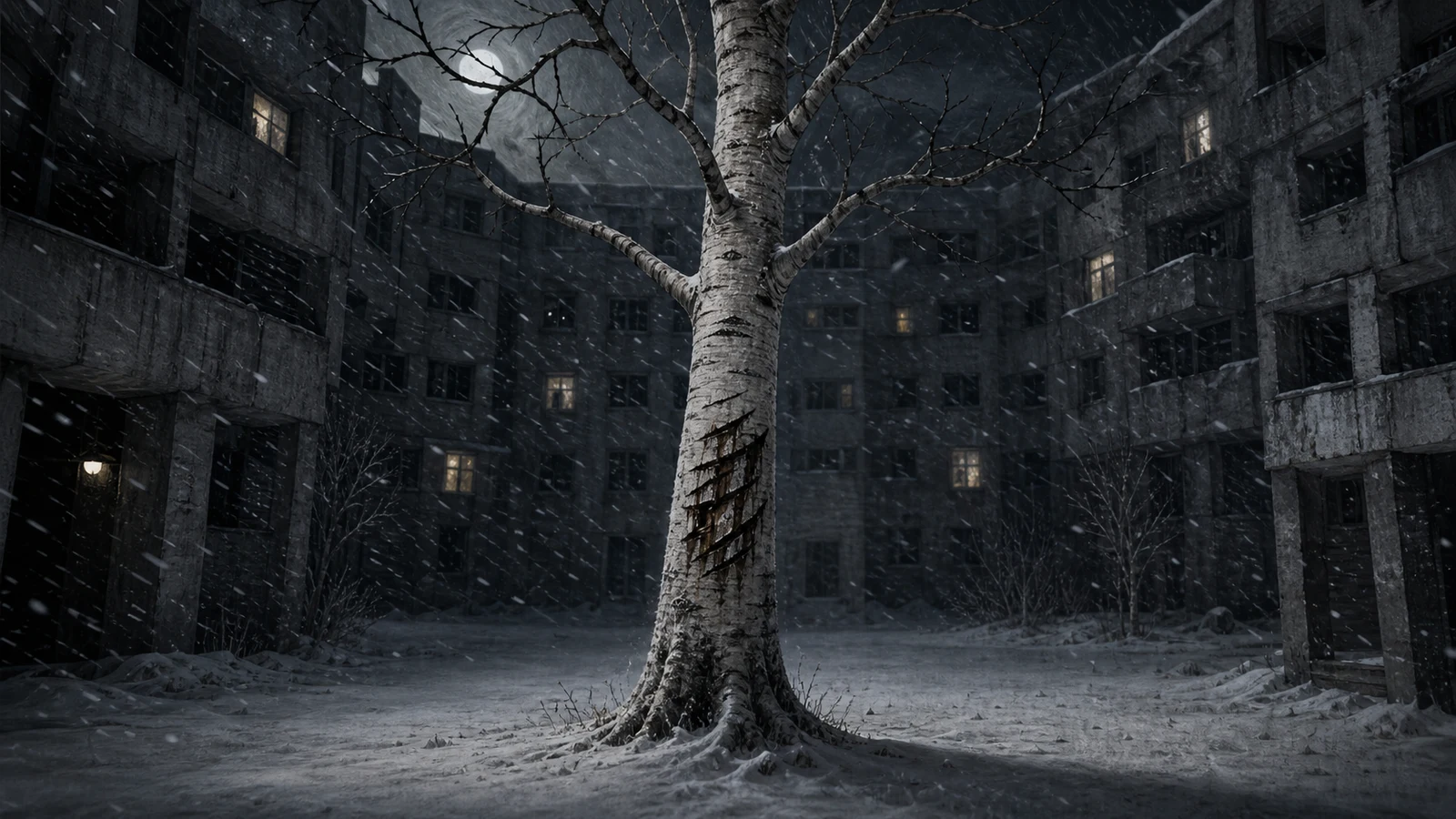
Original Anonymous369 Media generated section image for Oskar’s courtyard revenge ritual.
The Archive of Violent Desperation
Beneath the mundane surface of text books and model kits lies Oskar’s true curriculum: a hidden scrapbook filled with the severed histories of strangers. He cuts out newspaper articles detailing local homicides, gluing the stark black text and grainy forensic photographs into a private logbook. This scrapbook is not a manifestation of innate evil, but a desperate psychological defense mechanism. Surrounded by a sterile society that insists everything is safe, rational, and orderly, Oskar uses the archive of human violence to validate his own internal rage. The clippings prove to him that the world is inherently brutal—that his desire to inflict pain back onto his tormentors is not an anomaly, but the baseline rule of existence.
When Oskar takes his pocket knife to the courtyard at night, plunging the blade into the pale flesh of a birch tree, he is executing a rehearsal. The whispers of "Squeal like a pig" are the small, trembling efforts of a victim trying to learn the language of a predator. He stands alone in the snow, a tiny silhouette casting a weak shadow against the massive concrete walls of Blackeberg. The knife cuts into the wood, but it cannot cut into the system that traps him. He lacks the mass, the malice, and the physical capability to alter his standing in the human hierarchy. The scrapbook remains an unfulfilled promise of power—until the adjacent apartment unit is rented.
The Fractured Pillars of the Post-War Family
The complete failure of Oskar’s human support structure is realized not in Blackeberg, but in the rural isolation of his father’s cabin. The weekend visit promises a restoration of masculinity, a brief window where a father might see the wounds on his son and offer a shield. Instead, the cabin becomes an exhibition of neglect. Oskar’s father is a gentle but profoundly weak man whose emotional availability is entirely dependent on the level of the liquor bottle on the table. He is part of a generation of men who have drifted into quiet, domestic uselessness, unable to articulate their own grief, let alone navigate the complex terror of their children.
The arrival of the father’s male friend immediately displaces Oskar. The adult men retreat into the warm, slurred camaraderie of alcoholism, leaving the boy to sit in the dark corner of the room, listening to the clinking of glasses and the boisterous, exclusionary laughter. The camera holds on Oskar’s face as he realizes that his father is not a protector, but another fragile entity seeking escape from the winter. The human world has officially run out of options for Oskar. He returns to the city with a profound understanding that if he is to survive the gym class locker rooms and the frozen lanes of his neighborhood, he must look for an alliance outside the human boundary.
Exchanging Human Warmth for Frostbitten Armor
The relationship with Eli begins through the glass. Oskar stands on his balcony, looking across the narrow, freezing gap to the dark window of the next flat. When they touch the glass from opposite sides, it is an agreement to bypass the community entirely. Eli offers Oskar something no adult in his life can provide: absolute utility. Eli does not lecture him on turning the other cheek, nor does Eli look at his bruises with helpless pity. Eli looks at Oskar’s rage and recognizes it as raw fuel. The instruction Eli gives him—to hit back, to strike harder than the boy before him—is the first practical advice Oskar has ever received.
But this empowerment is a transactional trap. As Oskar begins to lift weights and stand up to his bullies, his physical posture changes, but his humanity is being steadily traded away. He begins to accept the dirt, the smell of copper, and the cold logic of Eli's existence. When Eli tells him, "I've been this age for a very long time," Oskar does not see a monster; he sees an indestructible refuge. He is willing to overlook the missing locals and the blood on Eli's chin because that blood represents the exact weapon he needs to terrify Conny. His scrapbook is no longer a collection of distant news stories; it has become his domestic reality.
The Final Trade-Off on the Frozen Playground
The true nature of Oskar's transformation is sealed not through a vampire's bite, but through his voluntary assumption of the handler's role. When Eli is forced to flee after the exposure of Håkan's death, Oskar is left behind to face the ultimate consequence of his brief rebellion. The confrontation at the swimming pool is the final sorting mechanism of the environment. Under the fluorescent lights of the municipal bathhouse, surrounded by the smell of chlorine and the threat of a severed eye, Oskar is forced to his knees. The system is preparing to crush him entirely, to drown him in the very waters meant for community recreation.
The sudden, silent slaughter of his tormentors by an unseen force from above is not a rescue; it is an eviction notice from the human race. As Conny’s severed hand drifts into the pool water, Oskar looks up from the depths and sees Eli smiling down at him. It is a look of absolute possession. The final image of Oskar sitting inside the train carriage, tapping code against a heavy wooden box that conceals an ageless parasite, confirms his regression. He has survived the bullies, but he has entered the box. He is the new Håkan, wrapped in a youthful coat, carrying the puzzle boxes and the secret blueprints into a lifetime of cold train stations and plastic canisters.
Read Let the Right One In Files in Order
Let the Right One In Complete Movie Lore is built as a five-file sequence. Start with Håkan’s acid canister, follow Oskar’s true crime scrapbook, move through Blackeberg’s institutional rot, enter Eli’s survival system, then finish at the bathhouse execution grid that sends the cycle back to a new feeder.
- File 1: The Feeder - Håkan’s Utility Profile: A Plastic Acid Canister Reveals Håkan’s Brutal Legacy in Let the Right One In
- File 2: The Prey - Oskar’s Internal Metamorphosis: How a True Crime Scrapbook Fueled Oskar’s Descent in Let the Right One In - current file
- File 3: The System - Blackeberg’s Institutional Rot: Why Cat Attacks and Hospital Fire Exposed Blackeberg’s Rot in Let the Right One In
- File 4: The Cycle - Eli’s Ancient Stasis: Why Cardboard Windows Expose Eli’s Survival System in Let the Right One In
- File 5: The Climax - The Bathhouse Execution Grid: How the Swimming Pool Climax Trapped Oskar in an Eternal Cycle
Previous file: A Plastic Acid Canister Reveals Håkan’s Brutal Legacy in Let the Right One In
Next file: Why Cat Attacks and Hospital Fire Exposed Blackeberg’s Rot in Let the Right One In