
Why Cardboard Windows Expose Eli’s Survival System in Let the Right One In
Eli isn't a romanticized immortal; she is an ancient attic animal trapped in a child's scarred anatomy. Discover the brutal biological reality hidden behind the cardboard windows.


Let the Right One In Complete Movie Lore: File 4 of 5
The Material Dirt of Eternal Childhood
To understand Eli is to look past the cinematic archetype of the vampire and look directly at the dirt under her fingernails. When she first appears on the playground climbing frame, she looks like another neglected child of the housing projects—barefoot in the snow, wearing a thin, unwashed shirt, and shivering slightly in the Swedish winter. There is no aristocratic grace here. Her skin is dry, her hair is matted, and she carries the faint, unsettling odor of an old closet that has been locked for decades. Eli does not inhabit a castle; she occupies a temporary apartment unit, living out of cardboard boxes and sleeping on a bare mattress or inside a dry bathtub.
This physical squalor is the reality of an ageless entity trapped in a child's anatomy. Eli has survived for generations not by dominating her environment, but by adapting to its lowest margins. Her childhood is an evolutionary camouflage. Because she appears small and fragile, the human world naturally lowers its defenses, allowing her to cross thresholds and evade suspicion. But this stasis is a physical prison. Her body cannot grow, her wounds heal into permanent scars, and her internal organs have been entirely replaced by the singular, predatory engine of the infection. She is a historical anomaly wrapped in a cheap winter coat, forced to endlessly repeat the same behavioral scripts to secure her next meal.
The Mutilated Identity Behind the Glass
The emotional core of Eli’s isolation is revealed in a silent, candle-lit bedroom, compressed into the line: "I am not a girl." When Oskar pushes for a conventional romance, Eli presents him with a visual truth that shatters the innocent framing of their relationship. The brief glimpse of the ancient castration scar confirms that Eli’s genderlessness is not a modern psychological choice, but the result of a horrific historical crime. Centuries before Blackeberg was built, Eli was a boy named Elias, who was violently altered by an ancient master.
This anatomical violation means that Eli’s entire existence is built upon a profound, foundational loss. She was stripped of her biological future, her reproductive identity, and her humanity before she ever understood them. When she tells Oskar, "I've been this age for a very long time," she is describing an eternity spent inside a body that has been hollowed out. She plays the role of a girl because it is the most effective mask for her survival, but beneath that mask lies a void. Her connection with Oskar is so intense because they are both broken things; she recognizes that Oskar’s schoolyard torment is a localized version of the same systemic cruelty that stole her own life centuries ago.
The Fatal Mechanics of the Invitation
The supernatural rules that govern Eli are not matters of folklore or etiquette; they are hard, unyielding laws of physics within her biology. The sequence where Oskar tests the boundaries of his apartment reveals the true terror of the vampire's constraint. When Eli steps across the threshold without an explicit invitation, her body does not simply stop; it begins to tear itself apart at the cellular level. Dark, viscous blood leaks spontaneously from her pores, her eyes fill with crimson fluid, and she collapses into a state of agonizing, systemic shock.
This violent reaction demonstrates that the "invitation" is a literal lock-and-key mechanism built into her curse. Eli cannot dominate a human home by force; she must be granted access by the free will of an inhabitant. This law turns her into a psychological manipulator. She must charm, terrify, or seduce her prey into letting her pass the barrier. The blood weeping from her skin is a graphic reminder of her complete dependence on human compliance. Without a human to say the words, she is completely locked out, left to starve in the cold corridors of the brutalist apartment blocks.
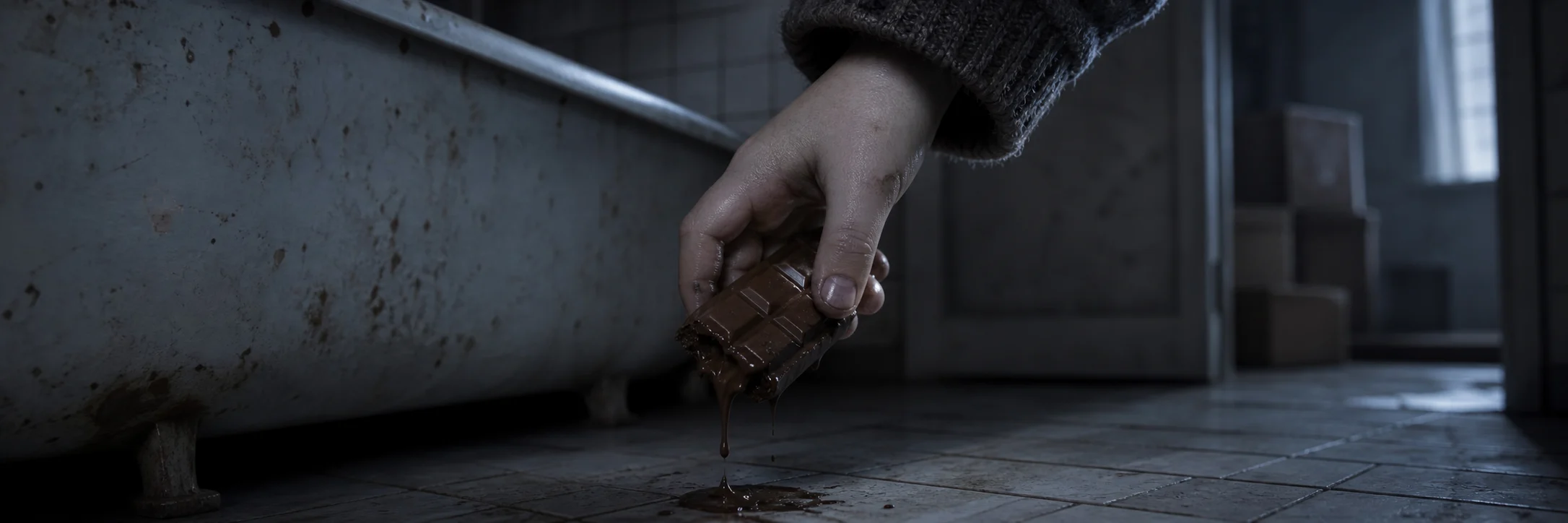
Original Anonymous369 Media generated section image for Eli’s failed attempt to share ordinary human food.
The Scripted Loop of the Parasite
The tragedy of Eli’s character is that she is entirely aware of her own parasitic nature. When she drinks the blood of the local citizens, she does not do so with sadistic joy; her expressions are marked by a weary, animalistic desperation. She feeds because she must maintain the machine. When she consumes a piece of human candy to please Oskar, her body rejects it with a violent, convulsive spasm. This moment is a stark reminder that she cannot participate in human ritual, human culture, or human warmth. She can only take from the world; she can never truly belong to it.
As the file closes on Eli, her departure from Blackeberg alongside Oskar reveals the infinite loop of her survival strategy. She leaves behind a trail of drained bodies, broken families, and an incinerated caretaker, but her focus is already on the next horizon. The heavy wooden chest on the train carriage is her mobile tomb, a box that keeps the modern world out while she rests. She has secured a new proxy, a fresh child whose trauma she can use to navigate the next few decades. She will always find a playground, she will always find a bullied boy, and she will always wait in the shadows until the right one asks her to enter.
Read Let the Right One In Files in Order
Let the Right One In Complete Movie Lore is built as a five-file sequence. Start with Håkan’s acid canister, follow Oskar’s true crime scrapbook, move through Blackeberg’s institutional rot, enter Eli’s survival system, then finish at the bathhouse execution grid that sends the cycle back to a new feeder.
- File 1: The Feeder - Håkan’s Utility Profile: A Plastic Acid Canister Reveals Håkan’s Brutal Legacy in Let the Right One In
- File 2: The Prey - Oskar’s Internal Metamorphosis: How a True Crime Scrapbook Fueled Oskar’s Descent in Let the Right One In
- File 3: The System - Blackeberg’s Institutional Rot: Why Cat Attacks and Hospital Fire Exposed Blackeberg’s Rot in Let the Right One In
- File 4: The Cycle - Eli’s Ancient Stasis: Why Cardboard Windows Expose Eli’s Survival System in Let the Right One In - current file
- File 5: The Climax - The Bathhouse Execution Grid: How the Swimming Pool Climax Trapped Oskar in an Eternal Cycle
Previous file: Why Cat Attacks and Hospital Fire Exposed Blackeberg’s Rot in Let the Right One In
Next file: How the Swimming Pool Climax Trapped Oskar in an Eternal Cycle