
Why Chauncey Was Born a Ghost in Luigi's Mansion
Chauncey is not just the mansion's first boss; he is the Charms family's youngest wound. In Luigi's Mansion, a sealed nursery, failed parents, flying toys, and the phrase 'born a ghost' turn a crying baby into the darkest evidence of a house that never protected its children.


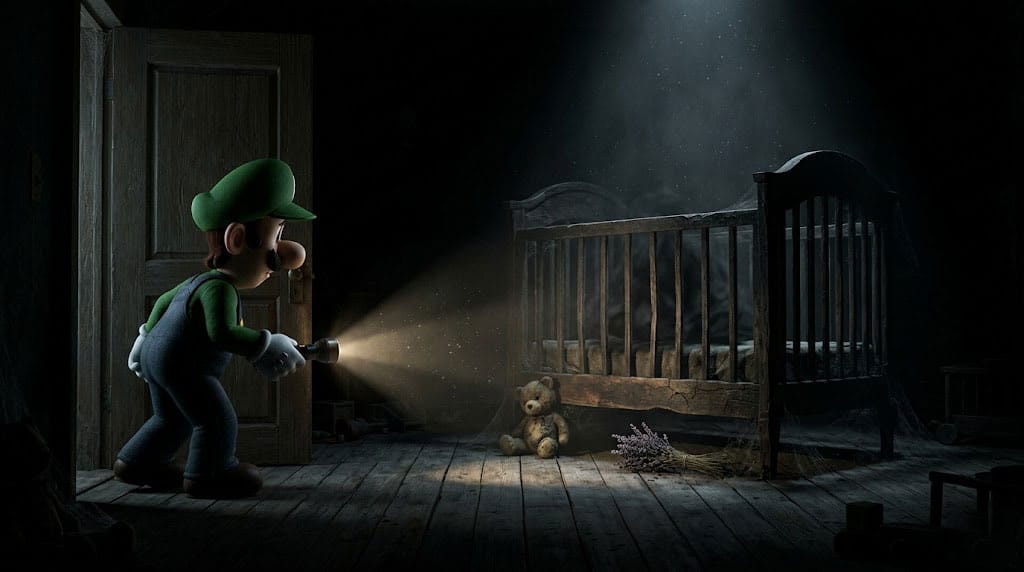
The air inside the nursery of the towering gothic estate is thick, suffocating, and unnatural. It smells faintly of sour milk, dried lavender, and the sharp, metallic tang of ancient dust. When a trembling green clad plumber slowly pushes open the heavy wooden door on the first floor, he does not step into a place of warmth and comfort. He steps into a chilling monument to parental failure and supernatural tragedy. The room is shrouded in absolute, pitch black darkness, save for the weak, shaking beam of a flashlight. In the center of the gloom sits an oversized wooden crib. From within its shadows emanates a sound that freezes the blood in the veins. It is not the monstrous roar of a demon or the guttural croak of a phantom. It is the rhythmic, echoing cry of a restless infant. For decades, players of the two thousand and one GameCube masterpiece viewed this encounter as merely the first boss fight, a quirky battle against a giant crying baby. But when you strip away the colorful, cartoonish presentation and conduct a forensic examination of the environmental lore, a profoundly disturbing psychological thriller emerges. Chauncey is not just a boss. He is a biological impossibility, a victim of severe domestic neglect, and a terrifying manifestation of childhood resentment.
The Tragedy of the Charms Bloodline
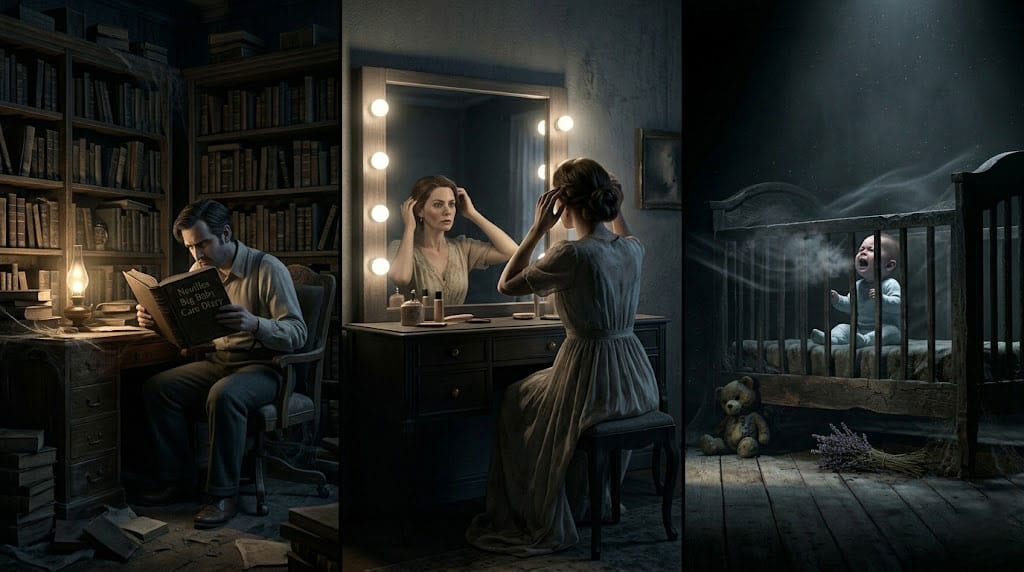
To fully comprehend the sheer psychological horror of this spectral infant, we must first examine the broken, doomed family that brought him into the dark. The architecture of the first floor tells a harrowing story of isolation and apathy. Chauncey is the youngest son of Neville, the Bookish Father, and Lydia, the Mirror Gazing Mother. He is also the younger brother to the twins, Henry and Orville. Yet, despite being surrounded by his immediate family, the infant is entirely alone. His father sits mere rooms away in the study, obsessively reading books and completely ignoring the world around him. His mother locks herself in the master bedroom, hypnotized by her own reflection in a vanity mirror, desperately holding onto her fading beauty.
The neglect is palpable in the very atmosphere of the estate. While Chauncey wails in the freezing darkness of the nursery, neither parent ever wanders the halls to comfort him. The internal biography registered within the Game Boy Horror scan reveals a chilling truth about the parents. In Nevilles study, the player uncovers a book titled Nevilles Big Baby Care Diary. In Lydias room, there is a similar journal. The fact that both parents are reading about childcare only in the afterlife suggests a profound, retroactive guilt. They are studying how to be parents only after their children are rotting in the earth. The twins suffocated in tiny wooden boxes while playing hide and seek, completely unnoticed by their apathetic caretakers. Chauncey was left to suffer in his crib, crying out with weak, failing vocal cords for a mother and father who simply could not be bothered to look away from their books and mirrors.
The Biological Impossibility of a Born Ghost
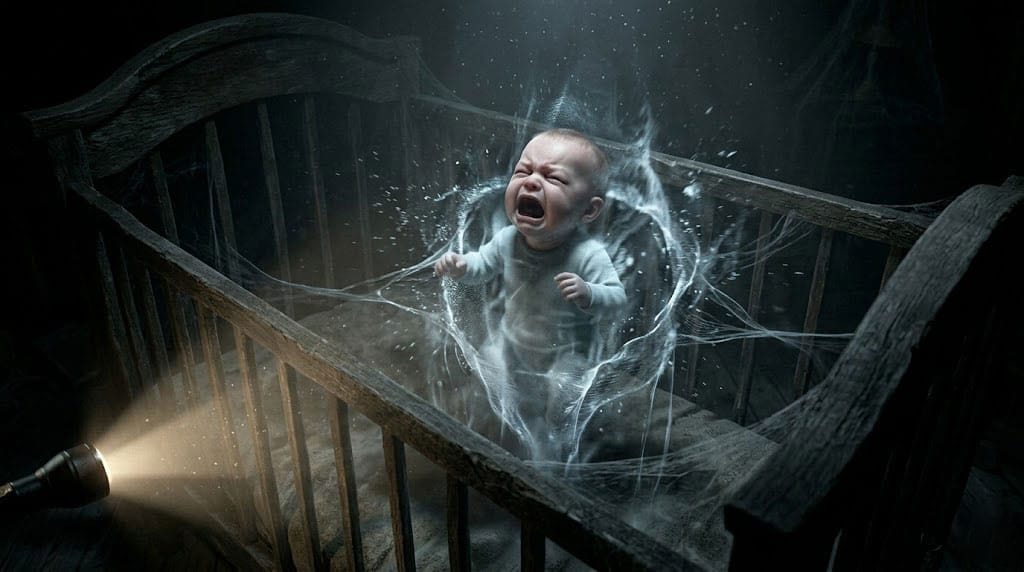
The most horrifying piece of the puzzle surrounding the youngest member of the Charms family rests in his official Game Boy Horror biography. The scan explicitly states that he cries loudly and never sleeps through the night, but since he was born a ghost, this seems natural. This single sentence unravels a massive, terrifying web of biological and supernatural implications. How can a human entity be born directly into the spirit realm. This phrasing implies a tragedy too dark for the colorful world of Nintendo to state outright.
Forensic lore analysts have long debated the grim reality of his demise. If an infant is born a ghost, it stands to reason that the child never had the opportunity to draw a single breath of living air. Did a silent, sweeping illness claim his life while he was still resting in his mothers womb. Or, perhaps more chillingly, did he perish on the exact same stormy night that claimed his mother. Legend suggests that Lydia died when a massive strike of lightning shattered her bedroom window, sending a jagged shard of glass slicing across her neck. If Lydia was pregnant with Chauncey during this catastrophic event, the sudden, violent end of the mother would guarantee the simultaneous death of the unborn child. Chauncey is a soul that was denied the experience of life, violently thrust into a cold, unfeeling afterlife before he even opened his eyes. He is trapped in a state of eternal, agonizing infancy, possessing the raw, chaotic emotions of a child but the terrifying, destructive powers of a poltergeist.
The Psychology of the Spectral Tantrum
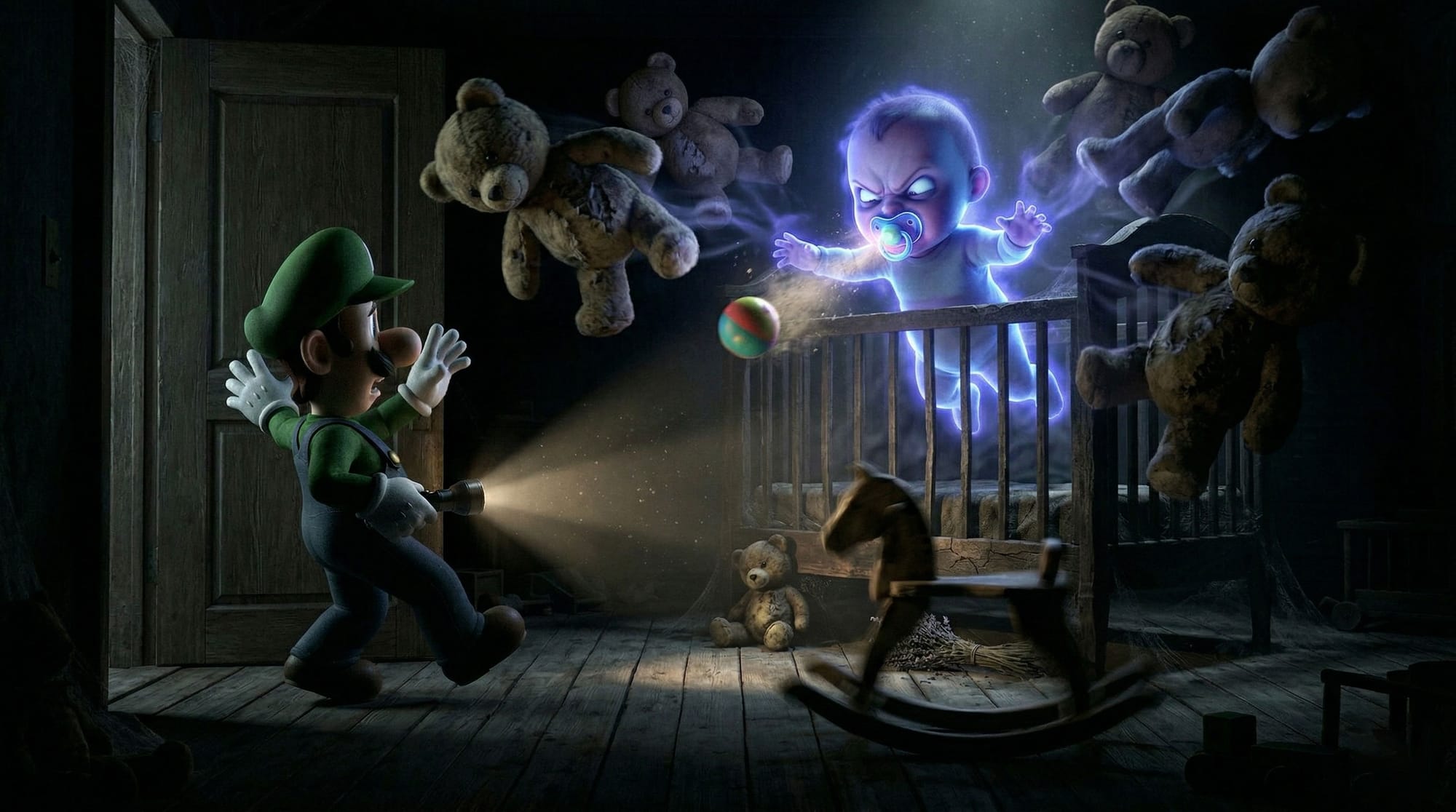
When Luigi first approaches the crib, he finds the ghostly infant sleeping peacefully. The heart monitor registers a soft, dreaming whisper as Chauncey mutters "Horsey... rocky... horsey" into the darkness. But to progress, Luigi must commit an act of profound intrusion. He uses the Poltergust 3000 to violently spin the wooden rocking horse sitting nearby, creating a loud, clattering racket that jolts the baby awake. The illusion of innocence is instantly shattered. Chauncey rises from the crib, his pacifier glowing in the dark, and his demeanor shifts from peaceful slumber to aggressive malice.
He floats toward the terrified plumber and playfully demands "Hey! Wanna play with me?". But this is not a request for a gentle game. The room becomes a chaotic playground of violence. Chauncey uses his telekinetic abilities to hurl massive, heavy teddy bears through the air directly at Luigis head. When Luigi retaliates by sucking up a rubber ball and launching it directly into the infants face, the true psychological depth of the encounter is revealed. Chauncey cries out "Ow! You gave me an owie!", followed immediately by a statement dripping with deep rooted, spectral resentment. He screams "I just wanted to play with you... I HATE grown-ups!".
This line is not mere childish whining. It is the manifestation of his eternal trauma. He hates adults because the adults in his life utterly failed him. His parents ignored him, his caretakers neglected him, and now, a strange adult man has invaded his sanctuary just to hit him with toys. He views all adults as cruel, selfish entities who only exist to bring him pain.
A Dimension of Vulnerability
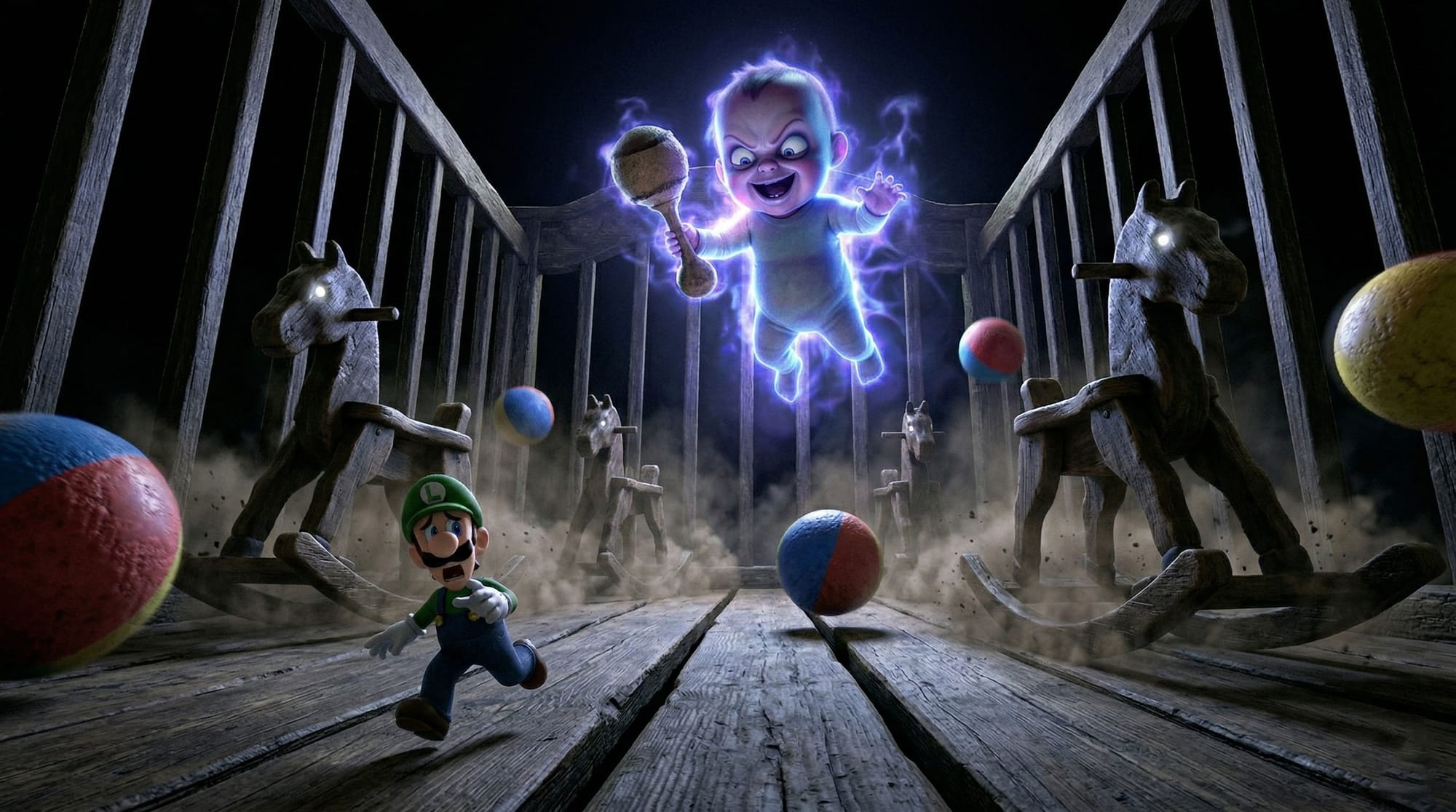
Driven into a state of absolute, blinding fury, the infant unleashes a surge of dark magic that fundamentally alters reality. He screams "Why do you have to be bigger than meeee? I've had enough! Small... Now grow smaller!". With a flash of blinding paranormal energy, Chauncey forcefully shrinks Luigi down to the size of a mouse, dragging the screaming plumber directly into the wooden slats of the crib.
This arena is a masterpiece of psychological warfare. King Boo and the portrait ghosts excel at exploiting fear, but Chauncey does something far more insidious. He forces the adult intruder to experience the exact same vulnerability and helplessness of an infant. The crib is no longer a small piece of furniture. It is a massive, sprawling gladiator arena. The wooden bars tower into the black sky like the walls of an inescapable prison cage. Luigi is completely isolated, stripped of his physical size advantage, and forced to look up at a baby that has now grown into a towering, godlike monstrosity.
Chauncey floats high above the arena, shaking his rattle with manic, infantile glee. The sensory overload in this sequence is staggering. The ground trembles violently as Chauncey summons massive, wooden rocking horses that charge across the arena like executioners on horseback. The heavy wooden hooves slam into the floorboards, forcing Luigi to sprint desperately to avoid being crushed into green paste. After the cavalry charge, the infant hurls gigantic, colorful beach balls that bounce erratically, threatening to flatten the plumber with every heavy impact.
The Violent Lullaby
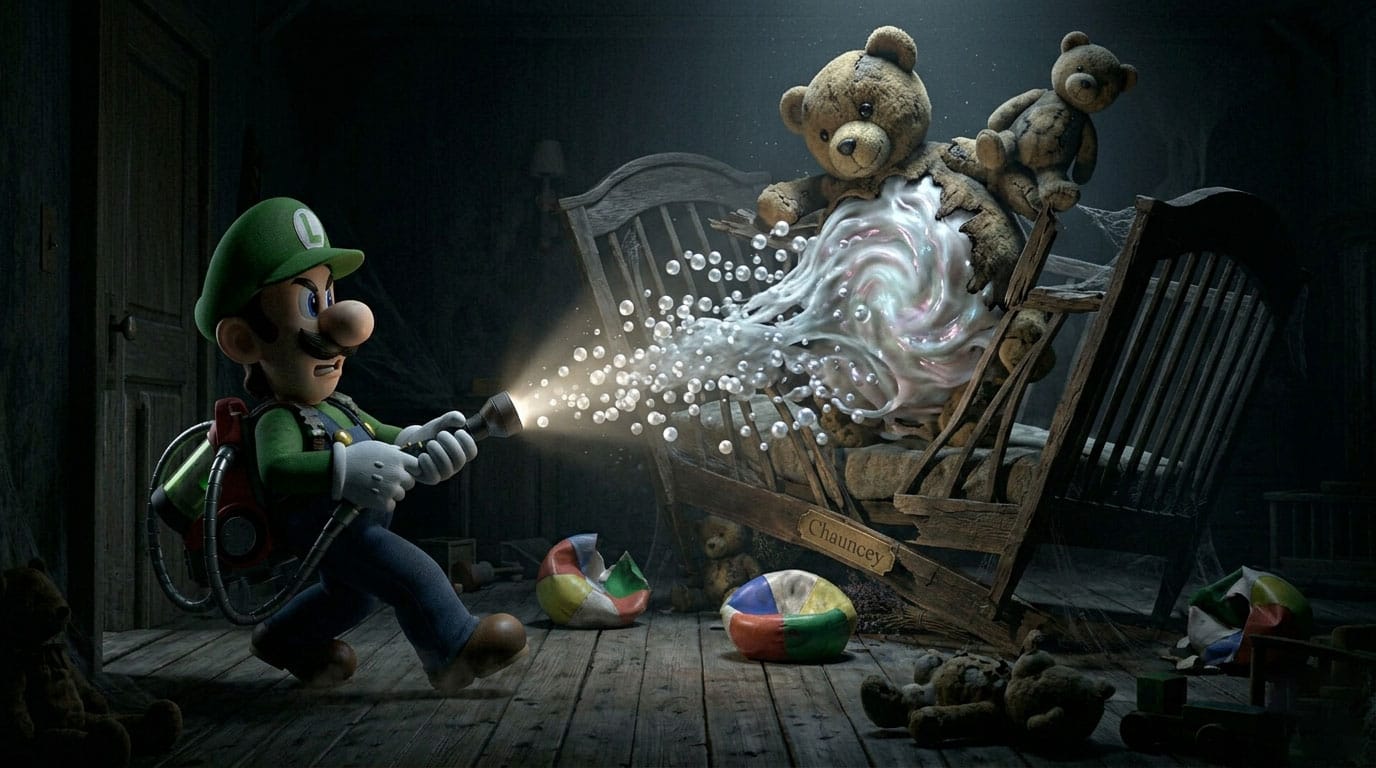
The sheer emotional weight of this battle is completely unique within the game. Luigi is not wrestling with a shadowy demon like Bogmire or a massive legion of spirits like Boolossus. He is fighting a one year old baby. To survive, Luigi must dodge the crushing barrage of toys, use his vacuum to snatch one of the massive beach balls out of the air, and fire it with brutal force directly into the crying infants face.
When the heavy ball strikes its target, the giant baby wails in absolute agony, exposing his ghostly heart to the cold, unforgiving light of the flashlight. The mechanical roar of the Poltergust 3000 drowns out the shrieks of the child. As Luigi pulls backward, his boots sliding against the floor of the crib, Chauncey thrashes wildly. He throws a violent, flailing tantrum, desperately trying to break free from the crushing suction of the machine. The juxtaposition of a grown man using industrial ghost hunting equipment to violently suck a screaming infant into a dark, lightless containment chamber is incredibly grim. When his health finally depletes to zero, the massive baby dissolves into a stream of spectral pearls and is violently ripped from the physical plane, screaming as he vanishes into the vacuum bag.
The Golden Frame of Eternal Sleep
With the infant pacified, the dark magic collapses, and Luigi is violently expelled back into the normal sized nursery, panting and covered in cold sweat. He claims the key to the second area, leaving the silent, empty room behind. But the tragic narrative of the Spoiled Baby does not conclude until Luigi returns to the underground laboratory of Professor Elvin Gadd.
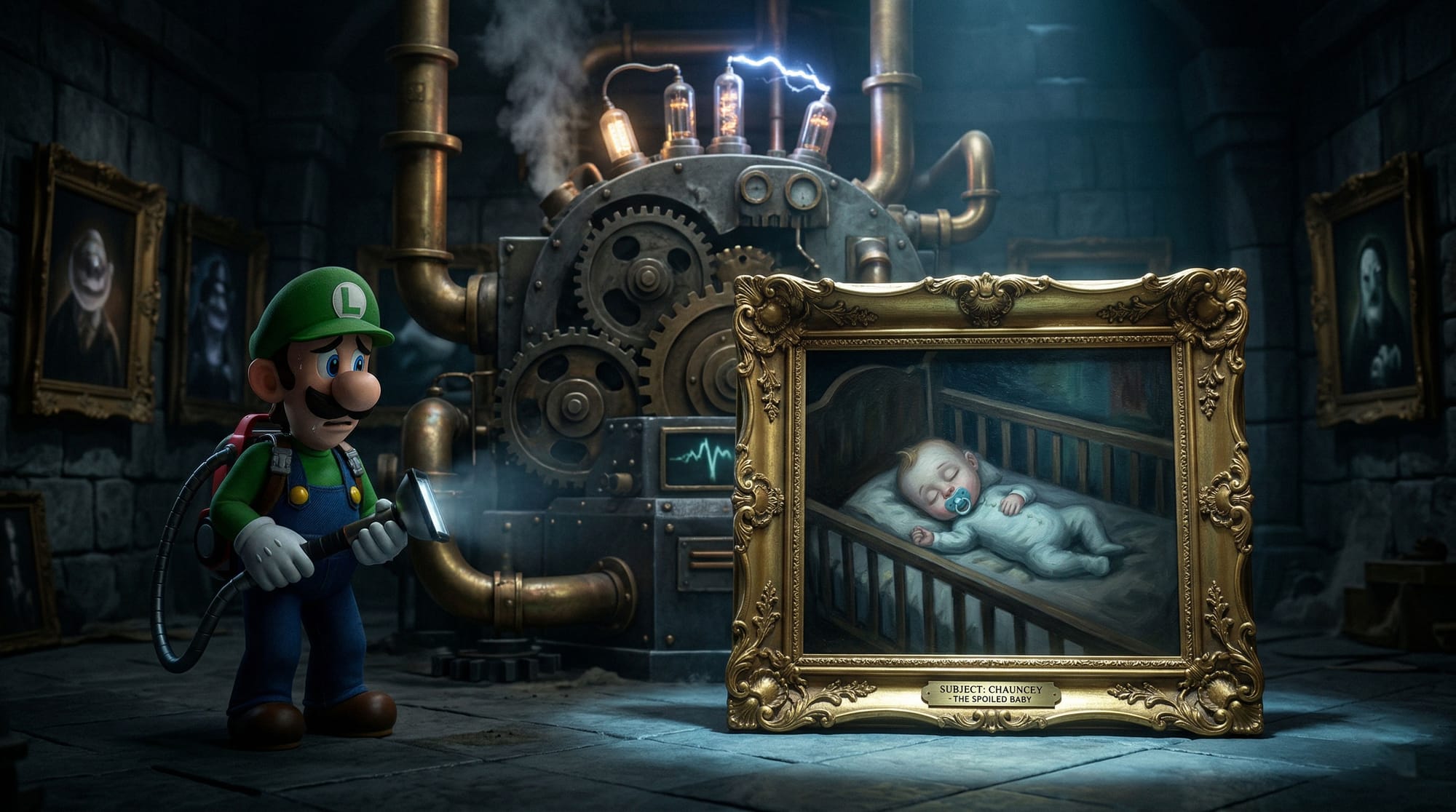
The eccentric scientist eagerly hooks the vacuum up to the heavy, grinding gears of the Ghost Portrificationizer. The machine was maliciously designed to compress sentient souls into static, two dimensional oil paintings, permanently sealing them behind thick museum glass. Chauncey is forced through the terrifying apparatus, flattened and paralyzed into a canvas prison. In his final, golden frame, he is depicted sleeping peacefully in his crib, his pacifier in his mouth, forever frozen in a state of quiet slumber.
It is a peaceful image, but it masks a profound cruelty. The infant who was born into death, who suffered from severe neglect, and who lashed out in a desperate bid for attention, is now locked in a dark gallery underground. He is finally asleep, but he is still entirely alone, separated from the parents who never bothered to comfort him in the first place.
What happens to the mind of a child who spends eternity paralyzed behind a sheet of cold glass, waiting for a mother who will never come to sing him a lullaby?
Continue the Mansion File
The mansion works best as a chained dossier. Step back if you missed the previous room, or keep going to follow the next piece of Luigi's Mansion lore.
Previous file: Lydia Charms Hid in the Mirror as Luigi's Mansion Took Her Children Next file: Why the Floating Whirlindas Never Stop Dancing in Luigi's Mansion