
Lydia Charms Hid in the Mirror as Luigi's Mansion Took Her Children
Lydia Charms was thirty-four, brushing her hair in a bedroom full of denial. In Luigi's Mansion, her vanity mirror, secret afterlife savings, shattered window, and Chauncey's impossible birth reveal a mother who chose her reflection because the nursery was too painful to face.


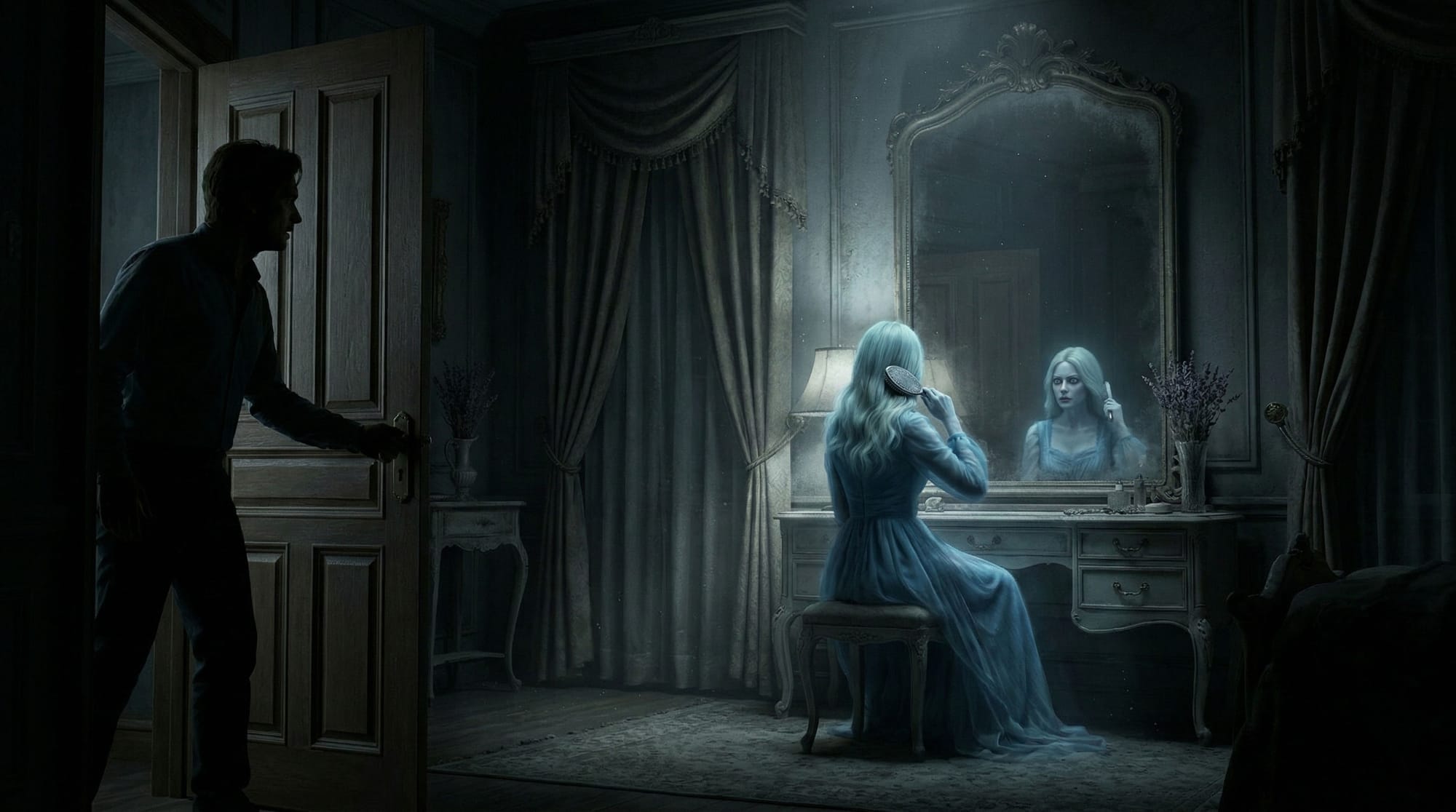
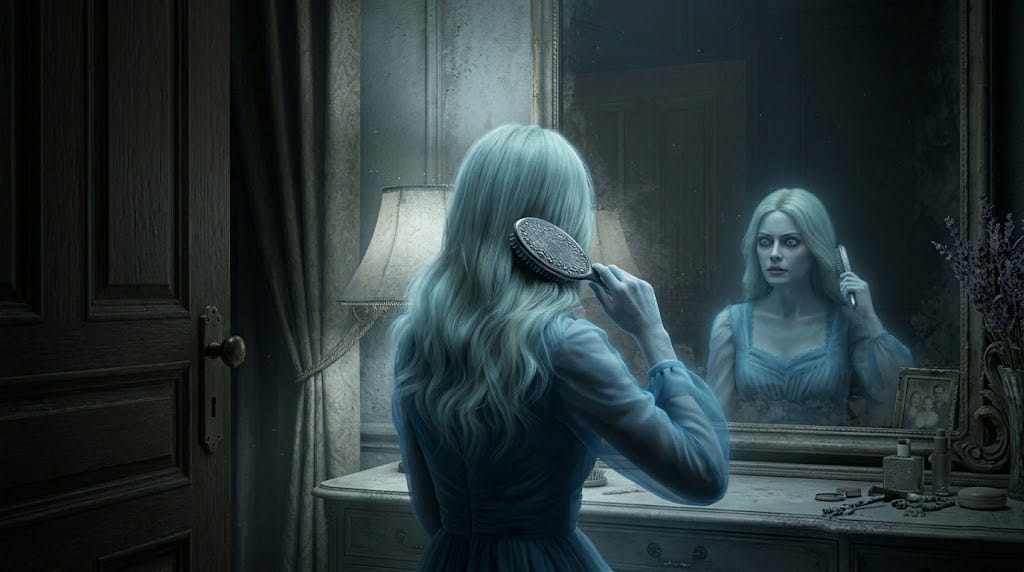
The air inside the Master Bedroom of the accursed estate is completely stagnant, heavy with the suffocating scent of dried lavender and ancient dust. When Luigi slowly pushes open the heavy wooden door on the first floor of the illusionary mansion, he does not step into a chaotic battlefield of shrieking phantoms. Instead, he steps into a chilling, perfectly preserved snapshot of domestic purgatory. The room is dimly lit, dominated by a massive vanity mirror and an unsettling, absolute silence. The only sound is the rhythmic, agonizing scrape of a spectral hairbrush moving through lifeless, pale blonde hair. Sitting before the glass is Lydia, the Mirror Gazing Mother. For over two decades, players of the two thousand and one GameCube classic have viewed this thirty four year old ghost as merely the second easy target in a brightly colored tutorial sequence. But strip away the cartoonish aesthetic and conduct a forensic examination of the environmental lore, and a profoundly disturbing psychological thriller emerges. Lydia is not just a ghost brushing her hair. She is a tragic figure trapped in an infinite loop of vanity and denial, a woman who watched her entire family rot around her and chose to retreat into the cold, unfeeling reflection of her own face.
The Architecture of Domestic Neglect
To comprehend the sheer psychological horror of Lydia, we must first examine the fragmented, doomed family she supposedly matriarched. The spatial layout of the first floor tells a harrowing story of isolation. Her husband, Neville, resides in the adjacent Study, forever locked in his rocking chair, ignoring the world in favor of his dusty books. Down the hall lies the Nursery, where their youngest son, Chauncey, wails in perpetual agony. Yet Lydia does not wander the halls searching for her lost infant. She does not attempt to communicate with the husband sitting mere feet away through the plaster walls. She sits with her back to the door, staring exclusively at herself.
The Game Boy Horror scans provide a chilling insight into her mindset. The device reveals that Lydia is deeply vain, obsessively proud of her well groomed blonde hair, and gets violently upset when anything threatens her pristine appearance. But vanity of this magnitude in a house of the dead is not merely a personality quirk. It is a severe, psychological coping mechanism. Lydia lived in a household defined by emotional neglect. Her husband chose the company of fictional characters over his own wife. Her twin sons, Henry and Orville, suffocated in tiny boxes while playing hide and seek, completely unnoticed by their parents. Confronted with the unbearable reality of her failing marriage and her dying children, Lydia simply shut down. She retreated into the Master Bedroom, sat before her vanity, and hyper focused on the one thing she could still control. Her own reflection.
The Secret Savings and the Illusion of Escape
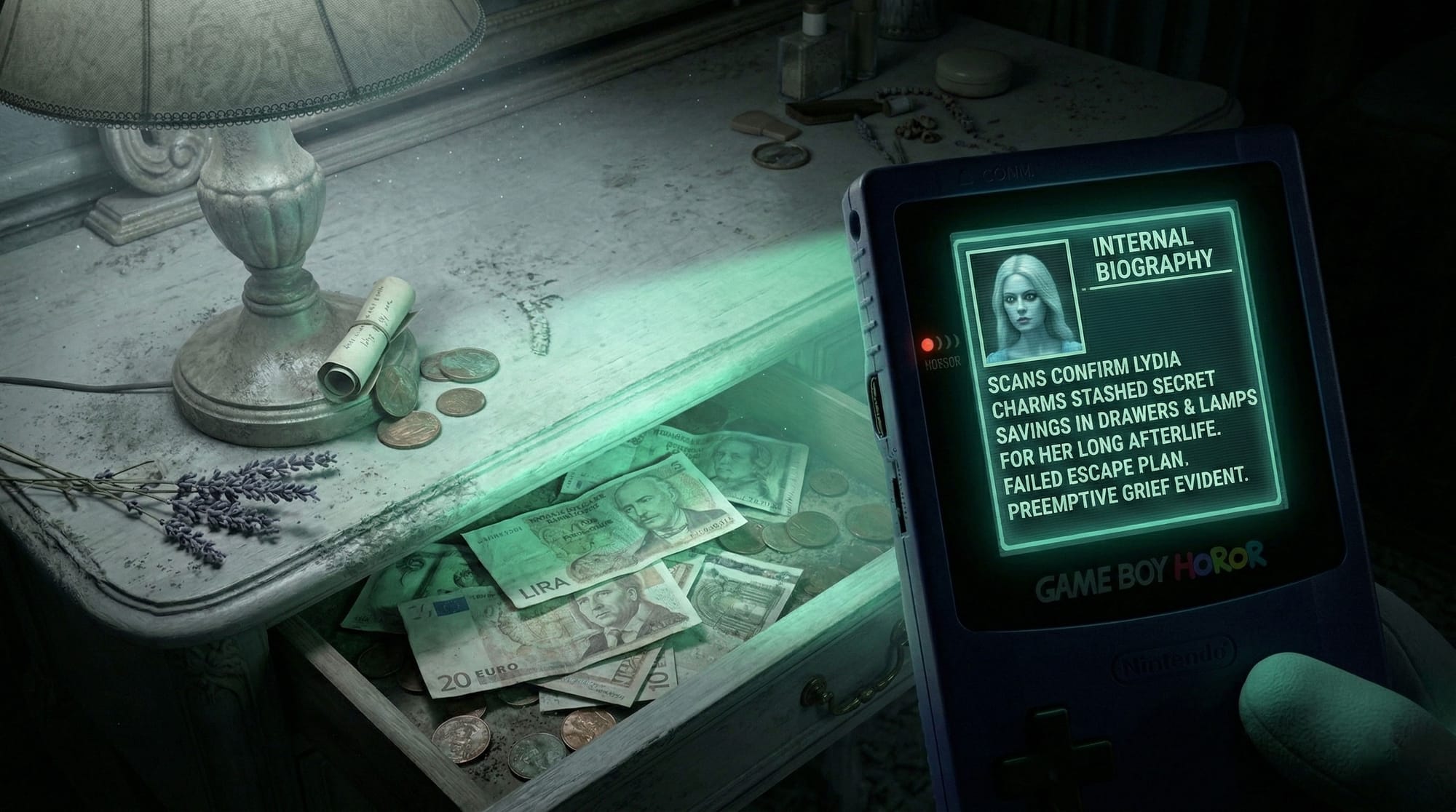
The internal biography registered within Professor Elvin Gadds device holds another deeply unsettling secret regarding the mother of the mansion. The scan explicitly states that Lydia stashed her secret savings away to prepare for her long afterlife. This single sentence unravels a massive web of paranoia and preemptive grief. Why would a living woman hoard secret wealth specifically for the afterlife. This detail suggests that Lydia was fully aware that a dark, consuming curse was creeping over her family. She knew the estate was poisoned by the despair that would eventually manifest as the shadow entity Bogmire.
Perhaps she was planning to abandon Neville. Perhaps she was secretly gathering funds to flee the rotting woods and take her remaining children far away from the paranormal rot infecting the property. But her escape plan failed. The curse of the Ghost King moves faster than human desperation. Her secret stash of bills and coins remained hidden in the drawers and the dusty lamps of the bedroom, entirely useless to a woman whose physical body had already expired. Her hoarding was a pathetic, futile attempt to buy her way out of a supernatural slaughter, proving that even in her final days, she believed material wealth could somehow shield her from the encroaching darkness.
The Tragedy of the Phantom Infant
The most horrifying piece of the Charms family puzzle rests heavily on Lydias pale, light blue shoulders. It is the tragedy of her youngest son. The lore describes the infant Chauncey as being "born a ghost." This biological impossibility carries deeply gruesome implications about Lydias final days among the living. If an infant is born directly into the spirit realm, it stands to reason that the child died before it ever had the chance to draw a breath of living air.
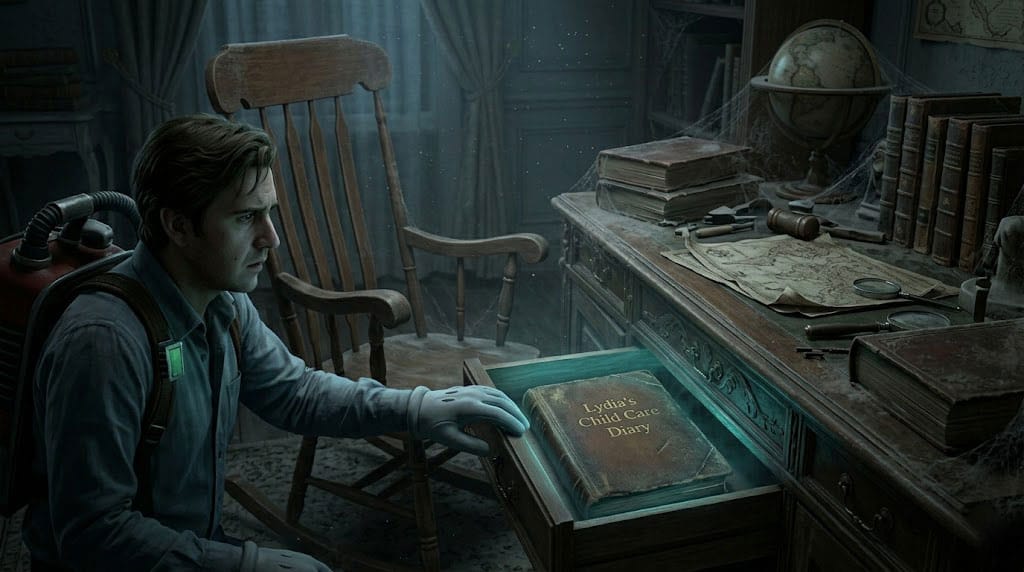
Forensic lore analysts have long suspected that Lydia was pregnant with Chauncey when the catastrophic events that wiped out the family took place. Did the unbearable stress of losing her older twin boys cause a fatal, silent complication. The guilt of this maternal failure must have been absolute agony. In Nevilles Study, Luigi uncovers a book titled Lydias Child Care Diary. The fact that this diary is located in her husbands room, and not her own, is a brilliant piece of environmental storytelling. It proves that Lydia completely abandoned her maternal duties, leaving her husband to retroactively read about raising children only after those children were already dead. Lydia could not bear to look at the empty crib. She could only bear to look at the mirror, desperately trying to convince her shattered mind that she was still beautiful, still whole, and still alive.
The Storm and the Shard of Glass
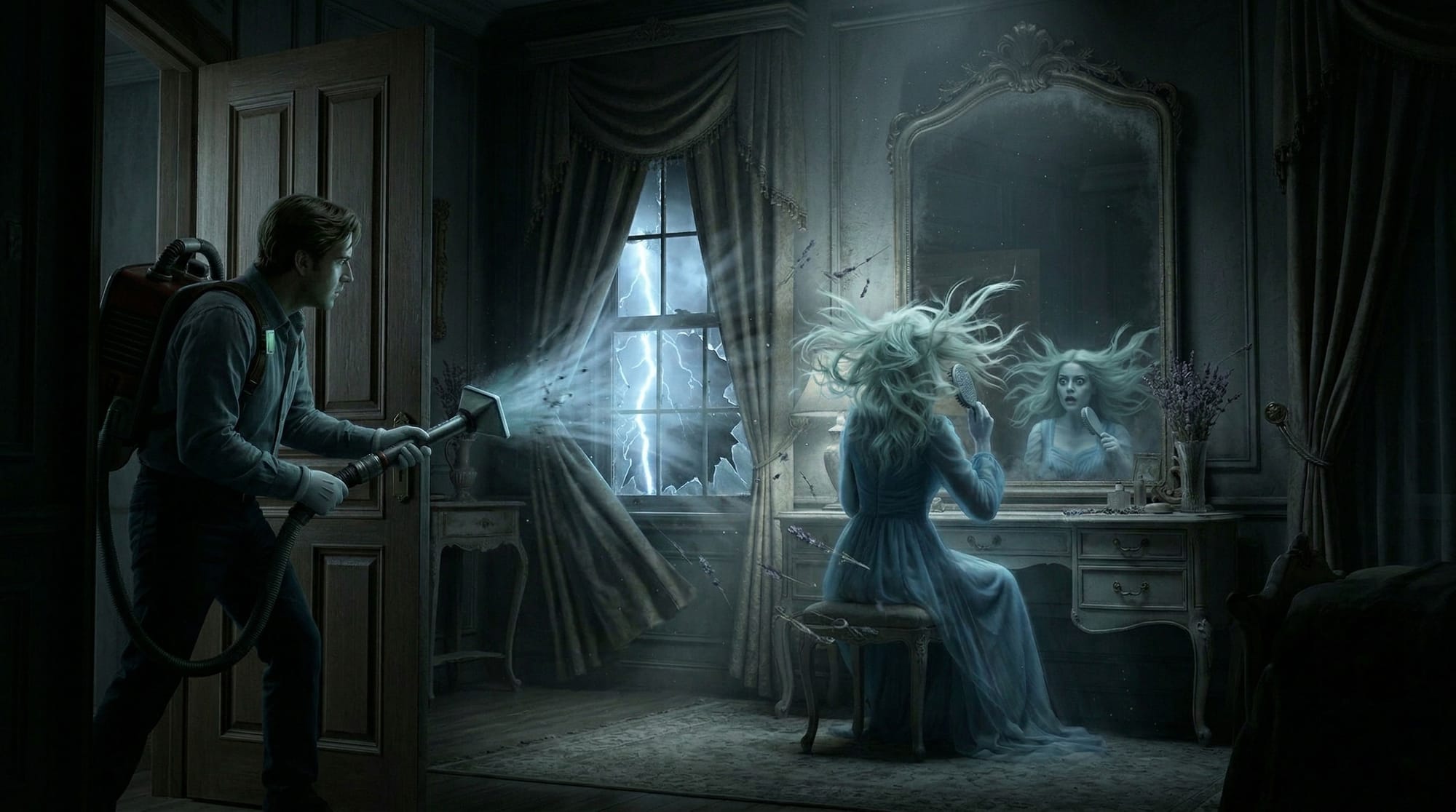
Every Portrait Ghost requires Luigi to exploit a specific vulnerability, and the method required to capture Lydia is a literal reenactment of her gruesome demise. When Luigi trembles in the doorway, the mother ignores him completely. She continues to brush her hair, whispering softly to her reflection. To break her trance, Luigi must aim the cold metal nozzle of the Poltergust 3000 at the heavy curtains hanging on the left side of the room. When the vacuum pulls the fabric back, it exposes a shattered windowpane. A violent, freezing draft of wind immediately blasts into the room, tossing Lydias pristine blonde hair into chaotic disarray.
This is not just a puzzle mechanic. It is the echo of her death. The fan lore surrounding the 2001 masterpiece paints a chilling picture of that fateful night. A massive storm raged outside the gothic estate. Lydia, consumed by her vanity, sat brushing her hair in the dark. The howling wind outside reached a fever pitch, tearing the heavy window open. When Lydia stood up to force the glass shut to protect her precious hair, a massive strike of lightning shattered the pane. A jagged shard of glass violently severed her neck. As she bled out on the cold floorboards, desperately gasping for air, her husband sat merely a room away, deaf to her gurgling screams over the thunder. By pulling that curtain back, Luigi is not just creating a draft. He is forcing Lydia to relive the exact, terrifying moment her life was violently extinguished.
The Cruelty of the Capture
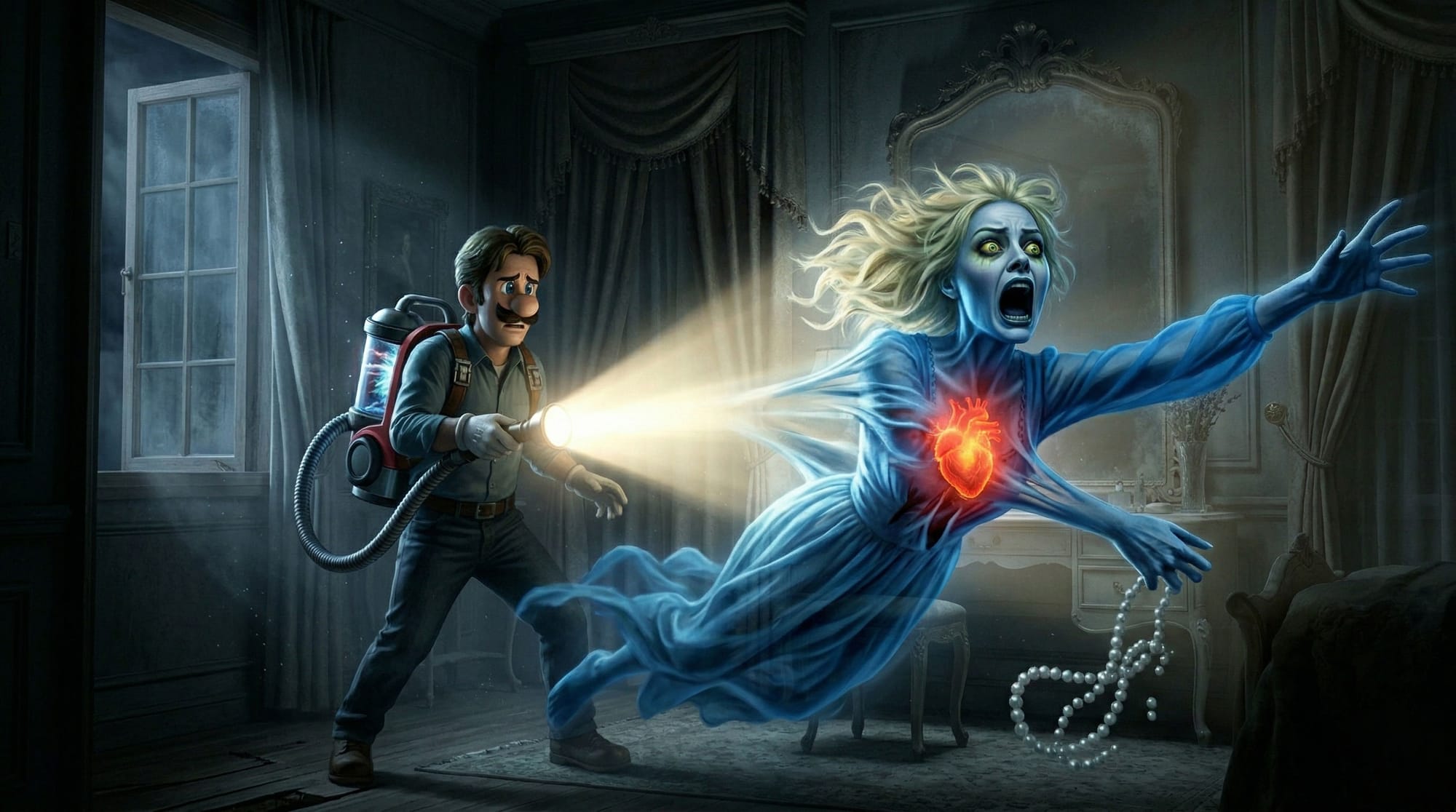
When the freezing wind hits her spectral form, the illusion of her peaceful vanity is instantly shattered. She shrieks in absolute horror, her yellow green eyes widening in panic as she realizes her perfect appearance has been ruined. She abandons the mirror and drifts toward the window, desperately trying to close the curtains and shut out the painful memory of her death. It is in this moment of profound vulnerability and distraction that her ghostly heart is finally exposed.
Luigi strikes with brutal efficiency. The blinding beam of the flashlight paralyzes the mother. The mechanical roar of the vacuum drowns out her screams of terror. She thrashes wildly, her long blue arms reaching desperately toward the vanity mirror, begging her reflection to save her. But the suction is too powerful. She drops a cluster of spectral pearls onto the rotting floorboards before being violently ripped from the physical plane, sucked into the suffocating, lightless containment chamber on Luigis back. She is separated from her family once again, reduced to digital data inside a ghost hunting machine. E Gadd praises Luigi through the communication device, completely indifferent to the tragic, domestic nightmare the plumber just dismantled.
The Eternal Frame of Denial
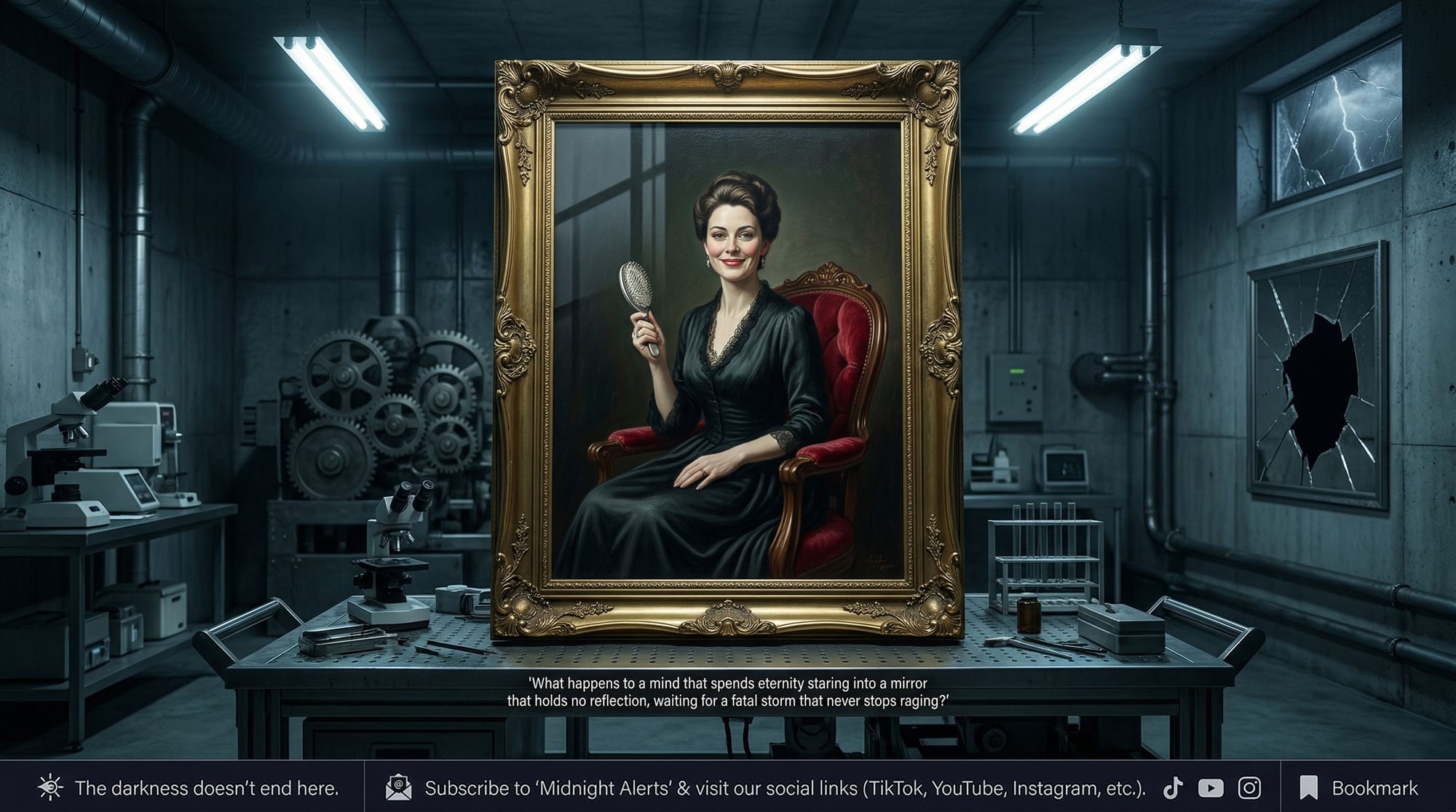
The psychological torment of Lydia Charms concludes deep underground, in the cold, sterile laboratory of the eccentric professor. Luigi plugs the vacuum into the heavy, grinding gears of the Ghost Portrificationizer. The machine, designed specifically to compress sentient souls into static oil paintings, subjects Lydia to a flattening, agonizing paralysis. Her wandering afterlife is pressed into a flat painted prison behind museum glass.
In her ultimate, golden frame, Lydia is depicted exactly as she lived and exactly as she died. She is sitting elegantly in a plush red chair, holding her silver hairbrush, staring lovingly out at the viewer. Even in eternal imprisonment, she refuses to acknowledge the reality of her situation. She does not look for the husband who ignored her. She does not weep for the infant that died in her womb. She simply smiles her vain, empty smile, perfectly content to be locked in a canvas prison as long as she never has to look away from her own face. She is a monument to the destructive power of vanity, a mother who let her family rot so she could remain forever beautiful in the dark.
What happens to a mind that spends eternity staring into a mirror that holds no reflection, waiting for a fatal storm that never stops raging?
Continue the Mansion File
The mansion works best as a chained dossier. Step back if you missed the previous room, or keep going to follow the next piece of Luigi's Mansion lore.
Previous file: Neville Charms's Baby Care Diary Exposes Luigi's Mansion's Failed Father Next file: Why Chauncey Was Born a Ghost in Luigi's Mansion