
The Fence-Post Video: How Evidence Rebuilt Jennifer Kesse's Case
Jennifer Kesse vanished from Orlando in 2006. Her car surfaced a mile away, parked by a person whose face vanished behind fence posts in every frame.


The most famous image in Jennifer Kesse's disappearance is not a face. It is the absence of one.
On January 26, 2006, Jennifer's black 2004 Chevrolet Malibu was found at Huntington on the Green, an apartment complex about a mile from her condominium near Conroy Road in south Orlando. Two days earlier, the 24-year-old had failed to show up for work. She had not called her family. She had not answered her phone. She had simply vanished from the edge of an ordinary morning.
Then investigators checked the security cameras.
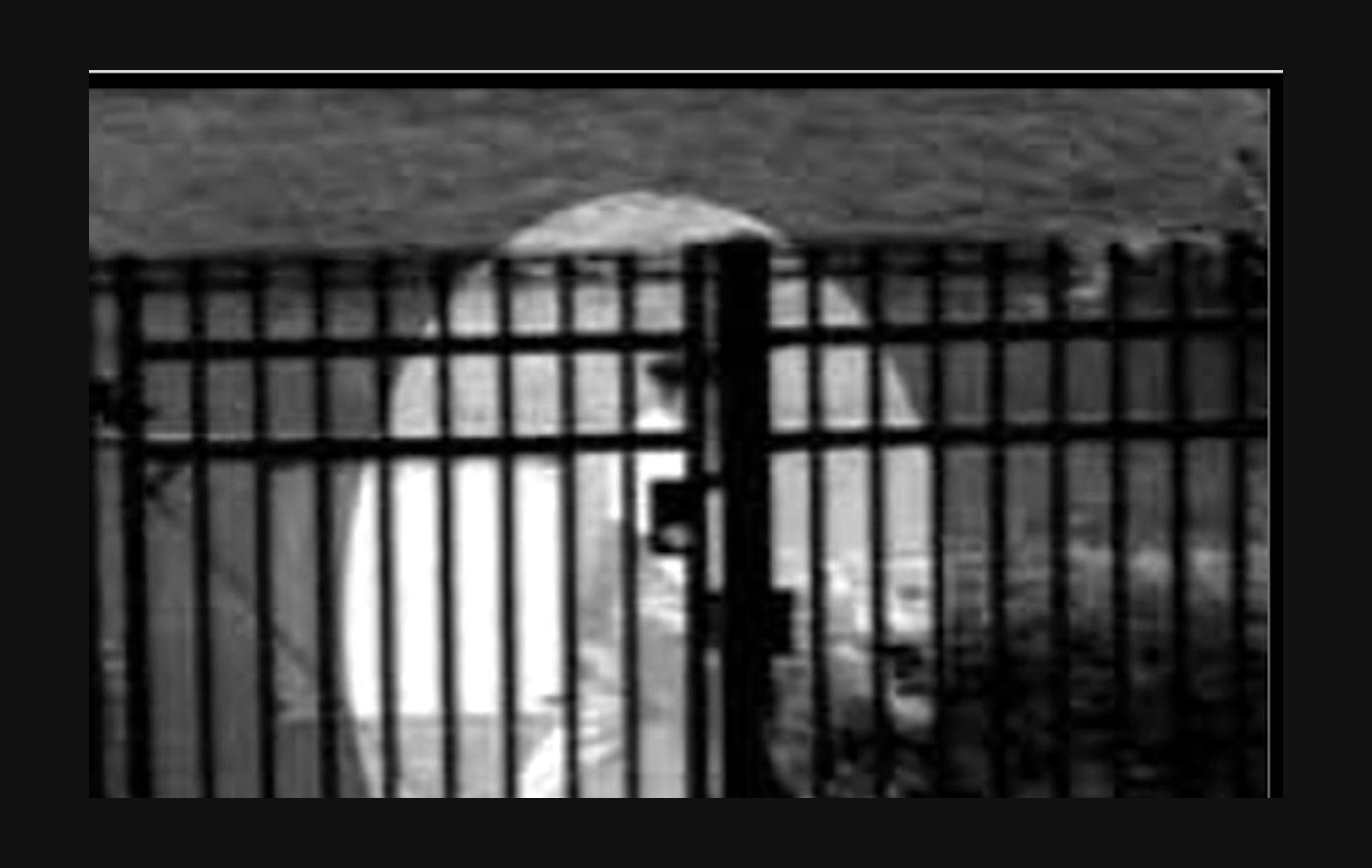
Around noon on January 24, one camera captured Jennifer's car entering the parking lot. The driver pulled in, sat for roughly half a minute, got out, and walked away. That should have been the break. Instead, the camera became one of the case's cruelest limitations. It did not record smooth video. It captured frames every few seconds. As the person of interest walked past the camera, fence posts blocked the face in the critical frames.
The evidence showed movement, timing, clothing, height estimates, and direction of travel. It did not show identity.
That distinction matters. In the Jennifer Kesse case, the fence-post video is powerful evidence. It is not proof of who took her. It is a narrow window into what happened after she disappeared, and for twenty years, that window has stayed half-covered.
The Morning Jennifer Was Missing
Jennifer Kesse was not someone whose silence made sense.
She worked in a finance role connected to Westgate Resorts in Ocoee. She was close with her parents, Drew and Joyce Kesse, and with her boyfriend, Rob Allen. Friends described her as safety-conscious and aware of her surroundings. She had bought a condominium at Mosaic at Millenia because it was supposed to be secure: a gated community, a guard presence, and a place where a young professional could build a life on her own terms.
The weekend before she disappeared, Jennifer had returned from a trip to St. Croix with Rob. On Monday, January 23, she went to work. That evening, she spoke with Rob around 10 p.m. Their relationship had the stress of distance, and the call included a disagreement, but available reporting does not turn that conversation into evidence of foul play.
The next morning, Jennifer did not arrive at work. She also did not answer calls. For the people who knew her, that was not a small deviation. It was the alarm.
By the time her family reached her condo, the scene inside looked less like a departure and more like an interrupted routine.
The Condo That Held a Timeline, Not an Answer
Jennifer's apartment was locked. Her travel bag was there. Her bathroom showed signs that she had used it that morning: makeup out, shower wet, towel wet. Her purse, keys, cellphone, and other personal items were gone.
That evidence suggested a basic sequence. Jennifer likely returned home, slept, woke up, and prepared for work. It did not prove exactly where she was taken, who took her, or whether the first confrontation happened at her door, near her car, in the parking area, or somewhere else close by.
That is the difference between evidence and certainty.
The apartment could support the idea that Jennifer made it through her morning routine. It could not identify the person responsible. And because the residence was not treated immediately as a sealed crime scene, later questions about contamination became part of the case itself. By the time the investigation hardened around abduction, family members and others had already been inside. That does not erase the value of what was seen there, but it limits what forensic conclusions can safely be drawn from the condo.
The room told investigators Jennifer was gone.
It did not tell them where.
The Malibu and the Thirty-Second Gap
The Malibu became the next piece of the evidence chain.
According to the FBI, items missing from Jennifer's residence included two phones, an iPod, keys, her driver license, and her purse. Her vehicle was later found away from her home. Surveillance showed a person of interest parking it at Huntington on the Green and walking away.
Inside the car, investigators did not find the kind of clean forensic answer families dream of. CBS 48 Hours reporting described an absence of useful fingerprints on the steering wheel and inconclusive DNA results from samples taken from the vehicle. Police discussed the possibility that the car had been wiped down, but possibility is not the same as proof. The person in the video sat in the car long enough to do something. The footage cannot show exactly what was done.
That is what makes the Malibu so important and so frustrating. It connects the disappearance to a known place and time after Jennifer was missing. It places an unknown person behind the wheel. It narrows the story.
But it does not finish it.
What the Fence-Post Video Can Prove
The surveillance footage can establish several things with caution.
It can show that someone other than Jennifer appears to have parked her car at Huntington on the Green around noon on January 24. It can show that the person walked away after leaving the vehicle. It can support a height estimate, with investigators and the FBI backing measurements that placed the person around 5-foot-3 to 5-foot-5 in earlier analysis. It can show clothing that investigators described as similar to a painter or manual worker's clothing.
What it cannot prove is just as important.
It cannot show the person's face. It cannot prove the person acted alone. It cannot prove whether the driver was the original abductor, an accomplice, someone moving the car under instruction, or someone connected in a different way. It cannot turn gait, clothing, or a general build into a name.
That is why the video should not be treated like a solved clue. It is a witness with damaged eyesight. It saw enough to matter, but not enough to end the case.
The Complex Around the Clue
Mosaic at Millenia was not a quiet, finished environment in January 2006. The complex was undergoing renovation and conversion work. Workers were present. Residents later described feeling uncomfortable around groups of men on the property. Jennifer herself had reportedly told her family that workers made her uneasy.
Those details matter because they describe the environment around her disappearance. They do not prove that a specific worker was responsible.
A former maintenance worker known publicly as Chino became part of later reporting after a former housekeeper said the person in the surveillance image resembled him by walk, clothing, and hair. He had done work in Jennifer's unit before she disappeared. He denied involvement, cooperated with questioning, and passed a polygraph, which itself is not definitive proof of innocence or guilt. Available public reporting does not establish him as the perpetrator.
Other men in Jennifer's life and workplace were also examined by investigators or discussed publicly over the years. The responsible way to handle that history is not to stack suspicion until it feels like evidence. It is to say what the record supports: people were looked at, theories were explored, and no arrest has been made.
In an unsolved case, a name is not proof. A theory is not a charge. A strange statement is not a conviction. And a person of interest is not the same thing as a legally established suspect.
The Files Her Family Fought to See
As years passed, Jennifer's parents did not simply wait for updates. They fought for access.
In 2019, after legal action, Orlando police agreed to turn over case materials to the Kesse family. CBS reported that the handoff included more than 16,000 pages of documents and 67 hours of audio and video. WESH reported that the family agreed to pay more than $18,000 for the records and that Orlando police would no longer lead the investigation under the agreement.
That records battle changed the case's shape. It moved a mountain of paperwork into the family's hands. It allowed private investigators to re-check old leads, revisit witness statements, and ask whether early assumptions had narrowed the investigation too quickly.
But files are not magic either. A case file can contain missed leads, contradictions, weak tips, witness memories, dead ends, and paperwork that looks more promising than it is. The value of those 16,000 pages is not that they automatically solved anything. Their value is that they gave Jennifer's family and investigators a larger map of what had been done, what had not been done, and what might still be testable.
New Testing, AI Hopes, and Evidence Limits
In 2022, the Florida Department of Law Enforcement assumed the missing-person investigation. On January 24, 2026, FDLE said agents were still actively investigating Jennifer's disappearance, analyzing evidence, conducting interviews, reviewing tens of thousands of documents and pieces of evidence, and pursuing leads. FDLE said Jennifer had still not been found.
Recent public reporting has also described renewed hope around DNA testing and artificial intelligence. FOX 13 reported in January 2026 that the Kesse family was working with an AI firm to examine the case file and the surveillance image, including the possibility of analyzing visible physical features such as an ear. The same reporting said new DNA samples had been tested the previous year and that investigators were closer to identifying several people they wanted to speak with.
That is hopeful. It is not a conclusion.
DNA can be powerful when the sample is clean, relevant, preserved, and legally traceable through chain of custody. But DNA can also be partial, mixed, degraded, transferred innocently, or unrelated to the crime. A lab result can generate a lead without proving who committed the disappearance.
AI image work has similar limits. Enhancement can sometimes clarify patterns already present in an image. It can also introduce error if the system invents detail that the original recording never captured. Ear recognition exists as a biometric field, but it is not as widely adopted as face or fingerprint identification, and any comparison from grainy surveillance would need careful validation before it could become reliable evidence.
The cleanest way to say it is this: new technology may help investigators ask better questions. It cannot be allowed to answer questions the evidence itself does not support.
What Still Remains Unanswered
The Jennifer Kesse case is still active. It is still unresolved. No one has been arrested. Jennifer has not been found.
The evidence tells a partial story: a young woman prepared for work, failed to arrive, disappeared from south Orlando, and had her car moved to another complex by an unidentified person. The video gives the case its most recognizable image. The records battle gives it its institutional shadow. The renewed FDLE review gives it a living investigative path.
But the core questions remain.
Who took Jennifer Kesse? Where was she taken? Was the person in the surveillance footage the person responsible, an accomplice, or only one part of a larger movement of the car? Did the original investigation lose evidence that could have mattered later? And can modern testing recover anything strong enough to move the case from suspicion to proof?
For now, Jennifer's case lives in that space between a clue and an answer. A fence post covered a face. Time covered almost everything else. What remains is the evidence still asking to be read correctly.
Archival Case Gallery
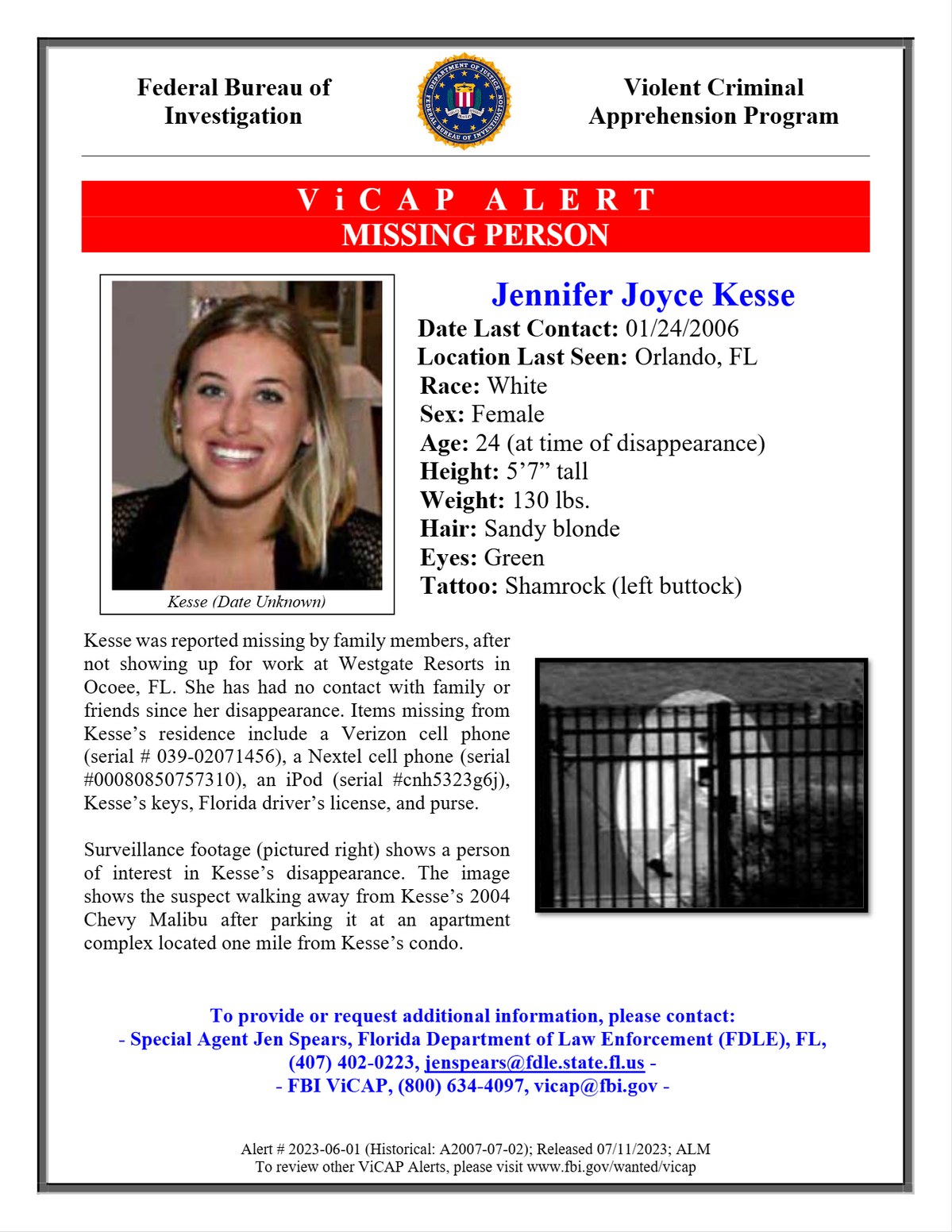
Archival case gallery: FBI ViCAP public alert for Jennifer Joyce Kesse, released July 11, 2023, with Jennifer's missing-person details and the fence-post surveillance image. The alert is included as official public case-record context, not as a claim that the image identifies the person of interest.
Sources & Case Notes
Last updated: June 6, 2026.
Primary sources and case notes: This article was built from the FDLE January 24, 2026 public update, the FBI ViCAP listing for Jennifer Joyce Kesse, the FBI ViCAP alert PDF, the FDLE missing-person flyer, CBS 48 Hours reporting on the surveillance footage and case-file handoff, WESH reporting on the 2019 records agreement, FOX 13 reporting on the Kesse family's AI and DNA-testing hopes, and public biometric context from the Biometrics Institute. Named individuals discussed in public reporting are handled as people examined, discussed, or reported around the investigation, not as legally established perpetrators. No person has been arrested or convicted in Jennifer Kesse's disappearance.
Correction policy: If you have source corrections, family-approved context, or image-rights concerns, contact Anonymous369 Media through Contact & Media Inquiries.
Image credits: Feature image, body image, and archival gallery are based on the FBI ViCAP public alert for Jennifer Joyce Kesse. The feature image is an Anonymous369 Media editorial crop/composite of that official public alert. No fake official documents, fake case labels, fake badges, fake lab records, or fake evidence text were created. News-media images from CBS, WESH, FOX, and other outlets were reviewed for context but not reproduced because reuse rights were not clear for this production pass.
Content warning: This article discusses an unresolved missing-person case, suspected abduction, investigative failures, and unresolved allegations in restrained, non-graphic terms.