
Melody Pianissima's Silent Piano Exposes Luigi's Mansion's Loneliest Prodigy
Melody Pianissima was twenty-six, brilliant, and already locked inside her own conservatory. In Luigi's Mansion, her Nintendo quiz, stalking butler, flying music sheets, and silent final portrait reveal a prodigy who chose art over people until her piano became the room that buried her.


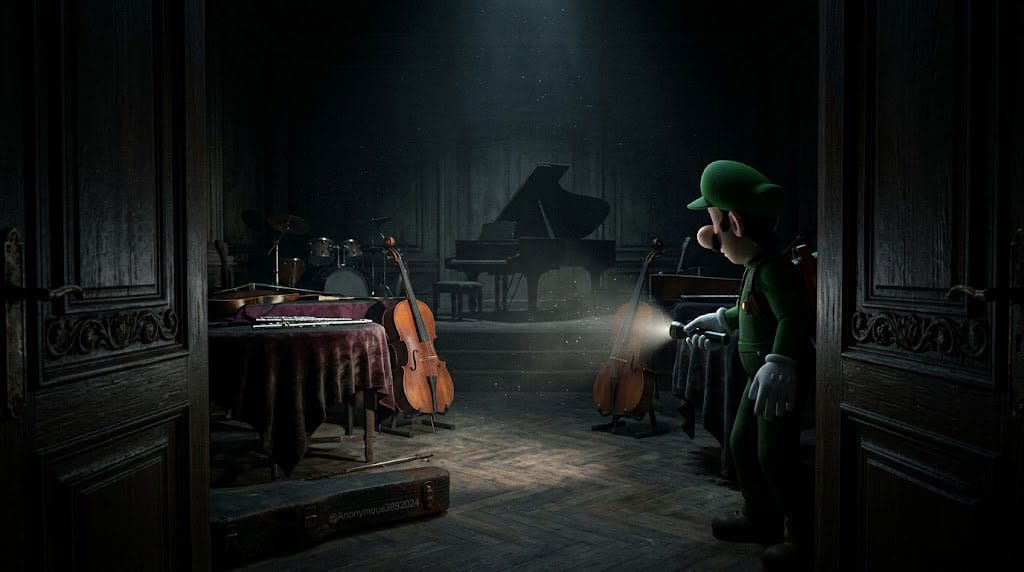
The air inside the Conservatory of the accursed estate is heavy, stale, and suffocating. It smells of polished mahogany, decaying velvet, and the distinct, metallic tang of ancient dust settling over unused instrument strings. When a trembling green clad plumber pushes open the heavy wooden doors on the first floor, he does not step into a chaotic swarm of shrieking phantoms. He steps into a tomb of absolute, oppressive silence. The room is immaculate, filled with cellos, flutes, and drums resting in pitch black shadows. At the far end of the room sits a grand piano, completely silent. For decades, players of the two thousand and one GameCube masterpiece viewed this room simply as a charming musical puzzle, a nostalgic nod to classic Nintendo melodies. But when you strip away the colorful, cartoonish presentation and conduct a forensic examination of the environmental lore, a profoundly disturbing psychological thriller emerges. The entity waiting in the dark is Melody Pianissima, The Beautiful Pianist. She is not just a ghost playing a song. She is a twenty six year old prodigy trapped in a perpetual loop of vanity, isolation, and unrequited obsession, a woman who shut out the world of the living only to be consumed by the horrors of the dead.
The Prodigy Who Shut Out the World
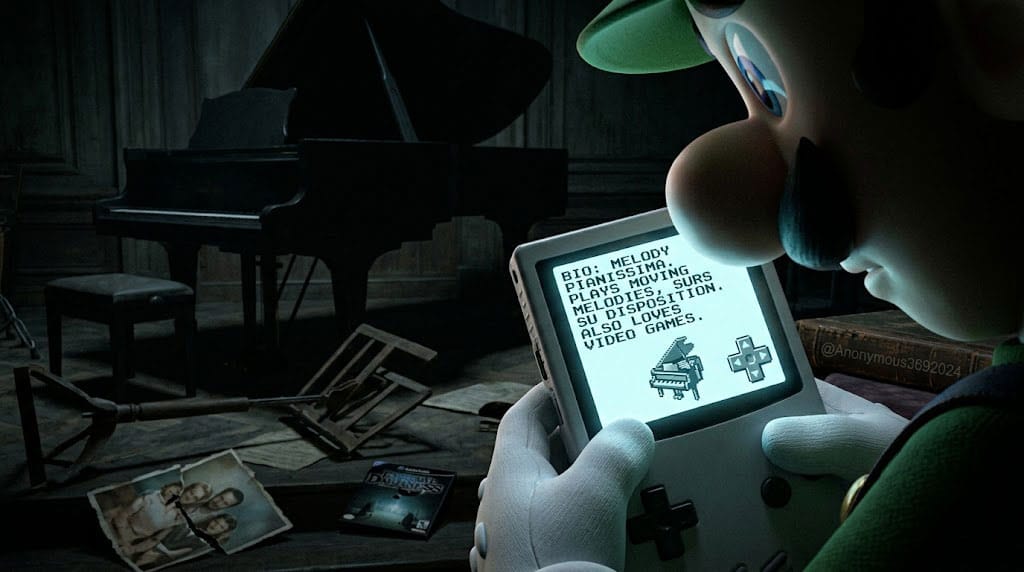
To understand the sheer psychological tragedy of Melody Pianissima, we must first examine the fragmented history she left behind. The internal biography registered within Professor Elvin Gadds Game Boy Horror scanner reveals a deeply complex and contradictory personality. The scan states that despite playing moving melodies, she has a surly disposition, and oddly enough, she loves video games. This brief description unlocks a terrifying psychological profile. Melody was a prodigy, blessed with incredible talent and undeniable beauty, yet she was fundamentally broken inside. Her surly disposition suggests a woman who was easily angered, highly irritable, and deeply impatient with anyone she deemed intellectually or artistically inferior.
Because of her nasty temper, it was likely impossible for her to maintain genuine human relationships. She alienated her friends, pushed away her family, and ultimately retreated into the sprawling, gothic mansion to be entirely alone. She became a recluse. She spent her days locked inside the Conservatory, dedicating her entire existence to striking the ivory keys and escaping into the digital fantasy worlds of video games. She preferred the predictable, controllable environments of fictional worlds and musical notes over the messy, unpredictable nature of human connection. Her isolation was not forced upon her by an external enemy. It was a self inflicted prison built from her own towering arrogance. When Luigi stands in the doorway, trembling with a flashlight, he is trespassing on the sacred sanctuary of a woman who hated humanity long before her heart ever stopped beating.
The Parasitic Gaze of the Wandering Butler
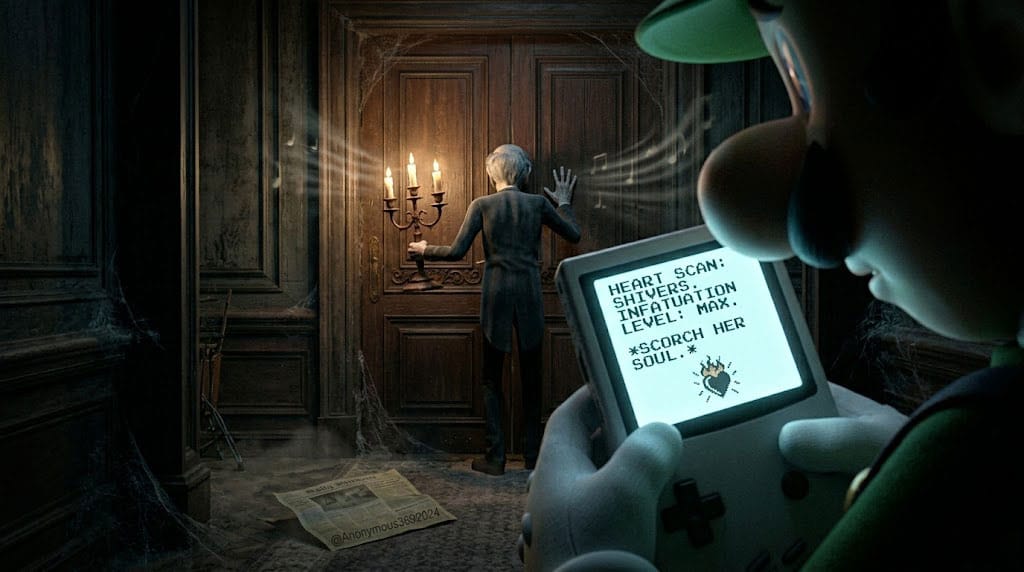
The true horror of Melodys existence is not just her isolation, but the toxic entity that lurked just outside her door. Down the hall from the Conservatory wanders Shivers, the seventy two year old butler of the mansion. The lore buried within the game reveals a deeply unsettling and entirely one sided dynamic between the two. Shivers is absolutely infatuated with the twenty six year old pianist. When Luigi scans the old mans heart, his internal monologue is broadcasted into the world of the living. Shivers laments that the beautiful Melody will not even give him the time of day. He desperately asks himself what he must do to win her, eventually declaring that he will show her his unbridled passion and scorch her soul.
Imagine the psychological torment of this scenario. Melody, a young woman who actively despises social interaction, is trapped in a house with an elderly servant who harbors a deeply unhealthy obsession with her. She locks herself in the Conservatory to play her music, but she knows he is out there. Shivers paces the dark hallway just beyond the heavy wooden doors, holding his candelabra, listening to her play. He is a voyeur, a parasite feeding off her talent from the shadows. Melody dismisses his affections entirely, treating him with the cold, callous indifference her surly disposition is known for. But in a house filled with death and despair, ignoring a delusional obsession does not make it disappear. It only allows the toxicity to fester in the dark.

The Symphony of Ash and Crushed Bone
Forensic lore analysts and deep dive theorists have long debated the exact nature of Melodys demise. The game refuses to provide a clean answer, but the environmental clues and community theories point to a gruesome, fiery tragedy inextricably linked to her greatest stalker. Shivers the butler is utterly terrified of fire, panicking blindly the moment his candelabra is lit by the player. The dark lore suggests that this crippling pyrophobia stems from the event that claimed both of their lives.
The theory paints a chilling picture of a stormy night in the mansion. Shivers, desperate to win the affections of the beautiful pianist, gathered a bouquet of flowers and entered the Conservatory while Melody was completely absorbed in a piano sonata. In his nervous, trembling state, the elderly butler tripped over one of the many instruments scattered across the floor. The heavy candelabra fell from his grasp, instantly igniting the dry, dusty velvet curtains and the old wooden floorboards. As the flames rapidly consumed the room, Shivers burned alive in the hallway, his unbridled passion literally destroying him. Inside the room, Melody was trapped. Desperate to escape the searing heat, she crawled underneath her massive grand piano to find shelter. But the fire compromised the structural integrity of the heavy instrument. A wooden leg snapped, and the massive piano came crashing down, violently crushing the young prodigy to death on the floor. Even in death, she remains anchored to the very instrument that served as her executioner, forever playing the keys to drown out the memory of the flames.
The Meta Nightmare of the Phantom Quiz
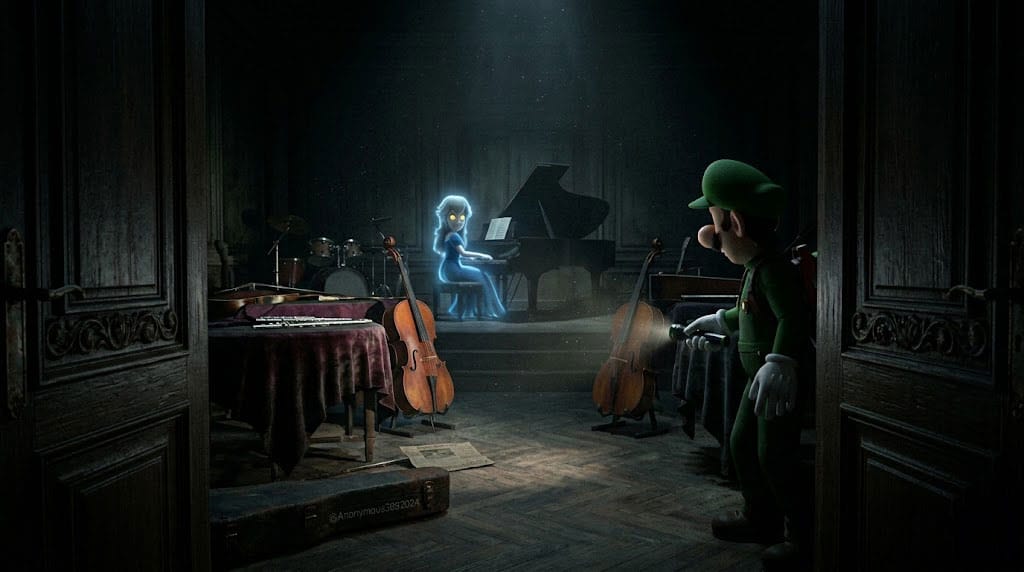
When Luigi finally enters the Conservatory, Melody refuses to acknowledge his presence. She demands perfection. To lure her out, Luigi must run around the room, manually tapping the drums, cellos, and flutes to make them play a synchronized rendition of a classic Nintendo melody. Only when the entire room is filled with music does Melody finally materialize at the piano, her yellow eyes glowing in the pitch black room. She compliments Luigi on his stirring performance and offers to play a piano sonata for him.
It is here that the game executes a brilliant and terrifying breaking of the fourth wall. Melody plays a rapid, complex arrangement of music from either the underwater stages or the athletic stages of past adventures. She then turns to Luigi and demands to know what the composer was thinking or what game the music originated from. This interaction has staggering implications for the lore of the universe. Melody explicitly loves video games, but the games she is referencing are the very real, life or death adventures that Mario and Luigi have actually lived through. Does her fractured, spectral mind view the legendary heroes of the Mushroom Kingdom as mere fictional characters in an arcade cabinet. Does she realize that the trembling, green clad plumber standing before her is a living, breathing entity, or does she simply view him as an interactive sprite in her own eternal digital fantasy. By forcing Luigi to answer trivia questions about his own traumatic past, she reduces his entire existence to a piece of casual entertainment.
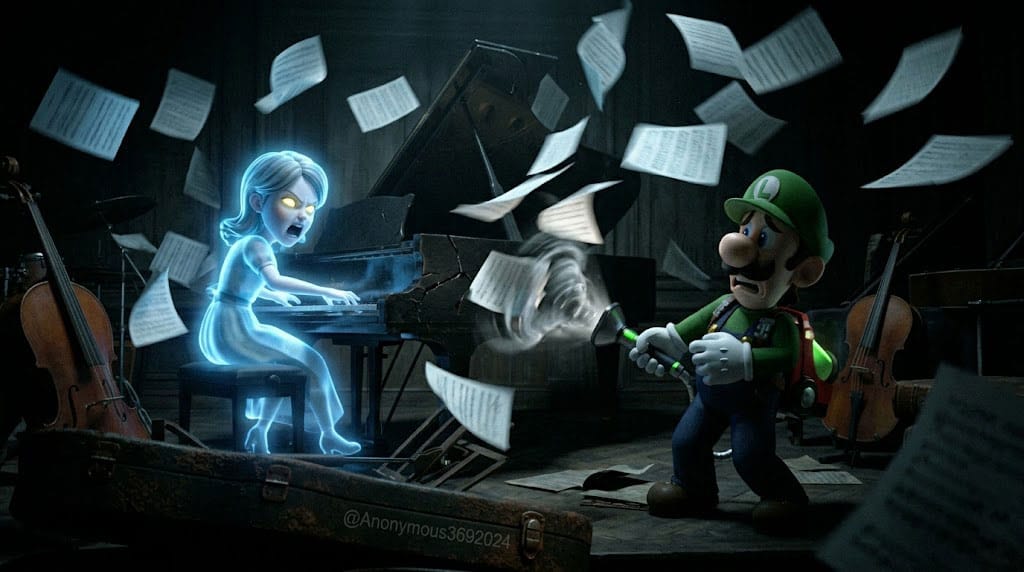
A Violent Crescendo of Rage
The sheer arrogance of the pianist is fully unleashed during her interaction with the intruder. If Luigi answers her musical trivia question incorrectly, the illusion of the elegant, sophisticated artist is violently shattered. Melody slams her ghostly hands down onto the keys of the piano in a fit of absolute, blinding rage. She screams at Luigi, furious that she put her heart and soul into the piece only to be insulted by a man she views as an uncultured peasant. She calls him an awful man, demands that he leave her presence, and instantly vanishes into the ether, forcing the player to leave the room and restart the entire grueling process from the beginning.
But if Luigi answers correctly, her response is equally terrifying. She laughs, an echoing, hollow sound, and declares that she does not need to hold back. She challenges the plumber to do battle with her lovely music sheets. She begins to play a frantic, chaotic piece on the piano, using her supernatural powers to telekinetically weaponize the very music she creates. Razor sharp sheets of paper fly across the room like shrapnel, slicing through the air and inflicting physical damage on the terrified hero. Luigi is completely outmatched by her artistic fury. He cannot attack her directly. He must use the roaring suction of the Poltergust to violently rip her flying music sheets out of the air, systematically destroying her lifes work right in front of her eyes.
The Final Note in the Dark
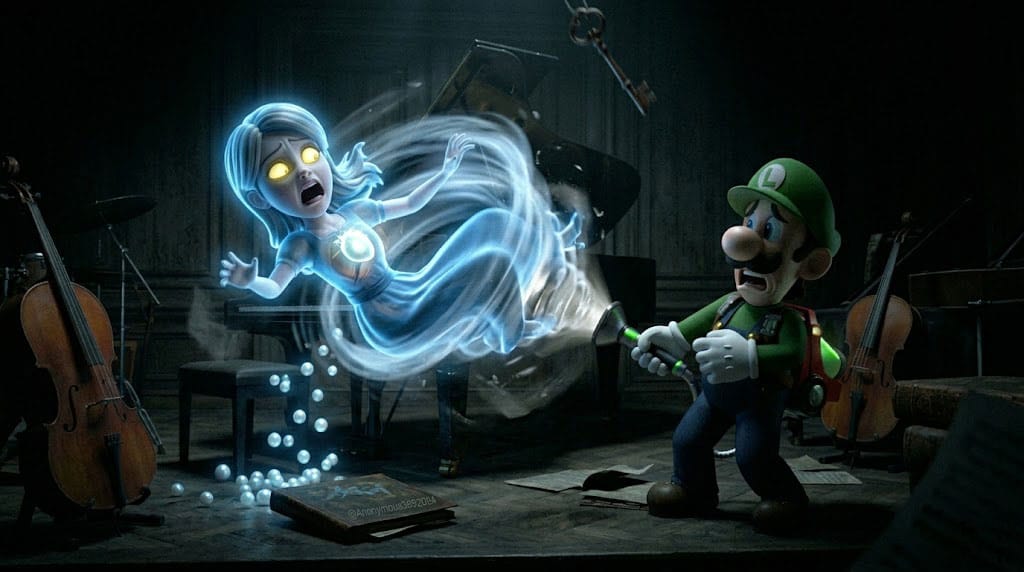
When every single sheet of music is sucked into the dark vortex of the machine, the beautiful pianist is left completely defenseless. Her music has been silenced. Her art has been destroyed. It is in this moment of profound vulnerability and artistic devastation that her spectral heart is finally exposed to the cold, unforgiving light of Luigis flashlight.
The mechanical roar of the vacuum drowns out her screams of panic. Melody thrashes wildly, her elegant blue dress twisting in the powerful current of the machine. She fights desperately to remain at her piano, her yellow eyes wide with terror as she realizes her eternal performance is coming to a violent end. She drops a cluster of spectral pearls onto the polished floorboards before being violently ripped from the physical plane. She is sucked screaming into the suffocating, lightless containment chamber on Luigis back. The Conservatory falls dead silent. The piano will never play another note. The key to the Dining Room drops from the ceiling with a cold, metallic clatter, a hollow reward for extinguishing the last flickering spark of a tortured genius.
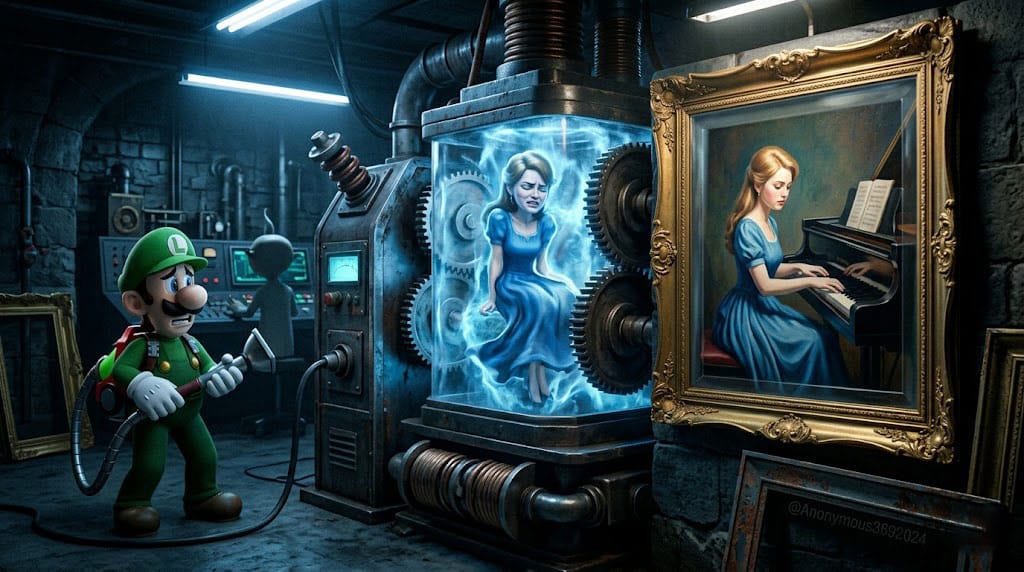
The Canvas of Silence
The psychological torment of Melody Pianissima concludes deep underground, in the cold, sterile laboratory of Professor Elvin Gadd. Down in the lab, Luigi connects the heavy vacuum to the Ghost Portrificationizer and lets the machine grind its cruel work into motion. The machine, designed specifically and maliciously to compress sentient souls into static oil paintings, subjects the young prodigy to a flattening, agonizing paralysis. What remains of her is not freedom, but paint, frame, and a display case.
In her ultimate, golden frame, Melody is depicted sitting elegantly at her grand piano, her hands resting gracefully on the keys, her face frozen in an expression of intense musical concentration. Even in eternal imprisonment, she is denied any sense of peace or closure. She can never press the keys again. She can never hear the music she so desperately loved. She is reduced to a mere decorative trophy, hanging silently in a cold, underground gallery for a mad scientist to admire. She spent her entire living existence shutting out the world to focus on her art, and now she will spend eternity in absolute silence, completely paralyzed in a dark room.
What happens to the mind of a musical genius when they are forced to spend eternity staring at a piano they can never play, waiting for a song that will never begin?
Continue the Mansion File
The mansion works best as a chained dossier. Step back if you missed the previous room, or keep going to follow the next piece of Luigi's Mansion lore.
Previous file: Why Shivers Runs From Fire in Luigi's Mansion Next file: Mr. Luggs Died at Thirty Hiding His Hunger in Luigi's Mansion