
The Black Bassinet Forces the Final Choice of Rosemary Woodhouse
The final horror of Rosemary Woodhouse is her choice to stay. Discover how the Bramford coven hijacked maternal instinct to force a mother to cradle her own destruction.


Rosemary's Baby Complete Movie Lore: File 5 of 5. After the Bramford's architecture, Guy Woodhouse's bargain, Dr. Sapirstein's clinical net, and Roman Castevet's inherited coven machine have done their work, the series ends where all of that pressure was designed to arrive: Rosemary Woodhouse at the edge of the black bassinet, holding a knife she can no longer use.
A weapon is only as effective as the hand that holds it. When Rosemary Woodhouse steps through the hidden partition of her linen closet, she carries a heavy steel kitchen knife, its blade catching the dim light of the Bramford's interior spine. She is a mother who has spent months enduring physical degradation, clinical gaslighting, and the systematic execution of her closest allies. The knife represents the final, primitive boundary of her individual autonomy, a literal cutting away of the politeness that has kept her captive for nearly a year. Yet when she finally reaches the center of the conspiracy, she discovers that her steel blade is completely useless against an architecture that has already hollowed out her choices.
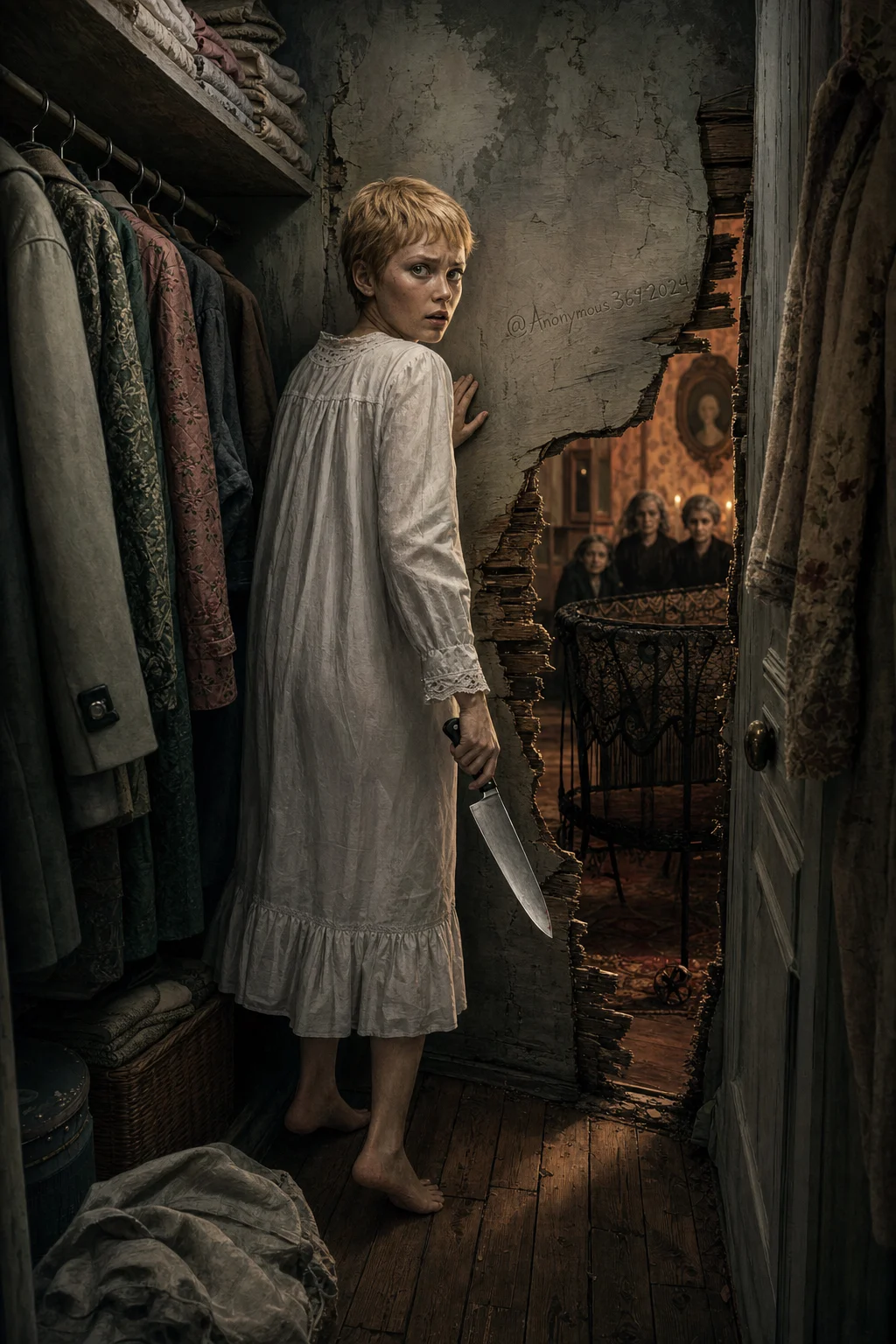
Original Anonymous369 Media generated section image for Rosemary Woodhouse entering the hidden Bramford passage.
The Steel Blade at the Linen Press Door
The path to the final confrontation requires Rosemary to trace the exact physical loop that Mrs. Gardenia died trying to seal. Armed with the carving knife, she enters the deep built-in closet at the head of her hallway, pushes aside the hanging winter coats, and forces her way through the loose wooden paneling into Apartment 7B. This movement is the ultimate rupture of domestic privacy. For months, the coven used this pass-through to violate her home; now she uses it to invade theirs.
Expectations of a traditional horror climax dictate that this breach should lead to a scene of violent retribution. Rosemary is a victim entering the lair of her abusers. However, when she steps out from behind the Castevet drapes, she is greeted not by a dark, blood-splattered altar, but by the warm, clinking-glass atmosphere of a high-society cocktail party. Roman, Minnie, Guy, and Laura-Louise are gathered in a brightly lit parlor, chatting amiably and sipping drinks. The horrific contrast immediately blunts the utility of her weapon. Rosemary stands in her nightgown, emaciated and trembling with a knife in her hand, while her tormentors treat her presence as a slightly eccentric, but entirely welcome, arrival at a family gathering. The coven does not flinch at the blade because they understand that physical violence is a tool of the desperate, whereas they control the entire social and medical reality of the room.
The Black Tulle and the Inverted Crucifix
In the center of this polite celebration sits the physical focus of the entire Bramford apparatus: a large, Victorian bassinet. It is an object that should symbolize safety, warmth, and the clean beginning of a new generation. Instead, the coven has dressed the cradle in a heavy shroud of black tulle and dark lace, transforming the domestic item into a catafalque. Hanging directly from the ceiling above the infant's head is a small, upside-down crucifix bound in dark leather.
This perversion of the nursery design is the visual anchor of Rosemary's ultimate capture. The black bassinet is not hidden in a basement or a secret vault; it is placed prominently in the living room, treated with the same pride a conventional family reserves for a traditional cradle. The presence of the inverted cross demonstrates that the coven has successfully inverted the moral landscape of the household. They have established a space where the monstrous is normalized and the traditional symbols of protection are turned upside down. When Rosemary approaches the dark fabric, she is not merely looking at a child; she is looking into a cradle that has been structurally re-engineered to nurse an apocalypse.
The Hereditary Trait of the Golden Eyes
The true horror of the bassinet is realized when Rosemary steels her resolve, steps to the edge of the dark lace, and looks inside. The camera remains fixed on her face, refusing to show the physical form of the anomalous infant, tracking instead the immediate, catastrophic unraveling of her sanity. Her jaw drops, her chest heaves, and she lets out a ragged, throat-tearing shriek that cuts through the polite murmur of the parlor.
ROSEMARY:
"What have you done to his eyes?"

ROMAN CASTEVET:
"He has his father's eyes."
The exchange strips away the final layer of clinical deception that Dr. Sapirstein maintained throughout her pregnancy. The anomalous physical traits, the golden, reptilian irises that stare back at her from beneath the black tulle, are not a deformity, a medical complication, or a delusion. They are the hereditary signature of the entity that occupied her bedroom on the night of the drugged mousse. Roman's calm, prideful correction recontextualizes her entire ordeal. The coven did not ruin her child; they successfully delivered their masterwork. The golden eyes are the definitive proof that her body was used as an extraction site for an ancient dynastic lineage, leaving her to face a creature that carries her own blood but belongs entirely to the dark.
The Rhythmic Motion of the Final Trap
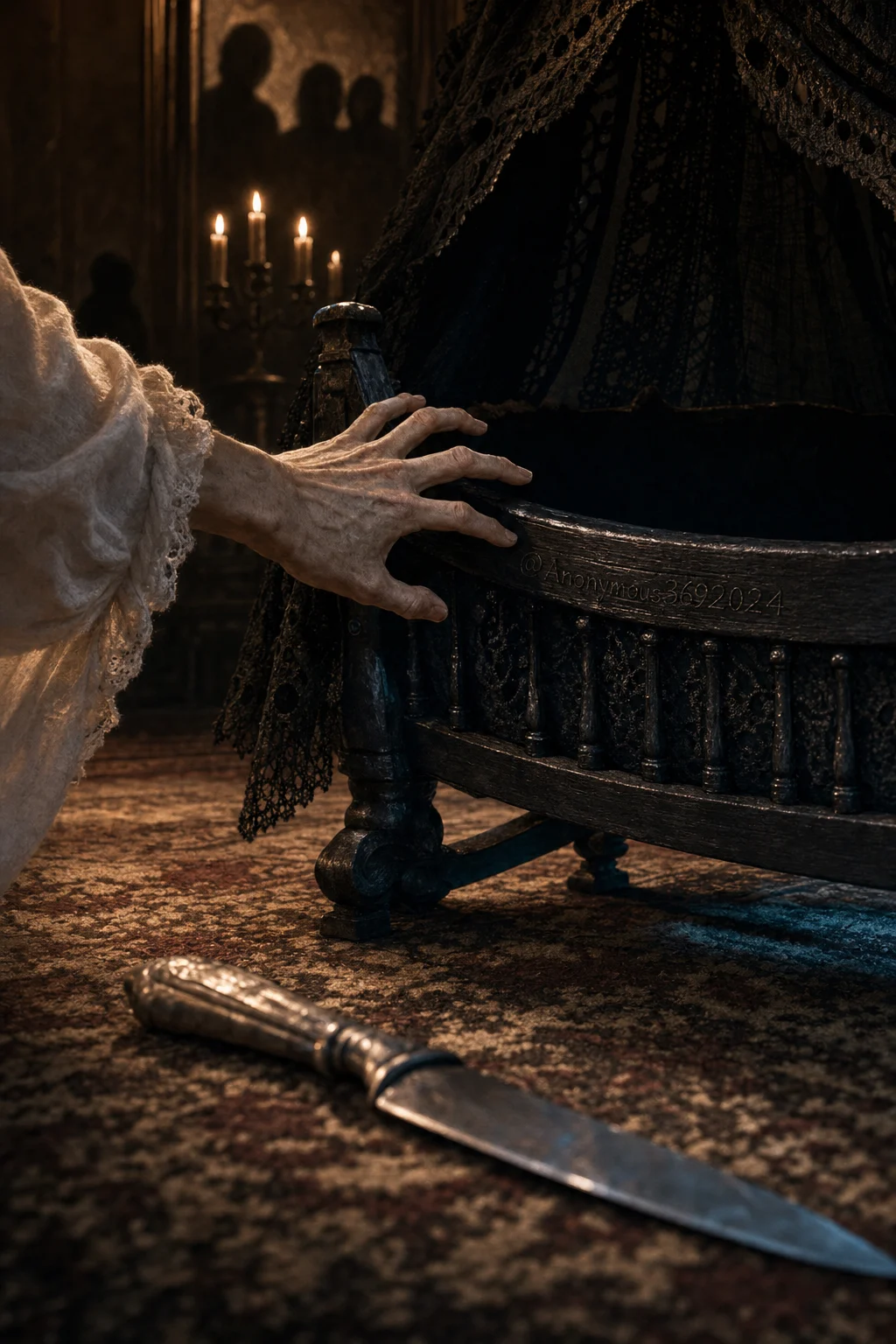
The ultimate tragedy of the narrative unfolds not through an act of violence, but through a slow, rhythmic motion. As the baby begins to cry, distressed by the shouting in the room, Laura-Louise attempts to rock the bassinet, but her movements are clumsy and harsh. Roman gently pushes her aside, turning instead to Rosemary and speaking with soft, undeniable authority: be a mother to your baby, and let him feel your hand.
At this moment, the trap closes completely. Rosemary's entire identity has been systematically dismantled over nine months; she has no friends left, her marriage is a transactional fiction, and her original social network is dead. The only structural instinct left intact within her shattered psyche is the maternal drive to comfort a crying child. She drops the kitchen knife onto the floor carpet, where it sits uselessly beside the coven's cocktail glasses. She steps forward, picks up a fallen pacifier, and takes her place at the head of the black bassinet.
As she begins to rock the cradle, a faint, hesitant smile forms on her emaciated face. The film concludes with the same soft, haunting lullaby that opened the story, drifting out over the rooftops of Manhattan. Rosemary has not been converted to Satanism by ideology or philosophy; she has been captured by her own capacity for love. The coven does not need to chain her to the floor or threaten her with a blade. They have achieved the ultimate conquest: they have forced the victim to become the voluntary guardian of her own violation, rocking the cradle of her destruction with the gentle, protective tenderness of a mother.
Read Rosemary's Baby Files in Order
This is File 5 of 5 in the Rosemary's Baby Complete Movie Lore path. The sequence begins with the Bramford's hidden apartment machinery, then moves through Guy Woodhouse's career bargain, Dr. Sapirstein's medical capture, Roman Castevet's inherited coven system, and Rosemary Woodhouse's final choice at the black bassinet.
- The Moving Chest Unlocks the Hidden Passages of The Bramford
- Stealing the Spotlight Blinds the Rival of Guy Woodhouse
- The Silver Charm Ball Inverts the Prenatal Care of Dr. Sapirstein
- Decoding the Anagram Unmasks the Bloodline of Roman Castevet
- Current file: The Black Bassinet Forces the Final Choice of Rosemary Woodhouse
Previous file: return to the ancestral lineage of Steven Marcato hidden behind a neighborly facade, where Roman Castevet's historical ledger prepared this room. To return to the beginning, go back to the Bramford's hidden passages that turned a home into a ritual machine.