
The Moving Chest Unlocks the Hidden Passages of The Bramford
The Bramford is more than a Gothic building. It is an architectural trap designed to dissolve privacy through a blocked closet, a moving chest, and Rosemary Woodhouse's inherited rooms.


Rosemary's Baby Complete Movie Lore: File 1 of 5. This five-file route begins inside the Bramford itself, where a moving chest, a blocked closet, and a dead tenant's warning turn domestic space into the first mechanism of Rosemary Woodhouse's capture.
A home is defined by its boundaries. The brick, mortar, and plaster of an apartment are meant to serve as an absolute barrier between the public world and the vulnerable self. Yet, when a building is re-engineered to serve a predatory lineage, the architecture itself becomes fluid. The Bramford, an old, black, elephantine structure looming over New York City, functions exactly as this type of spatial trap. It lures its occupants with the promise of high ceilings, Victorian charm, and prestigious isolation, only to reveal that its walls are not barriers at all, but membranes. To understand the mechanism that eventually consumes Rosemary Woodhouse, one must first look at the physical space she inherited from a woman who died trying to seal it shut.
The Divided Floor Plan of Apartment Seven E
When the rental agent, Mr. Micklas, guides prospective tenants through the dark wood and heavy stone of the Bramford, he presents the building's history as an administrative quirk of changing economic times. He explains that the building originally consisted of massive, sprawling luxury suites--the smallest among them being nine rooms. Over the decades, these sweeping family estates were broken up into smaller, modern units: fours, fives, and sixes. Apartment 7E is one such fragment. It is a four-room flat assembled from the residual limbs of a larger, grander apartment. Its living room was once a master bedroom; its dining room is a pair of servants' quarters crudely thrown together.
This division of space is presented as a routine real estate optimization, but its physical consequence is far more invasive. By slicing these massive apartments into interlocking puzzles, the building's management created a layout of extreme, unnatural proximity. The plaster walls separating the new apartments are thin, porous, and acoustically compromised. More importantly, the old paths of the original grand suites were never truly erased. They were merely covered up, leaving hidden points of connectivity between supposedly separate households. Apartment 7E does not sit adjacent to Apartment 7B, where Roman and Minnie Castevet reside; it is structurally entangled with it, sharing an internal spine that leaves both spaces vulnerable to mutual penetration.
The Dead Herbarium and the Leftover Note
The reality of this spatial trap is left behind in the artifacts of the previous tenant, Mrs. L. Gardenia. An eighty-nine-year-old woman who lived alone, Gardenia is reported to have slipped into a sudden, terminal coma just days before the apartment is leased to the Woodhouses. When Rosemary first walks through the space, she encounters the physical remnants of an elderly woman's final, desperate attempt to reclaim her environment. The second bedroom had been converted into a makeshift greenhouse and study--a dark room crowded with hundreds of small, dying, and dead plants arranged on tiered shelves beneath unlit fluorescent tubes.
This withered herbarium is the first material evidence of a domestic space under ecological and psychological siege. Gardenia was not merely a hobbyist; she was cultivating specific flora within the confines of her apartment to counteract an environment she could no longer control. Tucked away within the clutter of her old rolltop desk, Rosemary discovers a book containing a handwritten fragment left behind by the deceased woman: "I can no longer associate myself." The sentence is unfinished, aborted by the sudden onset of her fatal coma. It is a declaration of withdrawal--a line drawn in the sand by a woman who realized, too late, that the community surrounding her within the Bramford was not a neighborhood, but a coordinated coven. Gardenia's plants were dying because the air and the company within the building had turned toxic, prompting her to attempt a final, physical disconnection from the network next door.
The Highboy Chest and the Sealed Threshold
The most definitive piece of evidence regarding the Bramford's structural compromise is a heavy mahogany secretary chest. When Mr. Micklas leads the Woodhouses down the central hallway of Apartment 7E, he stops short, visibly bewildered by the arrangement of the furniture. The massive, ornate wooden highboy has been pushed directly in front of a deep, built-in closet door at the head of the hallway. The agent notes the absurdity of the placement, wondering aloud why an eighty-nine-year-old woman would expend her remaining physical strength to barricade a closet containing her own vacuum cleaner and linen towels. Guy Woodhouse jokes that the immense physical strain of moving such a heavy object is likely what sent the old woman into her fatal coma.
Guy's casual joke misses the profound terror of the act. Mrs. Gardenia did not move the chest out of an old woman's confusion; she moved it out of absolute necessity. The mahogany secretary was used as a desperate, heavy seal over a breach in her home. By dragging the massive piece of furniture across the door frame, she was physically locking a threshold that standard keys could no longer secure. She was willing to forfeit access to her own belongings, willing to exhaust her failing heart, simply to put an immovable wooden mass between herself and whatever lay inside that closet. The apartment was being offered to new tenants with the barricade still in place because Gardenia's sudden death left her final, defensive act intact--a silent warning carved into the floorboards by the friction of a desperate retreat.
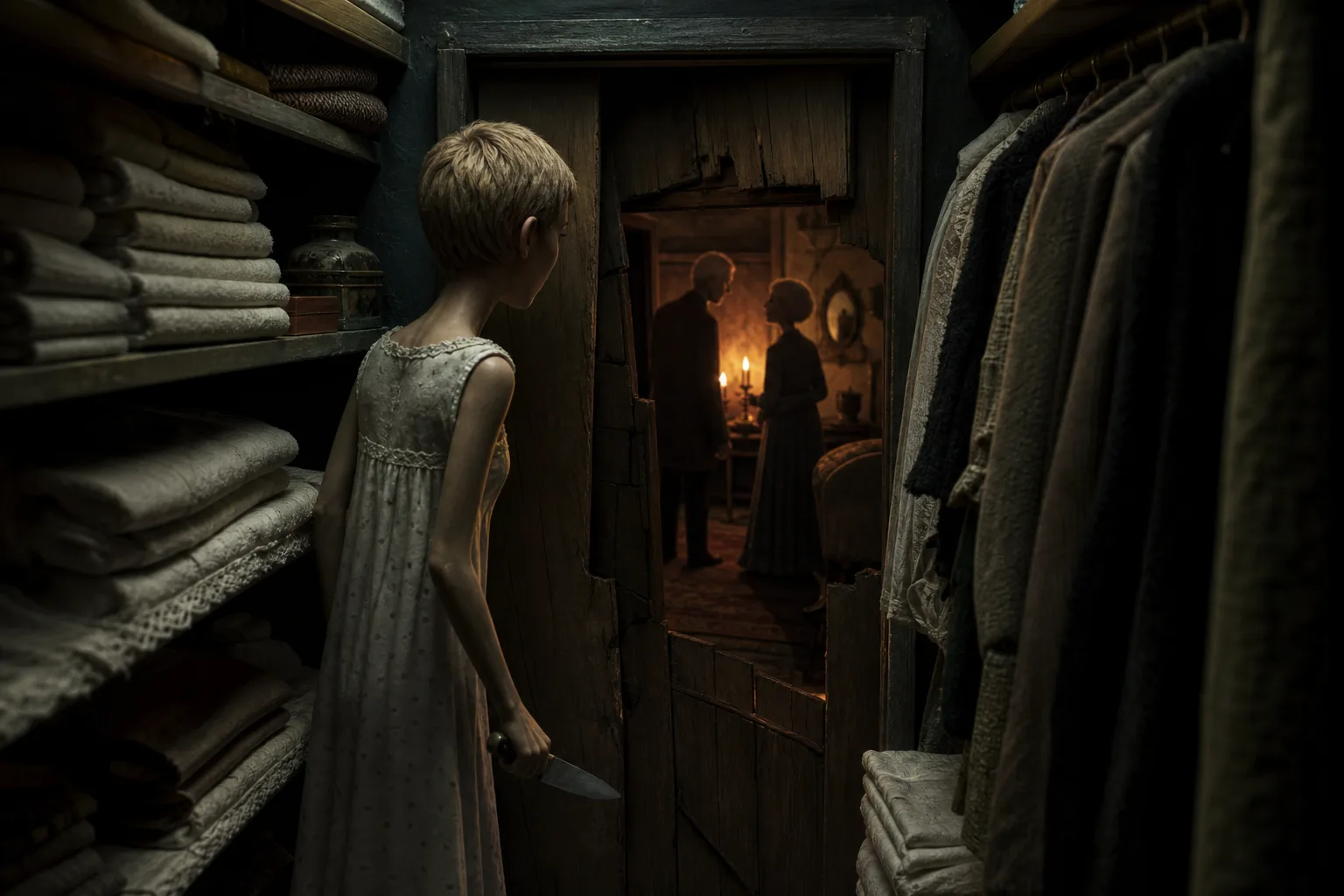
Original Anonymous369 Media generated section image for the Bramford pass-through closet.
The Shared Pass-Through of the Castevet Vault
The true nature of the closet is exposed only after the Woodhouses move in, clear away Gardenia's relics, and return the mahogany chest to its "proper" decorative place. With the barrier removed, the closet is revealed to be a deep, double-sided linen press built into the original framework of the undivided pre-war suite. The back wall of this closet is not made of solid stone or structural brick; it is a lightweight, removable partition that connects directly into the back of an identical closet within Apartment 7B. It is a pass-through--a physical bridge disguised as a storage space, allowing anyone in the Castevet household to step silently through the coats and linens directly into the heart of Rosemary's home.
This architectural loophole strips the Woodhouses of all domestic autonomy. Throughout Rosemary's pregnancy, the pass-through transforms her home into an open-air stage for the coven. It explains the ease with which Minnie Castevet enters the kitchen unannounced, the absolute surveillance maintained over Rosemary's daily routine, and the untraceable movement of late-night visitors. The heavy footsteps, the low, rhythmic chanting heard through the walls, and the sudden, vivid "dreams" of sea voyages and demonic visitations are not manifestations of a haunting; they are the physical realities of a shared floor plan. When Rosemary is drugged, the coven does not need to pick a lock or break a window. They simply push aside the clothes in the back of the linen closet, step through the threshold that Mrs. Gardenia died trying to block, and claim the space as their own.
The Quiet Architecture of Complete Capture
Ultimately, the horror of the Bramford is found in its polite, civilized permanence. The building does not shift its shape like a supernatural labyrinth; it remains exactly as it was drawn by its nineteenth-century architects. It uses the mundane reality of New York City real estate--the desire for a good lease, the admiration for old-world aesthetics, the physical density of urban living--to camouflage an ancient, predatory apparatus. The spatial trap works because the victim welcomes it, willingly moving the heavy mahogany chests back to the walls, opening the closets, and clearing the paths for their own violation.
When Rosemary finally discovers the truth, she flees her home only to find that the external world--the medical offices, the phone booths, the friendships--has already been compromised by the social weight of the Bramford's elite tenantry. Driven back into the apartment by sheer exhaustion, she seeks refuge behind her own locked front door. But a lock on a front door is useless when the architecture itself has bypassed the threshold. As she stands in the center of her apartment, she hears the low murmur of voices coming from the hallway, not from the outside corridor, but from within the deep recesses of the linen closet. The moving of the chest did not just unlock a hidden passage; it demonstrated that inside the Bramford, privacy is an illusion maintained only until the lease is signed.
Read Rosemary's Baby Files in Order
This is File 1 of 5 in the Rosemary's Baby Complete Movie Lore path. The sequence begins with the Bramford's hidden apartment machinery, then moves through Guy Woodhouse's career bargain, Dr. Sapirstein's medical capture, Roman Castevet's inherited coven system, and Rosemary Woodhouse's final choice at the black bassinet.
- Current file: The Moving Chest Unlocks the Hidden Passages of The Bramford
- Stealing the Spotlight Blinds the Rival of Guy Woodhouse
- The Silver Charm Ball Inverts the Prenatal Care of Dr. Sapirstein
- Decoding the Anagram Unmasks the Bloodline of Roman Castevet
- The Black Bassinet Forces the Final Choice of Rosemary Woodhouse
Next, the series leaves the blocked closet and follows the desperate vanity required to sign the Bramford's lease, where Guy Woodhouse turns marriage into the performance transaction that lets the machine keep moving.