
Stealing the Spotlight Blinds the Rival of Guy Woodhouse
Guy Woodhouse did not just stumble into an occult conspiracy. He auditioned for it, trading Rosemary's autonomy and Donald Baumgart's eyesight for a Broadway spotlight.


Rosemary's Baby Complete Movie Lore: File 2 of 5. After the Bramford's hidden apartment machinery has been opened, the series moves into the human transaction that let the building's design become Rosemary Woodhouse's prison: Guy Woodhouse's career bargain, Donald Baumgart's sudden blindness, and the domestic performance that turned marriage into a stage-managed trap.
An actor's fundamental currency is the suspension of disbelief. To succeed, they must look into a camera or across a stage and perform an intimacy they do not feel, projecting an illusion of truth that masks a cold, calculated methodology. For Guy Woodhouse, this professional conditioning did not stop when the director called a wrap. The apartment he shared with Rosemary at the Bramford was not a sanctuary; it was a theater. And the marriage within it was merely a long-running production that Guy was entirely willing to cancel the moment a more lucrative contract presented itself.
The Purgatory of the Yamaha Commercial
Before his entry into the Castevet coven, Guy Woodhouse is defined by his agonizing mediocrity. He is an actor who is known, but never revered. His face is recognizable to the public not because of profound dramatic achievements, but because he plays the mundane, smiling consumer in television advertisements for Yamaha motorcycles and household products. For a man infected with intense artistic vanity, this existence is a slow, daily humiliation. He views himself as a serious dramatic force trapped in the body of a commercial pitchman, forced to watch from the sidelines while peers with genuine artistic gravitas secure the defining roles of the generation.
This deep-seated professional resentment is the precise wound that Roman Castevet identifies and exploits. Roman does not approach Guy with ancient incantations or threats of violence; he approaches him as a veteran patron of the arts who recognizes an underappreciated talent. When Guy steps across the threshold of Apartment 7B to dine alone with Roman, leaving Rosemary behind, he enters an audition. Behind those closed doors, surrounded by the heavy Victorian drapes and hidden ancestral portraits of the Bramford, Guy confesses his desperation. He lays bare his willingness to do anything to escape the purgatory of commercial acting, establishing a transactional value system where human relationships are entirely secondary to a billing above the title.
The Calculated Affliction of Donald Baumgart
The true nature of Guy's pact with the coven manifests not in a sudden influx of wealth, but in the tactical destruction of his competition. The role of a lifetime--the lead in the Broadway play Luther--is awarded to Donald Baumgart, an actor whose talent and reputation consistently eclipse Guy's. Baumgart represents everything Guy lacks: critical respect, momentum, and an innate artistic authority. Under normal circumstances, Guy would remain an understudy, relegated to watching another man receive the applause that he believes rightfully belongs to him.
[THE TRANSACTIONAL TIMELINE]
Guy dines alone with Roman -> Baumgart suffers sudden blindness -> Guy inherits the lead in "Luther"
The shift occurs with terrifying efficiency. Shortly after Guy's late-night summits with Roman, Baumgart is struck down by an anomalous medical catastrophe. Overnight, without any prior trauma or genetic predisposition, the young actor goes completely blind. The suddenness of the affliction baffles the medical community, but within the walls of the Bramford, it is understood as a clean, surgical removal. Guy does not mourn his colleague; he reacts with the practiced, somber gravity of a man who has already rehearsed his public statement. The blindness of Donald Baumgart is the opening act of Guy's new career--a literal darkening of a rival's vision so that Guy may finally step into the illumination of the spotlight.
The Token of the Exchanged Silver Ball
The mechanism of this curse leaves behind a physical artifact that exposes Guy's direct complicity. When Rosemary, driven by an instinctual empathy that her husband lacks, contacts the blind Baumgart, she uncovers a detail that the coven failed to fully scrub away. Baumgart reveals that shortly before losing his sight, he met with Guy. During their interaction, a strange, seemingly accidental exchange occurred involving a small silver charm ball--the very same token associated with the pungent, earthy scent of tannis root that the Castevets distribute.
This exchange was not a coincidence; it was a physical handoff. Guy acted as the vector for the coven's malice, delivering the talisman that would strip Baumgart of his sight. By carrying this object to his rival, Guy actively participated in the poisoning of another man's life to steal his livelihood. The phone call between Rosemary and Baumgart highlights the stark contrast between the two actors: Baumgart is confused, broken, and searching for human connection, while Guy is increasingly distant, hyper-focused on his rehearsals, and entirely unbothered by the human wreckage left in his wake. Guy took Baumgart's eyes so that he could use them to read his own rave reviews.
The Domestic Theater of the Drugged Mousse
With his professional ascension secured, Guy's performance shifts from the stage to the bedroom. He is tasked by the coven with a specific biological delivery: he must ensure that Rosemary is physically prepared and sedated for the night of the ritualistic conception. The primary mechanism for this compliance is a dinner prepared by Minnie Castevet--a rich "mousse au chocolat" heavily laced with a powdery sedative that leaves a distinct, bitter, metallic aftertaste.
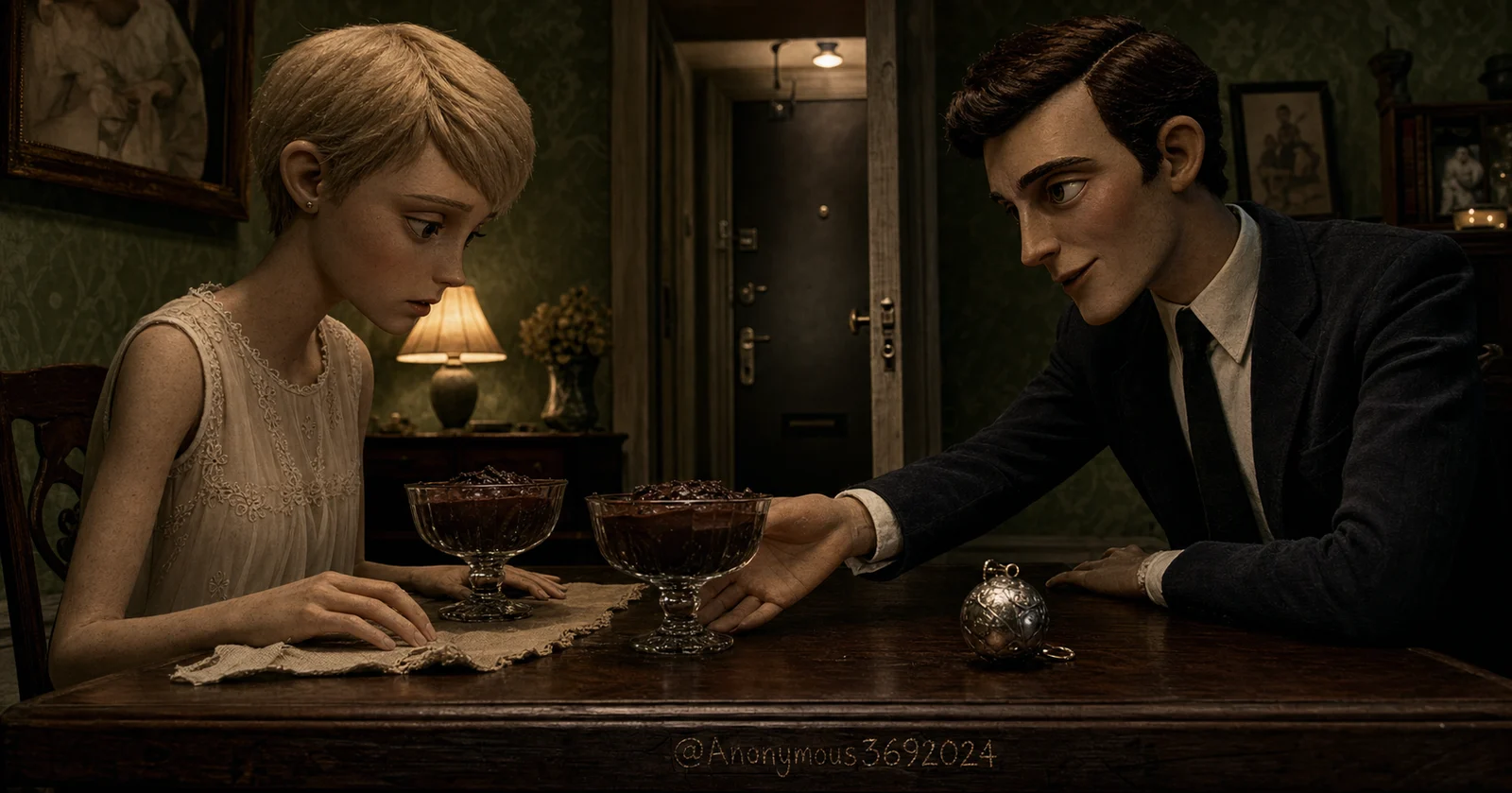
Original Anonymous369 Media generated section image for the drugged mousse scene.
ROSEMARY:
"It has a chalky taste. Kind of under-sweet or metallic."

GUY (Defensive, performing):
"Minnie went to a lot of trouble, Ro. Don't be rude. Eat it. It's just the rum or the cooking chocolate."
When Rosemary tastes the dessert and immediately recognizes its unnatural flavor, Guy's reaction is not one of marital concern, but of defensive anger. He bullies her, using guilt and accusations of social rudeness to force her to consume the drug. He watches her eat the poison with the cold detachment of a handler supervising a test subject. When the sedative takes hold and Rosemary slips into a state of semi-conscious paralysis, Guy does not protect her. He actively assists in stripping away her clothes, turning her body over to the archaic entities of the Bramford while he sits in the dark, waiting for his payment to clear. The scratches left on her skin the next morning are dismissed by Guy as a consequence of his own rough, drunken passion--a lie delivered with such fluid, casual ease that it confirms his complete transition from a failing actor into a sociopathic performer.
The Ultimate Capitulation of the Cast
The horror of Guy Woodhouse culminates in his total lack of grandeur. He is not a towering villain driven by cosmic ideology or dark philosophy; he is a small, vain man driven by a profound fear of insignificance. When Rosemary eventually unravels the conspiracy and confronts him with the truth, Guy does not deny his involvement with an air of demonic triumph. Instead, he whines. He defends his actions by pointing to his newfound success, his name in the papers, and the prestigious contracts that have flooded his agent's office.
He treats the systematic rape and psychological torture of his wife as an unfortunate but necessary production cost. In the final sequence inside the Castevet apartment, as the coven gathers around the black bassinet, Guy stands among them, subdued and pathetically eager to please. He has traded his firstborn child and the sanity of his wife for a permanent place on the Broadway stage. He remains an actor to the end--hollow, dependent on the approval of a monstrous audience, and fundamentally incapable of realizing that in the grand script of the Bramford, he was never the leading man; he was merely a useful piece of stage dressing.
Read Rosemary's Baby Files in Order
This is File 2 of 5 in the Rosemary's Baby Complete Movie Lore path. The sequence begins with the Bramford's hidden apartment machinery, then moves through Guy Woodhouse's career bargain, Dr. Sapirstein's medical capture, Roman Castevet's inherited coven system, and Rosemary Woodhouse's final choice at the black bassinet.
- The Moving Chest Unlocks the Hidden Passages of The Bramford
- Current file: Stealing the Spotlight Blinds the Rival of Guy Woodhouse
- The Silver Charm Ball Inverts the Prenatal Care of Dr. Sapirstein
- Decoding the Anagram Unmasks the Bloodline of Roman Castevet
- The Black Bassinet Forces the Final Choice of Rosemary Woodhouse
Previous file: return to the moving chest that unlocked the hidden passages of The Bramford, where the apartment's porous walls prepared the betrayal. Next, the series moves from Guy's calculated performance of marriage to the elite clinical net cast by the Sapirstein regimen.