
The Winter of the Babysitter: How the Oakland County Child Killer Haunted Michigan
Between 1976 and 1977, four children vanished from suburban Michigan and were later found in the snow. Nearly fifty years later, the Oakland County Child Killer remains unidentified, surrounded by fractured evidence, disputed suspects, and families still demanding answers.


In the mid-1970s, the suburbs north of Detroit still carried a fragile promise.
Children walked to hobby shops. They rode bicycles along neighborhood streets. They were sent to nearby stores with coins in their pockets and the ordinary confidence of a world that believed danger lived somewhere else. Along the Woodward Corridor, in communities like Ferndale, Royal Oak, Berkley, and Birmingham, childhood still had distance. A child could leave a house, cross a few blocks, and be expected back before dinner or after the streetlights came on.
Then winter began taking children.
Between February 1976 and March 1977, four children disappeared from Oakland County, Michigan. Mark Stebbins was twelve. Jill Robinson was twelve. Kristine Mihelich was ten. Timothy King was eleven. Each vanished from ordinary movement: walking home, riding away after an argument, going to a convenience store, buying candy at a pharmacy.
They were not found immediately.
That was the detail that froze the suburbs.
The children had been held alive. Some had been fed. Some had been washed or cleaned. Their bodies were later placed near roads, snowbanks, parking lots, and ditches where they would be discovered. The unknown offender came to be known as the Oakland County Child Killer, and in public memory, by an even colder name: the Babysitter.
The name suggested a horror that was almost impossible for parents to process. The killer was not simply snatching children and killing them in panic. The evidence suggested control, time, shelter, access, and a form of care twisted into domination. The children were kept somewhere while police searched, while families prayed, while the entire Detroit region watched the news and wondered whose child might vanish next.
Nearly fifty years later, no one has been charged with the four confirmed murders. The case remains open. Modern investigators continue to review tips and evidence, but the record is scarred by old forensic limits, conflicting police theories, disputed suspects, legal battles, and the shadow of a separate child exploitation network that has never been legally proven to be connected to the killings.
The Oakland County Child Killer case is not only a story about an unidentified predator.
It is a story about what happens when a community loses its simplest belief: that a child can go to the store and come home.

The Four Children In The Snow
The first confirmed victim was Mark Douglas Stebbins.
On February 15, 1976, Mark spoke with his mother by phone and said he was leaving the American Legion Hall in Ferndale to head home. He never arrived. Four days later, on February 19, his body was found near an office complex in Southfield. According to later reporting, his cause of death was listed as asphyxia by smothering. Investigators also documented rope or ligature marks and evidence that he had been sexually assaulted.
That was the first rupture.
For months, the horror did not repeat in a way the public could see. Then, just before Christmas, twelve-year-old Jill Robinson left her Royal Oak home after an argument with her mother. She rode away on her bicycle on December 22, 1976. Witness accounts later placed her near a hobby shop and other local businesses along Woodward Avenue.
On December 26, Jill's body was found along Interstate 75 in Troy. She was fully clothed. Police reported no evidence of sexual assault. Unlike the other confirmed victims, Jill had been killed with a shotgun.
Her death complicated the pattern before the pattern was fully understood.
Then came Kristine Marie Mihelich.
Kristine, ten, was last seen on January 2, 1977, after heading toward a nearby 7-Eleven in Berkley. She was missing for nineteen days. On January 21, a mail carrier found her body in a snowbank in Franklin Village.
Public accounts describe Kristine as fully clothed and not sexually assaulted. Her cause of death was listed as suffocation. The length of her disappearance became one of the case's most agonizing details. Investigators believed she had been held alive for part of the time the region searched for her.
The fourth confirmed victim was Timothy John King.
On March 16, 1977, Tim left his Birmingham home to buy candy at Hunter-Maple Pharmacy. He had made the short trip before. This time, he did not return. His disappearance triggered a massive search across Metro Detroit, with police stopping cars and families scanning the streets in dread.
On March 23, Tim's body was found in a ditch in Livonia, across the county line in Wayne County. His cause of death was suffocation. Investigators also found evidence that he had been sexually assaulted.
The confirmed case would end there.
The fear did not.

The Captivity Pattern
The most frightening element in the Oakland County Child Killer case was not only that the children were abducted.
It was that they were kept.
Investigators came to believe the killer had access to a private indoor location where children could be held for days without obvious detection. The four victims had been missing for different periods of time, from several days to nearly three weeks. Their bodies showed signs, in varying ways, of being fed, cleaned, or cared for before death.
That did not make the crimes less violent.
It made them more controlled.
The offender seemed to understand that the entire area was searching. He seemed willing to wait. He seemed able to move through the region, place bodies in public or semi-public locations, and avoid immediate detection. Each body was found in a location where discovery was likely. The placements read less like hurried concealment than managed exposure.
Then there was the detail that still haunts the King family.
After Tim disappeared, his father, Barry King, appeared on television and pleaded for his son to come home. In one of the most repeated accounts of the case, Barry mentioned that Tim loved Kentucky Fried Chicken. When Tim's body was later examined, investigators found that he had eaten chicken shortly before his death.
That detail is often described as the killer responding to Barry King's plea.
The safer wording is that the timing created a devastating inference. The available record does not prove exactly why Tim was fed that meal. But for the family, and for the public, it felt like the offender had listened, absorbed a father's hope, and turned it into another form of cruelty.
The victims were also linked by trace evidence. Reporting over the years has described white animal hairs, often identified in accounts as canine hairs, recovered from the victims' clothing. In 2011 reporting, those hairs were said to have come from the same dog. That evidence has long been treated as one of the case's most important physical links, though its modern value depends on what samples remain viable and how they were preserved.
The pattern was clear enough to terrorize a region.
It was not clean enough to name a killer.

The Task Force And The Blue Gremlin
After Kristine Mihelich's murder, law enforcement began moving toward a broader coordinated response. By the time Timothy King vanished, the investigation had become one of the largest of its kind in United States history at the time. Michigan State Police and local agencies formed a large task force, and more than 11,000 tips poured in.
The public was desperate to help.
That did not mean the information was easy to use.
Investigators worked in an era before modern databases, cell-phone records, license-plate networks, and rapid DNA analysis. Tips came by phone, mail, interviews, memory, and rumor. The region was crowded with fear, and fear is not always a clean witness.
One lead came to dominate the public imagination: a blue AMC Gremlin with a white stripe.
Witnesses reported seeing Tim King near a vehicle resembling a blue Gremlin in the pharmacy parking lot around the time he vanished. The lead sent investigators into a massive effort to identify and interview owners of similar vehicles.
For decades, the blue Gremlin became almost inseparable from the case.
But even that lead is not beyond dispute. In later years, some family members and investigators questioned whether the Gremlin focus may have been overstated or misleading. The vehicle remains part of the case history, but not a solved clue.
The task force also encountered stranger material. In 1977, psychiatrist Dr. Bruce Danto received a long, error-filled letter from someone calling himself "Allen." The writer claimed to know the killer, whom he called "Frank," and described himself as living under that man's control. The letter folded together Vietnam trauma, class resentment, captivity claims, and a promise of photographic proof if immunity could be arranged.
A meeting was arranged.
"Allen" never appeared.
The letter became part of the case's vast mythology: possibly a real lead, possibly a hoax, possibly the voice of someone frightened and unstable, possibly a person trying to manipulate investigators. The record does not allow it to be treated as a confession or a solution.
It is evidence of something else: the investigation had become a magnet for terror, fantasy, opportunism, and fragments that did not fit.
North Fox Island And The Theory Of A Network
The Oakland County Child Killer investigation eventually intersected with one of Michigan's darkest separate scandals.
In 1976, authorities uncovered a child sexual abuse and child exploitation operation tied to North Fox Island, a remote island in Lake Michigan. The island had been purchased by Francis "Frank" Shelden, a wealthy businessman. Under the front of Brother Paul's Children's Mission, boys were flown to the island, where they were exploited and photographed. Gerald Richards, a former teacher connected to the operation, was prosecuted. Shelden fled and died years later without facing trial in the case.
The North Fox Island material must be handled with precision.
The abuse ring was real.
Its connection to the Oakland County Child Killer murders remains unproven.
Some investigators, journalists, family members, and independent researchers have argued that the overlap in time, geography, suspect networks, and victimology cannot be ignored. They have questioned whether the killings were the work of one offender acting alone, or whether the children were connected to a wider network of men who exploited minors in Michigan during the same era.
Other investigators have cautioned that overlap is not proof.
ClickOnDetroit's summary of the case notes that investigators do not believe Shelden or Richards was the Oakland County Child Killer, though one theory holds that the killer could have been someone victimized by or connected to the island network. Former investigators have also acknowledged that police explored pornography-ring and abuse-network angles, including whether the victims were photographed or filmed. Those questions remain unresolved.
The North Fox Island theory has power because it explains something the lone-offender model struggles with: access, silence, privilege, and the possibility that more than one man knew more than he ever told.
But a theory can be emotionally persuasive and still not be legally proven.
That distinction matters for every name in this case.
Christopher Busch And The Suspicion That Would Not Die
The most persistent suspect in public discussion is Christopher Brian Busch.
Busch was the son of a high-ranking General Motors executive. He was also a convicted child sex offender. In 1977, another offender, Gregory Greene, reportedly told investigators that Busch had killed Mark Stebbins. Busch was investigated, but he passed a polygraph and was not charged in the murders.
He remained free when Timothy King was abducted.
That fact has haunted the victims' families.
In November 1978, Busch was found dead from a gunshot wound. The death was officially ruled a suicide, though family members, researchers, and some police sources have questioned aspects of the scene. Photos later released or described in reporting showed items that deepened suspicion, including ropes or ligatures and a drawing that some believe resembled a tortured child or Mark Stebbins. Some accounts described the ligatures as bloodstained; prosecutors later disputed that characterization and said there was no blood on the ropes.
That conflict is essential.
There are two records running beside each other: the record of suspicion and the record of proof.
Families and some researchers believe Busch remains one of the strongest leads. In 2012, however, prosecutors said DNA did not match Busch and stated publicly that there was no piece of evidence proving he killed Mark, Jill, Kristine, or Timothy. A&E's 2026 overview similarly notes that authorities later cleared him as a suspect, while also reporting that some journalists and family members continue to believe the investigation protected or mishandled him.
The safest conclusion is not that Busch was the killer.
It is that Busch became the center of the case's deepest unresolved suspicion because his history, timing, privilege, and the disputed scene around his death left families with questions the official record never answered to their satisfaction.
Hair Evidence, Sloan, And The Unnamed Man
Another major lead is tied to Archibald Edward Sloan.
Sloan, a convicted child molester serving life sentences for unrelated crimes, became important because of hair evidence associated with his 1966 Pontiac Bonneville. Reporting from ClickOnDetroit says investigators found a hair in Sloan's car that was a DNA match to evidence found at two Oakland County Child Killer crime scenes: Mark Stebbins and Timothy King.
The hair was not Sloan's.
That is the critical point.
Investigators have believed it belonged to someone Sloan knew, or someone who had access to the car. Sloan has not provided the answer investigators want. If the unknown donor of that hair can be identified, it may represent one of the strongest remaining physical pathways into the case.
There is also the James Vincent Gunnels lead. Gunnels was linked by mitochondrial DNA to a hair found on Kristine Mihelich. A mitochondrial match can include the tested person or a male relative on the maternal line, and it does not carry the same individualizing force as a full nuclear DNA match. Gunnels denied involvement in the murders.
This is where the case becomes both hopeful and maddening.
There are biological clues.
They are not simple enough to solve the case by themselves.
Modern DNA, genealogical methods, and improved forensic comparison may still help. But 2026 reporting from Local 4 also makes clear that much of the evidence is old, degraded, used up, or limited by the way it was collected and tested over decades.
Technology can reopen a door.
It cannot replace what the original investigation failed to preserve.

Families Against The Wall
The Oakland County Child Killer case has never belonged only to police.
It has belonged, painfully and persistently, to the families.
Barry King, Timothy King's father, spent decades pushing for transparency. He filed lawsuits and Freedom of Information Act battles seeking access to records, especially around Christopher Busch. His family obtained thousands of pages of documents, but the process only deepened their belief that crucial information had been withheld, mishandled, or minimized.
Barry died in 2020 without the answer he had fought for.
His daughter, Cathy Broad, has continued that advocacy. In 2026, she told Local 4 that she wants the case treated as a dedicated cold case, with evidence retested, files digitized, and obstruction questions evaluated openly.
Kristine Mihelich's mother, Deborah Jarvis, also took legal action. In 2012, she filed a federal lawsuit seeking $100 million in damages and alleging that officials had withheld information and mishandled the investigation. The case was dismissed in 2013, with courts accepting immunity arguments and finding the lawsuit could not proceed as filed.
That legal outcome matters.
No official was found legally liable for a cover-up in that suit.
But the dismissal did not erase the families' anger. It did not answer the core question. It did not identify the killer. It did not restore trust.
Sheriff Michael Bouchard has publicly rejected the idea that he saw evidence of a law-enforcement cover-up, while also saying the case can still be solved if new technology or someone with real information supplies the missing piece. Michigan State Police have said the investigation remains open and that new tips are investigated.
The families are left in the space between those statements.
They hear that the case is active.
They live with the fact that it is still unsolved.
What The Snow Kept
The Oakland County Child Killer case is now a race against time.
Original investigators have died. Witnesses have aged. Suspects have died. Memories have changed. Evidence has been consumed, degraded, disputed, or preserved under the limits of older forensic practice. The children at the center of the case would now be older adults, their lives stolen so long ago that the suburbs that lost them have been rebuilt, repaved, renamed, and sold to new families who may not know what happened on those winter roads.
But the case has not disappeared.
It survives because four children were taken from ordinary days and returned to the world in snow. It survives because their families refused to let official silence become the final word. It survives because every generation that learns the case has to confront the same terrible contradiction: the killer may have been a lone predator, or the visible edge of a wider abusive network, but either way, the children were failed by more than one moment.
Mark Stebbins.
Jill Robinson.
Kristine Mihelich.
Timothy King.
Their names are the only fixed points in a case crowded by theories, suspects, task forces, rumors, documents, lawsuits, and dead ends. The killer's name remains unknown. The Babysitter remains a title without a face.
Somewhere in the old files, in the hair evidence, in the vehicle leads, in the men who knew one another, in the memories that have not yet been spoken aloud, there may still be a door.
For nearly fifty years, it has stayed closed.
The snow kept the shape of the crime.
It did not keep the truth.
Archival Case Gallery
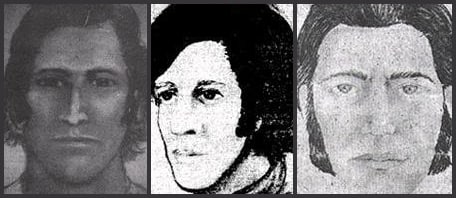
Archival case gallery: composite-sketch imagery connected to the Oakland County Child Killer investigation, reproduced from a Wikimedia Commons public-domain-marked file as non-graphic case context.

Archival case gallery: a blue 1974 AMC Gremlin X photographed by Christopher Ziemnowicz and licensed CC BY-SA 4.0. Included only as representative vehicle context for the disputed blue Gremlin lead; it is not the case vehicle.
Sources & Case Notes
Last updated: May 24, 2026.
Primary sources: This article was checked against ClickOnDetroit/WDIV's 2023 case timeline and evidence summary, Local 4's 2026 anniversary reporting, A&E Crime + Investigation's 2026 overview, WXYZ reporting on the Busch and obstruction disputes, the federal dismissal record in Jarvis v. Cooper, and public North Fox Island reporting from News From The States. Suspects, North Fox Island connections, abuse-network theories, and cover-up allegations are presented as disputed leads or allegations, not proven legal conclusions.
Correction policy: Corrections, source documentation, and image-rights concerns can be directed to Anonymous369 Media's contact and media inquiries page.
Image credits: Feature and section images are Anonymous369 Media documentary recreations based on winter Michigan roads, Woodward Corridor storefront context, the Timothy King fried-chicken detail, the disputed blue Gremlin lead, and non-graphic file/evidence imagery. They are not archival photographs, official evidence images, depictions of victims, or depictions of an identified offender. The Archival Case Gallery uses a Wikimedia Commons public-domain-marked composite-sketch image and a Creative Commons Attribution-ShareAlike 4.0 photograph of a blue 1974 AMC Gremlin by Christopher Ziemnowicz as representative vehicle context; the Gremlin photograph is not the case vehicle.
Content warning: This article discusses child abduction, child murder, sexual abuse in non-graphic terms, child exploitation networks, and allegations of institutional mishandling.