
The Sealed Valve: Three Blows That Stopped More Than a Whistle
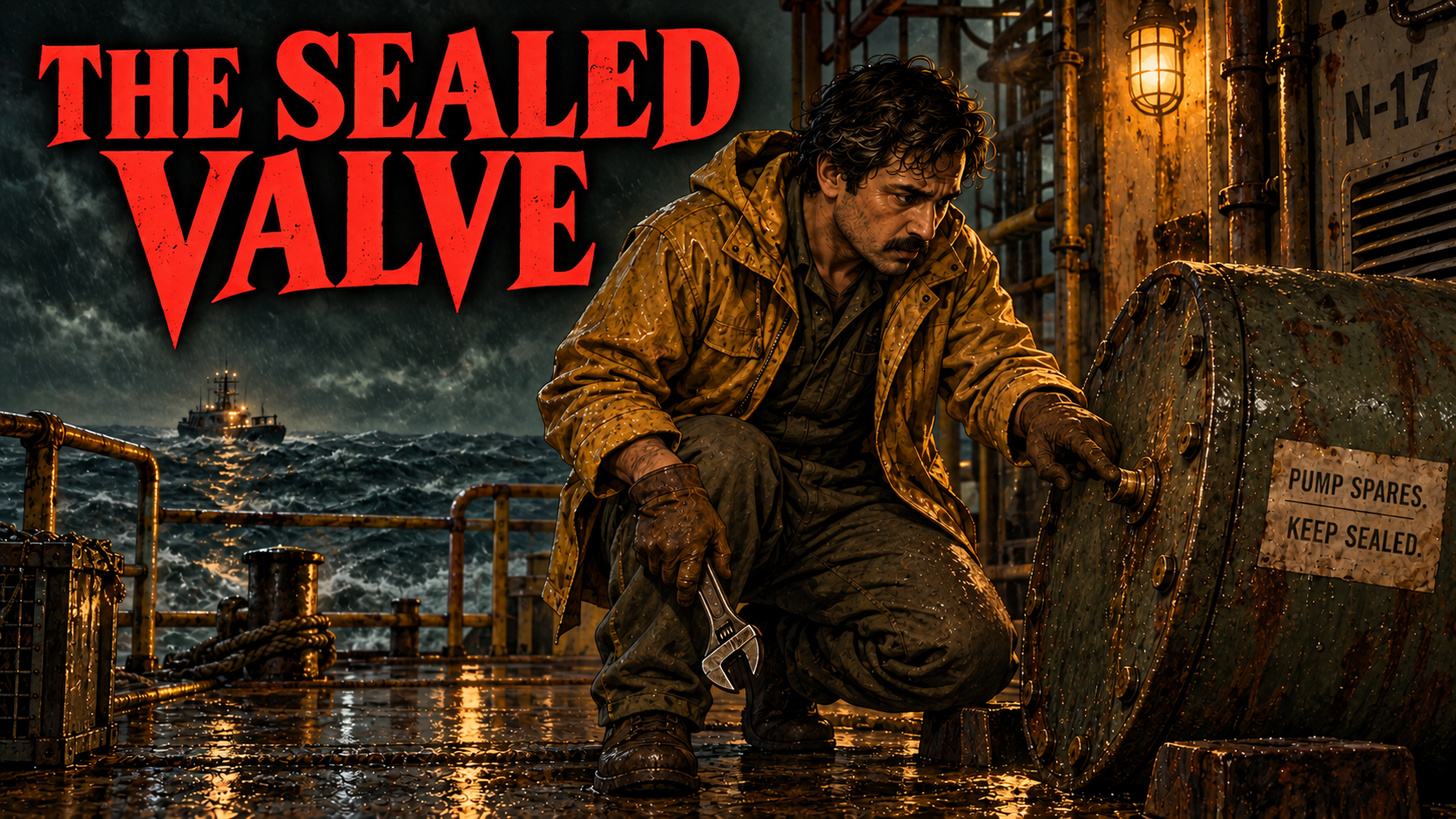
The label said PUMP SPARES. KEEP SEALED. Rafiq Ansari closed the damaged valve to keep seawater out. Eleven days later, he learned what he had silenced.


An original horror story by Anonymous369 Media.
The cable snapped while the last drum was still above the deck.
Rafiq Ansari saw the hook jerk sideways and shouted for the men to get clear. The drum struck the steel on its lower rim. Rust fell from the walkway overhead. It tipped onto its side, rocked once, then rolled toward the rail.
He drove his boot against the rim and held it against a stanchion. The post shuddered beneath his hand. Beyond the rail, the supply boat dropped into a trough, taking its deck and the men on it out of sight.
When it rose again, the skipper was already signaling to leave.
They had waited four days for the delivery. It was November 1974, and drilling on the small North Sea platform had stopped for the winter. Five men remained to keep the machinery running. Behind the unloading area, the generators roared through the ventilation grilles. The boat's engine added to the noise, and the wind tore words away as soon as the men shouted them. To make himself understood, the man beside Rafiq had to bring his mouth close to Rafiq's ear.
Keeping the vessel alongside any longer would put its crew at risk.
He waved the skipper away. The boat's engine faded as it pulled clear. The wind and the generators stayed with them.
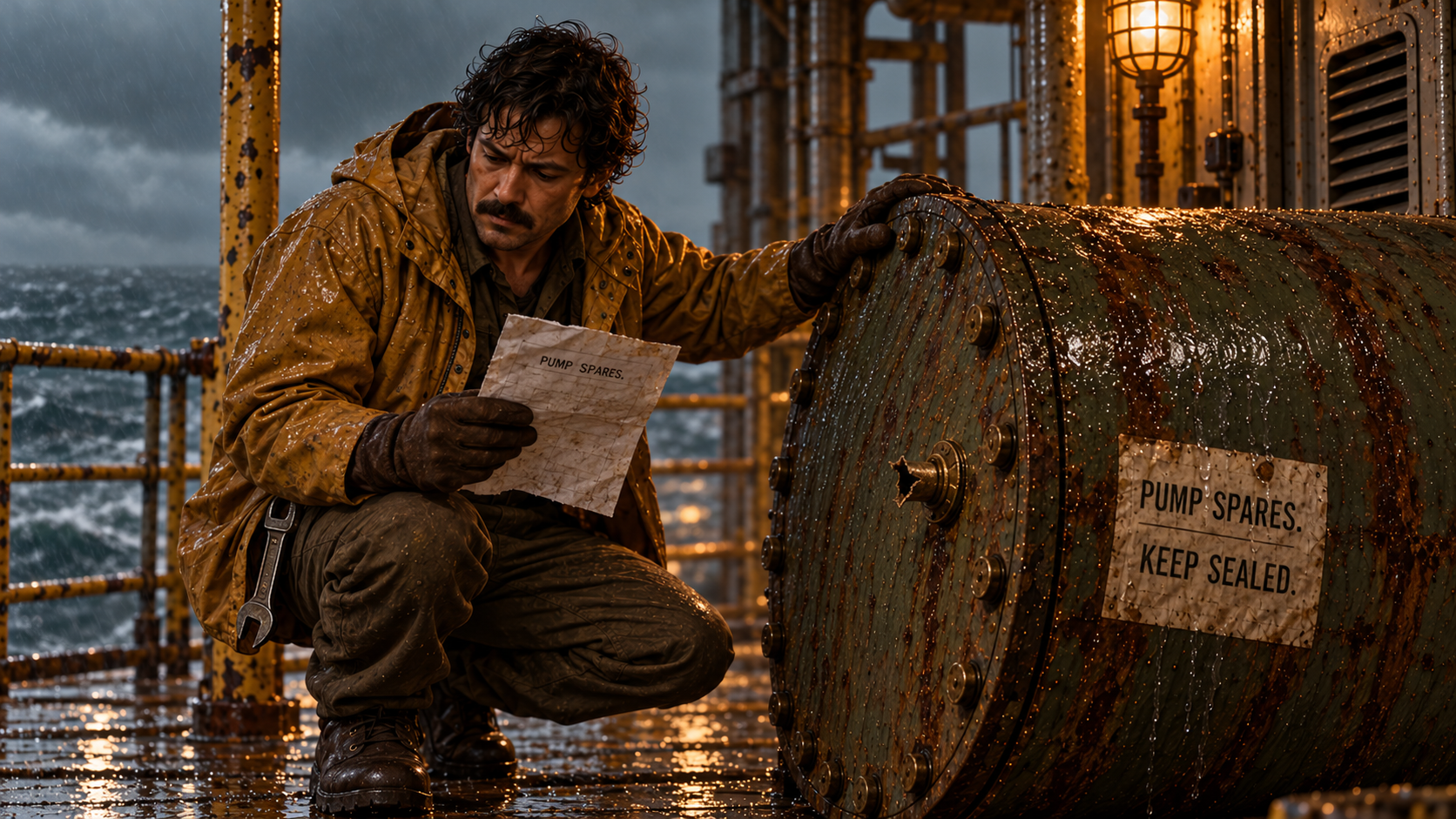
PUMP SPARES. KEEP SEALED.
The other men followed the departing boat to the rail while Rafiq crouched beside the drum. It was wider than the rest of the shipment, with a lid held down by a ring of bolts. Water ran off the paper label.
PUMP SPARES. KEEP SEALED.
He checked the manifest inside his jacket. The description matched.
Near the lid, a brass valve had taken the impact. Its wheel was missing, and the short neck beneath it had split. Each gust drew a thin whistle across the exposed opening.
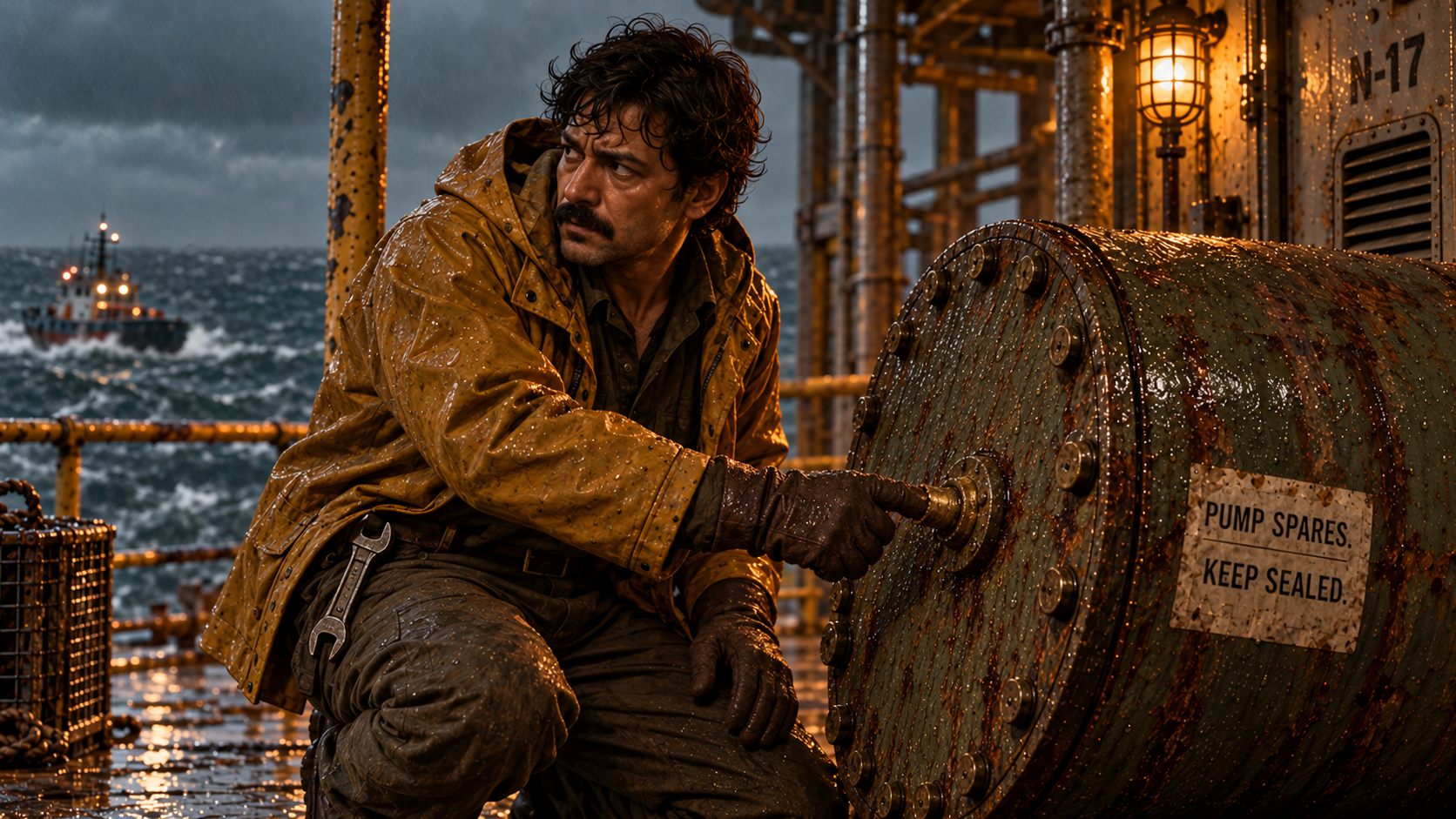
The Broken Brass Neck
Rafiq pressed a gloved finger over it. The whistle stopped. He lifted his finger and watched a bead of salt water slip into the split.
He pictured the parts inside: machined surfaces, bearings, everything that would have to be cleaned or replaced if seawater reached it. The valve was ruined. Whoever opened the shipment ashore would have to replace the fitting anyway.
He set his free hand against the drum to steady it and took the wrench from his belt.
The first blow bent the brass neck against the casing.
He changed the angle of the wrench. The second flattened the opening, but a narrow slit remained along one edge. He leaned closer, saw water collecting there, and struck a third time.
The slit closed.
He waited through another gust. No whistle.
Two of the men brought a cargo trolley. Together they levered the drum onto it. Its wheels hammered over the steel joints as they crossed the deck.
They wheeled it through the doorway and along the passage beside the generator room. Sheltered from the wind, Rafiq could hear the machinery more distinctly: the exhaust, the rattle of the engines, a loose panel shaking against its frame. The generator-room door stood open onto the passage. At the dry store, the trolley's wheels caught on the raised threshold.
“Mind your fingers,” Rafiq shouted to the man holding the other end.
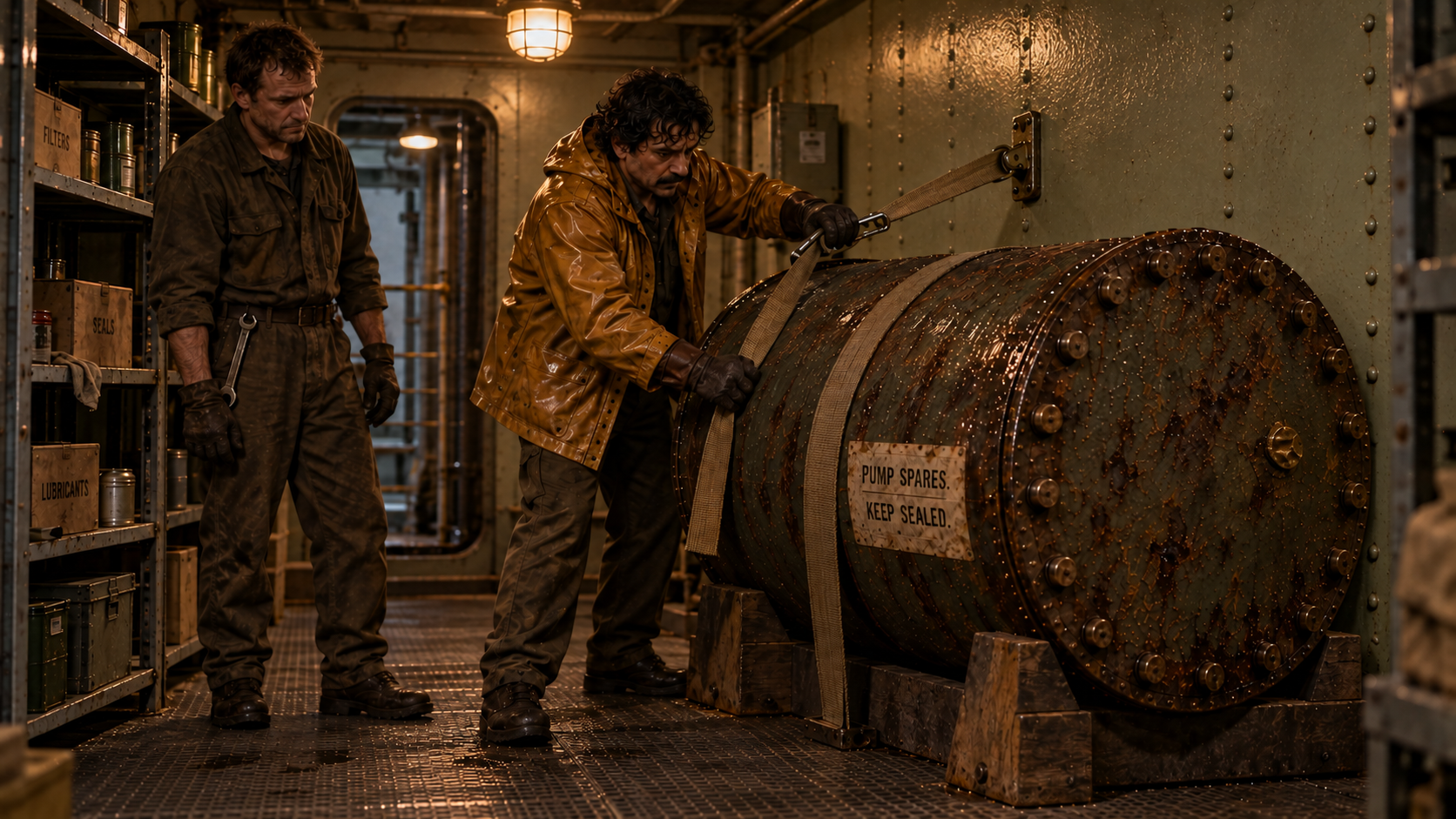
The Dry Store
They lifted it across, pushed it against the wall and secured it with a strap. The lid stayed bolted shut. With the shipment marked KEEP SEALED and the boat already gone, Rafiq saw no reason to open it there.
The man helping with the strap called something to him. Rafiq caught only the last word. He pointed to the buckle, waited for the man's nod, then pulled it tight. The engines were just beyond the store's wall.
He pulled the store door shut.
At the desk outside the store, he entered the damage in the cargo book.
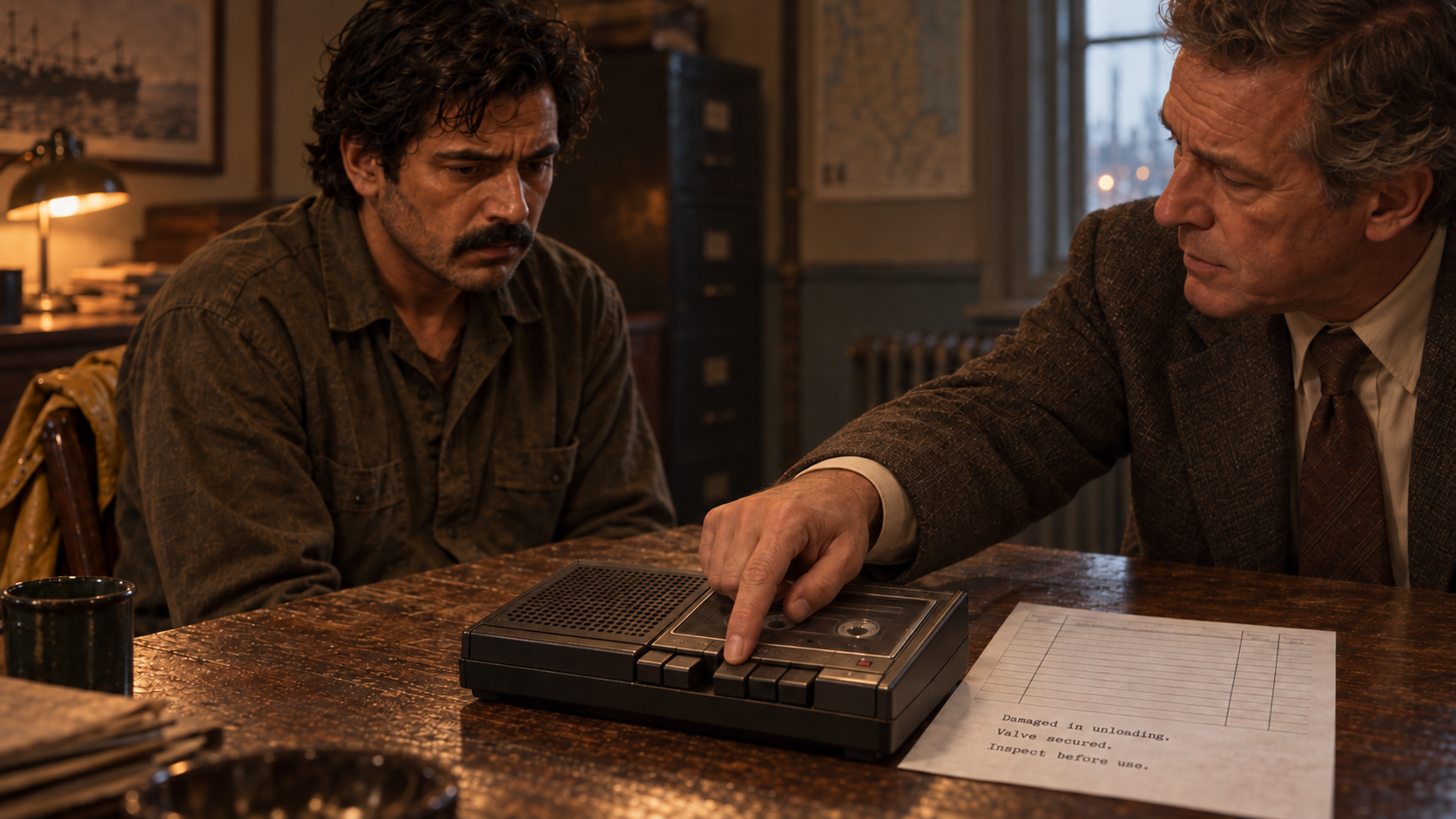
Damaged in unloading. Valve secured. Inspect before use.
He ruled a line beneath the entry. As he put the pen down, the light above the desk weakened. An alarm began sounding upstairs.
He laid the pen across the open book and went upstairs.
By morning, the sea was too rough for another boat. He reported the damaged shipment over the radio and was told to hold it for collection.
The drum remained strapped against the wall while the men changed watches, repaired the machinery and ate at the same small table. The generators ran through every meal and every attempt to sleep. Their vibration came up through the chair legs and trembled in the water at the bottom of a cup. After a while, Rafiq noticed it only when an engine faltered.
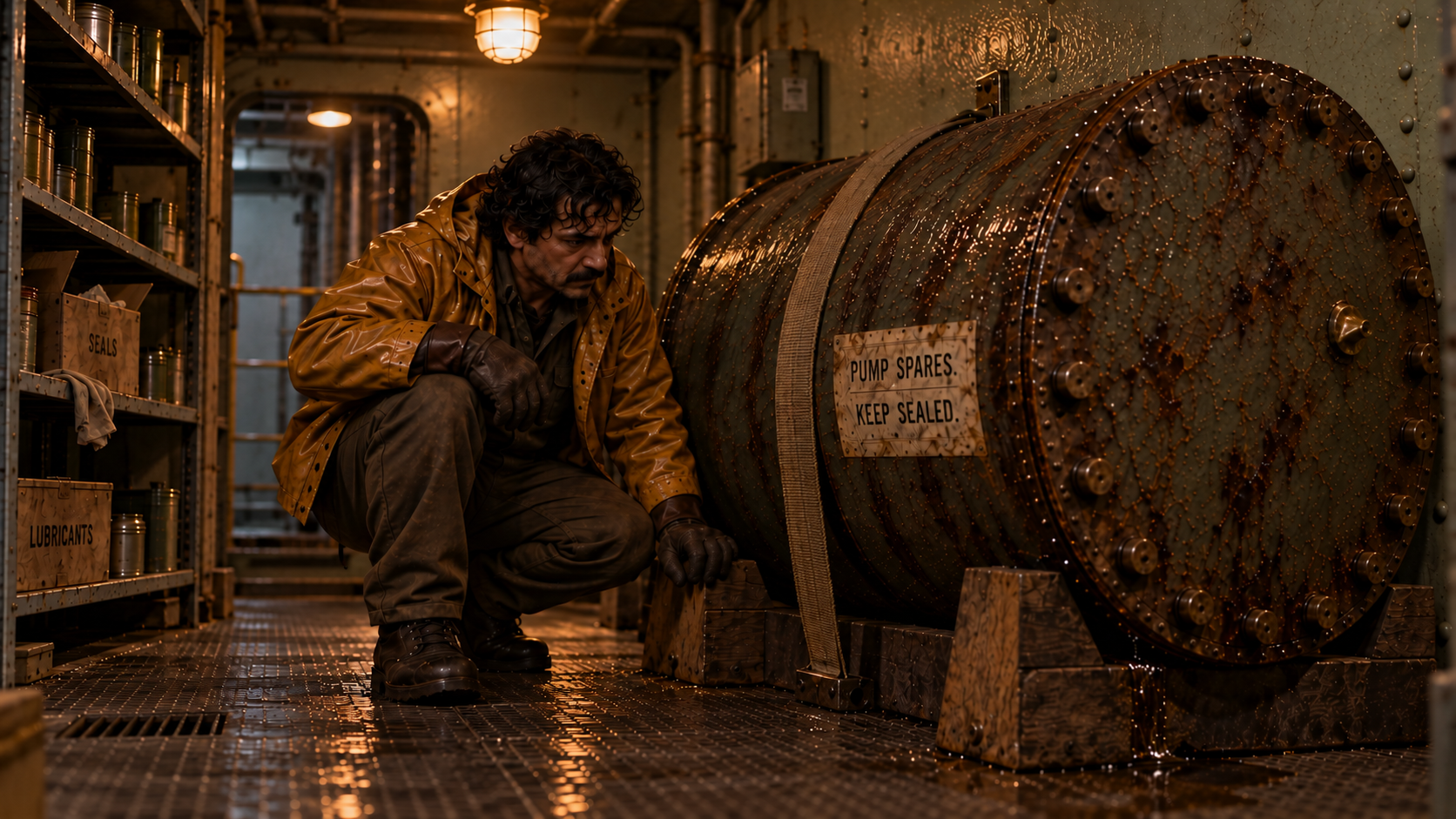
The Eleventh Day
On the eleventh day, he came down to check a fuel line and caught a smell beneath the familiar diesel.
He stopped outside the dry store.
The smell thickened when he opened the door. He lifted the lid of a provisions carton, then checked the drain beneath the shelves. Beside the drum, he crouched and found a dark wet seam under its lower rim.
He stayed there a moment, looking at it. Then he went to get another man.
They loosened the lid bolts with a socket wrench. Most turned after the first hard pull. One had bent in the fall. Rafiq braced his foot against the casing while the other man took hold of the wrench with him.
The bolt shifted with a short metallic crack.
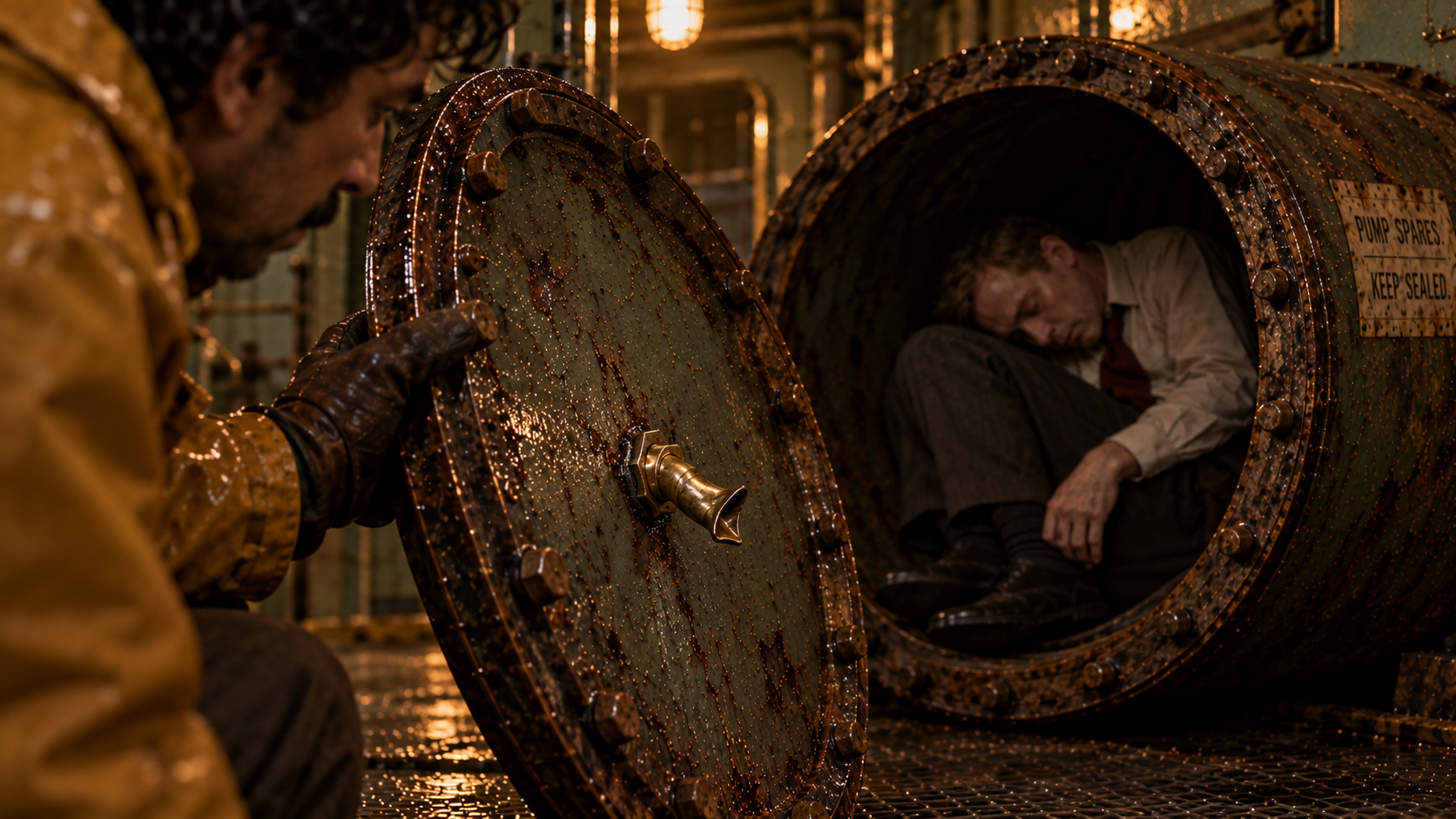
They worked the lid loose and raised one edge. The man beside Rafiq let go and backed into the shelving, his hand over his mouth.
Rafiq kept hold of the wrench.
A man's knees were drawn against his chest. His folded suit jacket lay beneath him, and his tie was still knotted at his throat. Two water bottles had rolled into the space between his feet. One hand rested near the lid; above it, pale scratches crossed the paint. Several fingernails had broken away.
There had been enough room to fold himself inside. Rafiq could see how little room there had been to move afterward.
Beside the man's other hand lay a small cassette recorder in a plastic sleeve.
Inside the Lid
Rafiq's eyes went to the brass fitting. From the inside, a short tube ran down toward the place where the man's face had been. At its far end, the neck was crushed flat against the casing.
He could still feel the wrench turning in his hand as he had adjusted it for the second blow.
He knew what he had closed.
They left the store and shut the door. Upstairs, Rafiq made the radio call himself. He gave the platform's position and said they had found a body. When he tried to describe the shipment, he could see the words on the wet label, but they would not come in the right order.
The police reached the platform when the weather broke. They took the recorder, the papers sealed inside the man's jacket and the cargo book from the desk.
Later, ashore, a detective told Rafiq what they had learned. The dead man was a company accountant. He had disappeared with copies of paper ledgers showing payments diverted into criminal accounts. Someone had searched his flat before he fled.
A crewman from the supply boat had admitted taking payment to hide him until the next port. The drum was supposed to stay aboard. Its false cargo label and manifest entry had concealed him too well: in the hurried unloading, it had been lifted with the platform's stores.
The crewman had watched it fall.
He had said nothing.
The Recorder
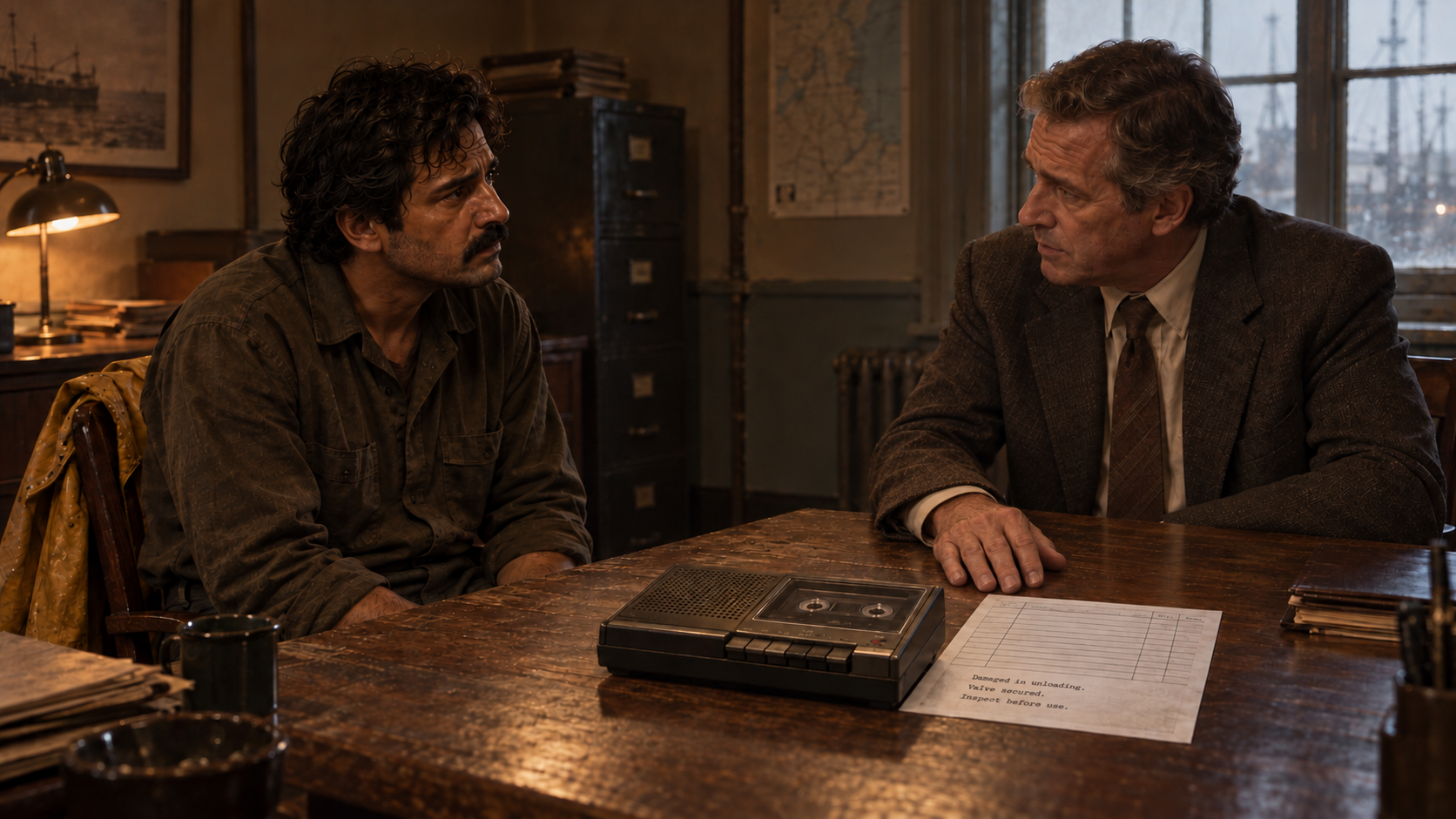
Rafiq sat with that while the detective placed a cassette player on the table between them. Beside it lay a photocopy of the cargo-book entry.
The detective explained why the accountant had brought the recorder. The ledger copies contained false company names and entries that concealed where the money had gone. He had been making a spoken guide to accompany them, identifying the accounts and the pages that needed to be read together. While hidden aboard the boat, he had used the waiting time to finish that explanation from memory.
The tape had been wound to the beginning of the man's final recording.
The detective pressed play.
Cloth rubbed close to the microphone. Rafiq leaned forward. A man's voice came through the small speaker, low and careful.
“Start with the account numbers, not the company names. The companies on those pages never received the money.”
He paused. There was another rustle of cloth.
“We're moving again. I think this is the last stop.”
Metal scraped overhead. The voice stopped.
A sharp bang was followed by a rush of movement. Then the impact overwhelmed the microphone, breaking into a harsh crackle.
Rafiq saw the hook jerk sideways again.
For several seconds, no voice came through. Machinery throbbed beneath the tape hiss. He found himself watching the reels, checking that they were still turning.
The man dragged in a breath and coughed. Something small knocked against the recorder.
“Still here.”
The fall didn't kill him, Rafiq thought.
Rafiq lowered his eyes to the table.
Through the drum's steel, the microphone had picked up the platform machinery. He recognized the uneven beat of the generator they had been trying to repair. Beneath it ran the thin whistle from the brass neck.
The whistle stopped briefly, then returned.
That was my finger, Rafiq thought. I held it shut.
A boot scuffed outside. The breathing paused.
“At last.”
The first wrench blow struck.
The man cried out. Before he could finish, the second blow cut across his voice. The third left a low ringing in the steel.
The whistle was gone.
Open It
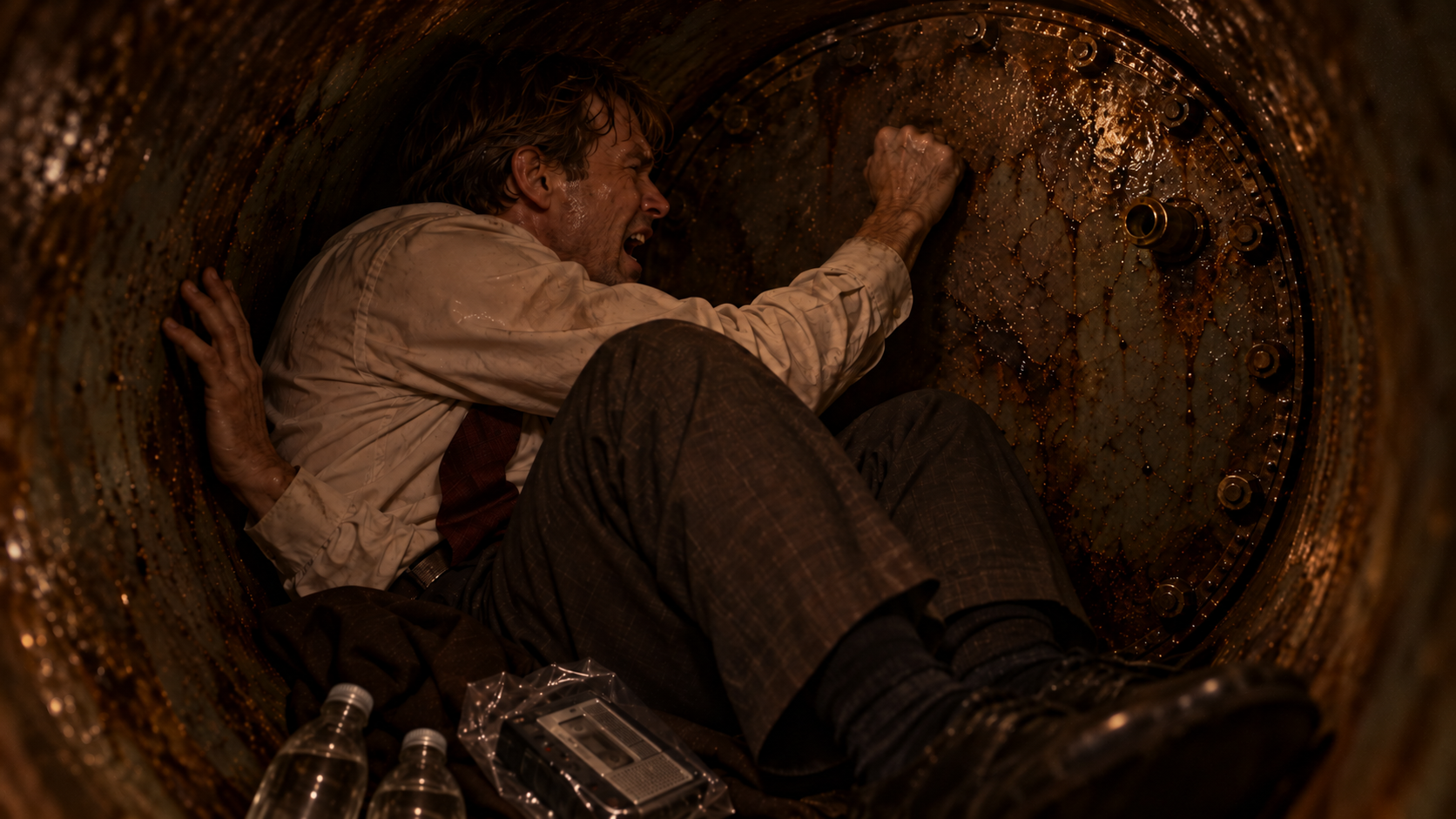
“No. Open it.”
He struck the underside of the lid. The microphone was inside with him; each blow came through close and blunt, while the wind outside was only a distant wash.
“Open it. There's been a mistake.”
He gave his name. Then he shouted it again.
How did I not hear him yelling? Rafiq thought.
His hand tightened on the edge of the table. He remembered the wind, the open generator-room door, having to shout his warning to a man whose hands were inches from his own. Here, the cassette played into a quiet room. The microphone had been inside the drum, beside the captive's mouth; Rafiq had been outside, with steel between them and machinery in his ears.
Something scraped down the wall of the drum. The blows quickened, stopped, began again. Rafiq looked at the detective, but the detective was watching the player.
Outside the drum, trolley wheels rattled across the deck.
Rafiq remembered his hands on the handles. The wet metal. The awkward weight as they lifted it over the threshold.
Then, faintly beneath the captive's shouting, his own voice came through the speaker.
“Mind your fingers.”
He drew his hands off the table and held them in his lap.
The wheels moved again. A door shut. The machinery became duller, but the man inside was still calling.
Rafiq pictured the drum where they had left it, strapped against the wall. A man trying to lift a bolted lid with his back, his knees, whatever part of himself he could force against it. Outside, beyond the store door, Rafiq had been writing in the cargo book.
The detective rested a hand beside the stop button.
Rafiq did not ask him to press it.
The voice began to lose its words. Calls broke off halfway through. There were gaps in which Rafiq could hear the machinery and little else, then a scrape, a cough, a breath drawn too close to the microphone.
Once, the man tried to shout and produced only a dry, strained sound. He tried again.
Rafiq kept listening. On the platform, he had stood close enough to hold the drum steady and had heard none of this. Here, every pause kept him waiting for the next attempt.
One More Tap
Near the end, the man tapped on the lid.
Rafiq gripped the sides of his chair. His hands had begun to shake, and holding on did not steady them.
I was right there, he thought.
He could see his glove against the brass neck. He had held the opening shut with one finger, then taken his finger away.
The words formed in his mind, plain and accusing: He was alive when I touched it. I closed it. I put him in that room.
The man waited, then tapped again.
Rafiq tried to swallow. His eyes were wet. He lowered his head toward the photocopy, but the words blurred before he could read them.
He knew the entry by heart.
Damaged in unloading. Valve secured. Inspect before use.
I was making sure the parts didn't get wet, he thought.
His mouth moved. Nothing came out.
From the little speaker came one more tap.
He lifted his eyes to the detective. An appeal rose in his mind: Please. Answer him.
The detective's hand rested beside the player. Rafiq watched it, waiting for it to move.
He had seen the body. He knew it was a recording. Still, he looked at the detective as if the man could get up, go back to the store and open the lid.
The darkness doesn't end here. All our social links, TikTok, YouTube, Instagram, and more, are waiting for you at the bottom of this page. Just click the "Social Links" button below to find us on our other platforms. Make sure to bookmark this page and subscribe to our "Midnight Alerts" so you never miss a deep dive into the unknown.