
The Scraping Man
1924. In a coal town where the mine never seems to hurt anyone, the lights go out every midnight for fifteen minutes, and something climbs the road from the mine, breathing like the sickest man the new doctor has ever treated. He has never looked. Tonight, he needs the light.


An original horror story by Anonymous369 Media.
From winter into spring, I was the company doctor at Blackwood Ridge, and I never treated a single mine injury. The town paid for that every night at midnight, in fifteen minutes of darkness they called the Dead Shift. All winter, I kept those fifteen minutes like everyone else, and I never once looked at what walked the road.
On my first night, the mine foreman took the lamp out of my hand.
I had come up from Thurmond that afternoon, winter of 1924, in the back of a company wagon. Coal smoke hung between the hills. The road climbed from the mine mouth past the company store and on up the hollow, with the houses strung above it. My rooms were over the store. The consulting room faced the road, and a wooden stair ran down from its door to the gravel.
The foreman had come up that stair while I was unpacking. He set the lamp on the desk and dragged an iron shutter across the window. It caught halfway. He put his shoulder beneath the swollen wooden frame, lifted, and drove the bolt home with the heel of his palm.
"When the siren goes, put that out, Dr. Novak," he said. "Power's off for fifteen minutes. Nothing shows at a window."
A narrow strip of glass remained uncovered. He folded a towel and pushed it into the gap.
"Don't be looking out there, either."
My contract listed every duty a physician might owe a coal town. I had read it twice on the train. It did not mention shutters.
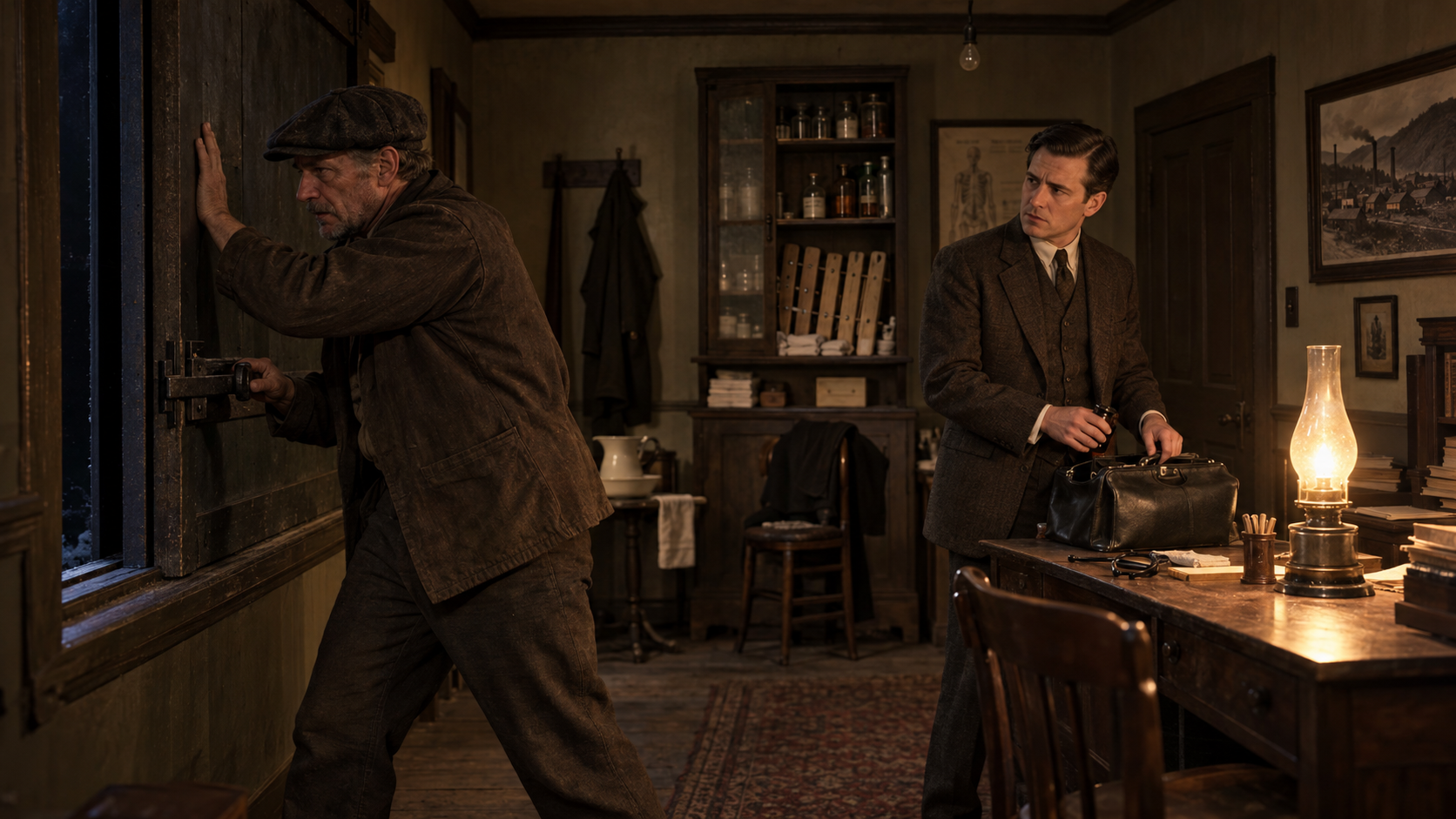
The siren sounded before I could ask. The foreman turned down the wick, and the room was gone. Bolts struck home along the road, one after another. Below us, the ventilation fan kept droning at the mine.
Then iron began to drag over gravel.
The sound came uphill in long pulls, with a pause between them. Something breathed in those pauses: a wet, laboring pull that caught before it was finished.
I had heard men breathe that way. I remembered a patient who gripped the bedstead each time he tried to fill his lungs, as though he could haul himself toward the air. His wife had worn a hollow into the chair beside him.
I had sat beside a dozen beds like his. None of them had ever been walking.
The scraping reached the store.
I stood. The foreman's hand closed around my wrist and held me beside the desk. The breath outside dragged on until my own chest began to ache.
Then the iron moved again, and the sound climbed on up the hollow.
At a quarter past midnight, the bulb came on above us. The foreman let go. Four white marks remained on my wrist where his fingers had been.
"You'll get used to waiting," he said.
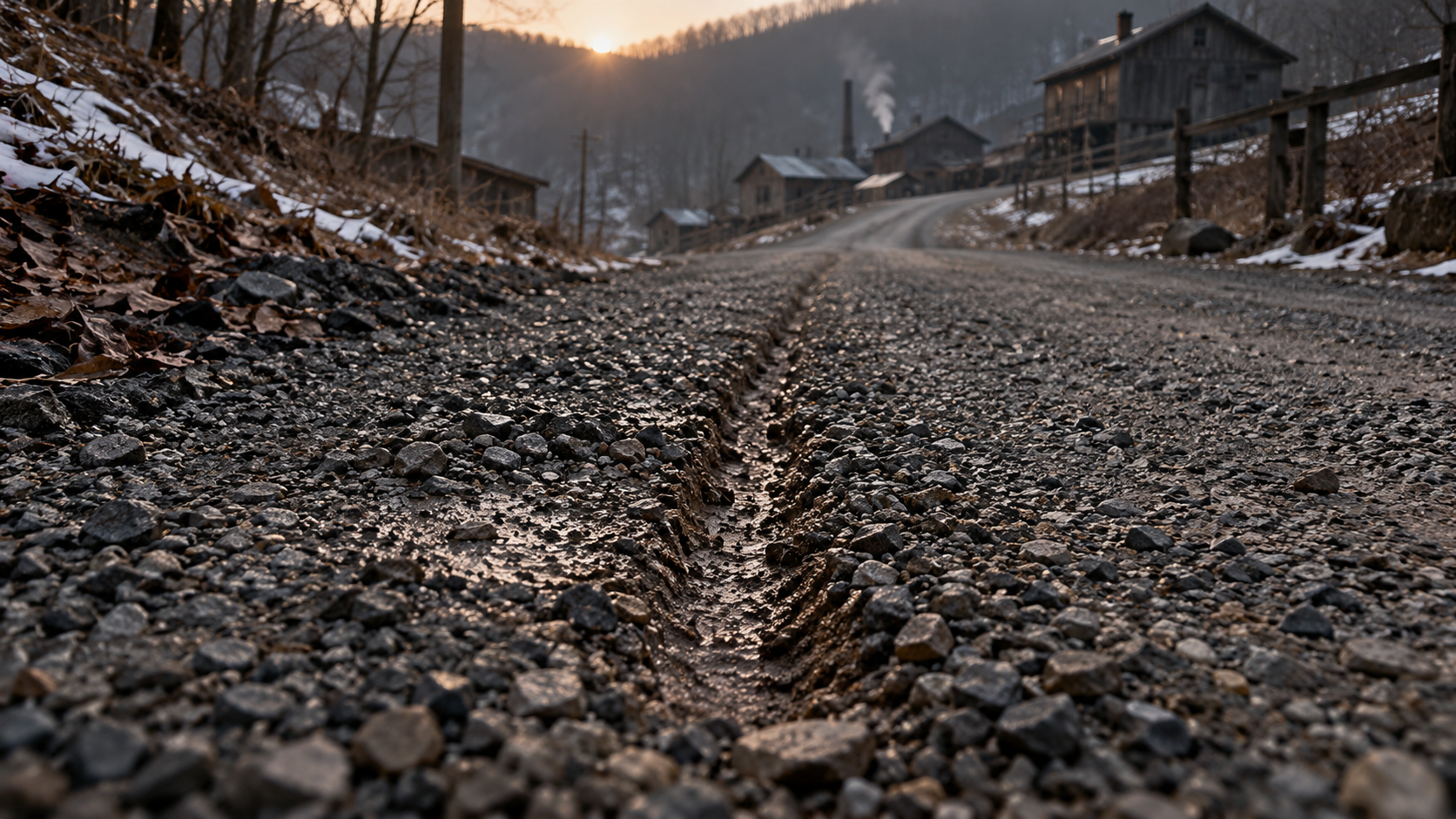
At first light I went down the stair to the road. A groove the width of a pick blade ran through the gravel from the mine mouth, past the store and on toward the houses above. Where the road softened, its edges had crumbled inward.
There were no footprints beside it.
By the time the snow went, I knew which stair creaked beneath a patient and which mothers would apologize before asking me to come. I dressed kitchen burns, delivered babies, and listened to old men cough. My cupboard of splints stayed full.
I asked to see the accident book.
The superintendent brought it himself and stood beside my desk while I turned the pages: roof falls, crushed hands, men carried out of the afterdamp after an explosion. Some names were followed by a date of return to work. Others had a line drawn through the space where that date should have gone.
The last serious injury was eleven years old. After it came page upon page of dates with nothing beneath them.
"A good record," the superintendent said.
I put my finger beneath the last name. "Did my predecessor attend this one?"
"That's his writing."
He drew the book toward himself while my hand was still on it.
The doctor before me had left one other thing: a pair of spectacles in the desk drawer, folded beside a dried bottle of ink, the lenses as thick as the bottom of a jar. When I held them over a page, the ruled lines swelled and buckled. I put them back.
An accident book could be kept clean. A man's chest was harder to persuade.
So I listened to the miners themselves. Men who had cut coal for thirty years sat shirtless on my table while I moved the stethoscope across their backs and asked them to breathe again. Their lungs were clear. I had examined hundreds of miners before Blackwood Ridge, and I had never heard lungs like these.
The men began to ask whether something was wrong.
"No," I told them.
And every night at midnight, I lay in the dark and listened to something climb the road, breathing like the sickest man I had ever treated.
At a quarter past, lamps came up behind curtains, someone set a kettle back on the stove, and an old man in the next house took up his coughing where he had left it. Ordinary sounds returned so quickly that the fifteen minutes began to feel like something I had endured alone.
I stopped going down to look at the groove in the mornings. When the towel fell from my shutter, I folded it tighter and wedged it back.
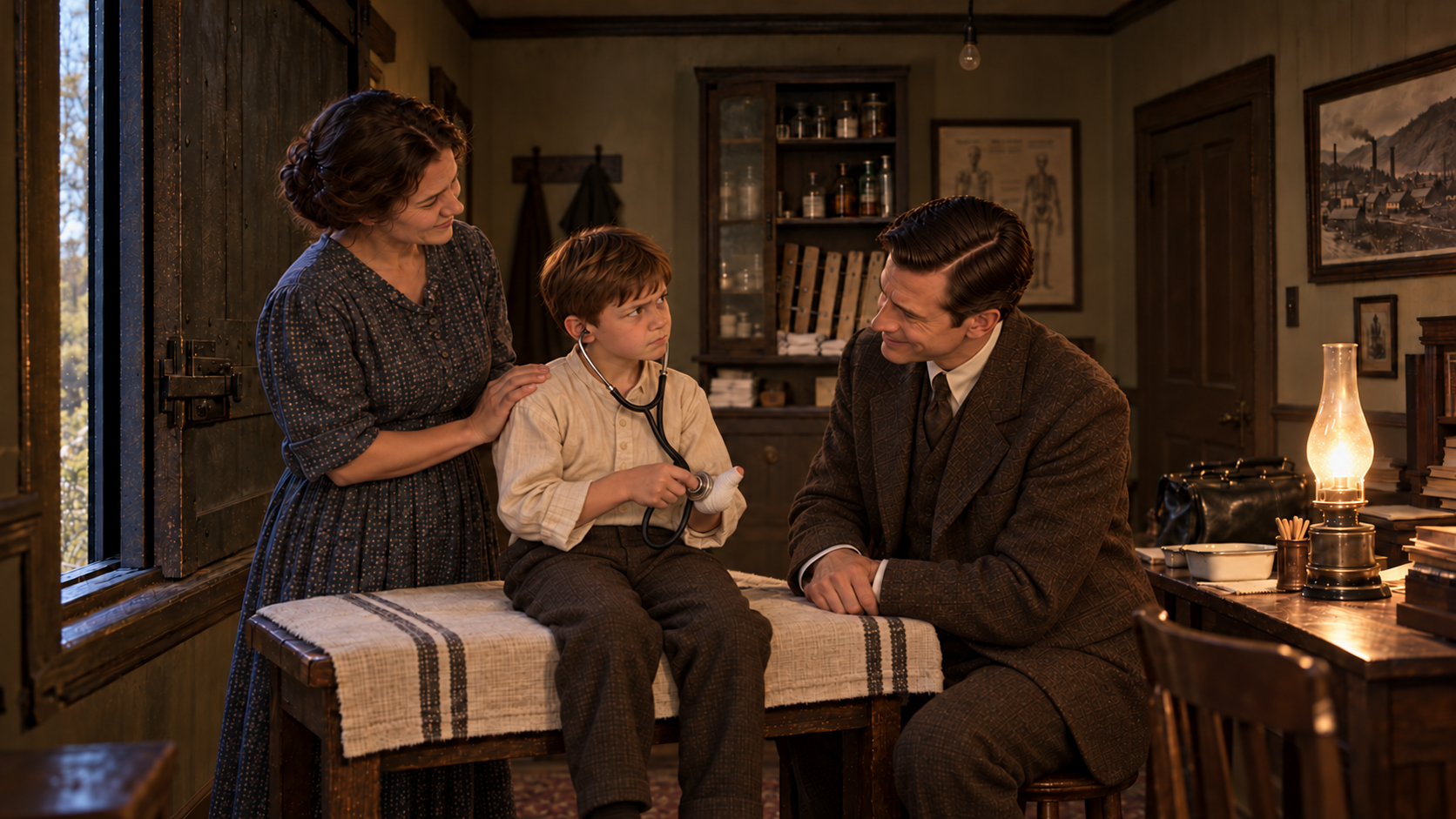
I learned its name from Caleb Sutton. He was seven. His mother brought him in with a fishhook through his thumb, his free hand clamped around the wrist.
Hattie told him to look at her while I worked. He watched my hands instead, and he did not cry.
Afterward, I let him listen through the stethoscope. He pressed the chest piece against his shirt and went very still.
"Is that me?"
"That's your heart."
He moved it to his bandaged thumb. When he heard nothing there, he gave me a look of such deep suspicion that his mother laughed. Then he noticed the iron shutter.
"Do doctors have to close theirs too?"
"Everyone does," Hattie said.
"Even for the Scraping Man?"
Her hand settled on his good wrist. "Especially then."
That evening I asked the foreman what it was.
"The children call it that," he said. "The rest of us don't call it anything."
"And if a light shows?"
"Then the mine starts taking men again."
"And if someone looks?"
He turned his cap in his hands. The brim had a polished patch where his thumb kept passing.
"Then that's between him and it."
I told him a company could keep a town obedient with a story like that. It could pay a man to drag a pick up the road while everyone else sat in the dark.
The foreman looked past me at the cupboard of splints.
"How many men have they brought you, Doctor?"
In April, Ned Sutton came up my stair a few minutes before midnight. Coal was still caught in the creases beside his nose, and he had buttoned his coat wrong.
"Caleb can't get his air."
I took my bag and followed him uphill.
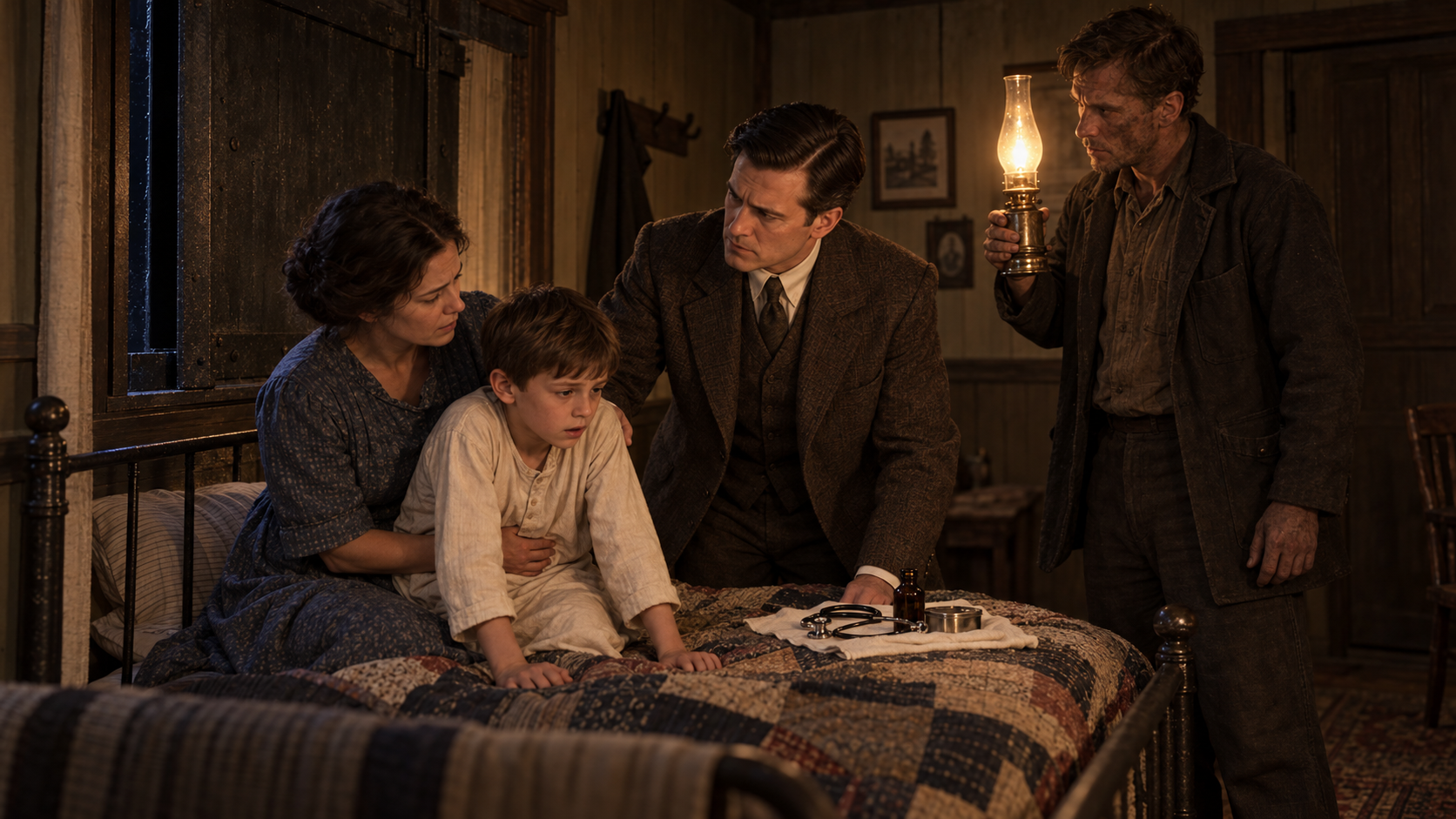
Hattie sat on the edge of the bed in the front room with Caleb between her knees. He was bent forward, his palms pressed into the quilt. Every breath ended in a thin whistle. His lips had darkened at the edges, and when I said his name, his eyes came to me, but he could not answer.
I put my hand against his back. His ribs fought beneath it.
"Can we get him to the hospital?" Hattie asked.
The railway was hours away by wagon. He did not have hours. His throat was swelling shut, and if it closed, I would have to make an opening below it. I laid my instruments on a clean cloth over the quilt, where I could reach them without taking my hand off him.
Ned stood at my shoulder with the lamp. The bed was pushed against the window that faced the road. The shutter covered most of the glass, but its warped edge left a sliver of black beside the flame.
"Keep it right there," I said. "I need to see."
The siren began.
Ned looked at the window. He pulled off his coat and packed it into the gap, pressing the sleeves flat with both hands. Then he bent across the bed and blew out the lamp.
"Ned," I said.
"Fifteen minutes, Doctor." He was breathing like a man who had run much farther than he had. "You know what happens."
Down the road, iron began to scrape.
My hand was still on Caleb's back. In the dark I could feel what I could no longer see: the strain, the pause, the smaller effort after it.
Hattie whispered into his hair. "With me. Try with me." She drew a slow breath for him, and he tried to follow it. The whistle thinned until I had to lean close to hear whether it was still there.
"He doesn't have fifteen minutes," I said.
Ned didn't answer. The mattress dipped as he sat on the other side of his son. I heard his palm moving over the quilt, searching, until Caleb's fingers found it.
I took out my matches. The loose heads rattled in the box, and Ned went still. For a long moment he said nothing.
"Don't let it show," he whispered.
I struck the match below the edge of the mattress. Hattie turned her back to the window and curled over the lamp while I lit the wick. Ned leaned across and pushed the coat harder into the gap.
In that cupped light I could see Caleb's face and the instrument under my hand. I picked up the scalpel.
Outside, the scraping reached the house and stopped beneath the window.
Then it breathed. It was close enough now that I could hear the whole of each breath: the wet drag, the long fight for air, and at the very end, a thin whistle.
I had been listening to that whistle since I came into the room.
It was Caleb's.
Caleb jerked beneath my hand. He coughed, then coughed again, deeper, hard enough to pull his fingers out of his father's. His chest lifted. He dragged in a full breath and let it out against his mother's dress.
Hattie said his name until he answered her.
Ned put his forehead against the boy's hair and kept it there.
I set down the scalpel. It had never touched him.
Outside, the breathing went on.
The window was still covered. A boy was breathing easily under my hand, and I had not done it. I could have left the window covered. Instead, I reached past the lamp and drew the coat down an inch, because I wanted to see what this town had been trading with.
It stood an arm's length from the glass. Coal dust ran down the front of its head and rose again, the way dust hangs in a shaft after a shot. It never settled long enough to make a face.
Its eyes did. They were level with mine, clouded and ringed with white, like the eyes of an old man with cataracts. I leaned toward the gap before I knew I was doing it.
It breathed, and the glass trembled in its frame. Caleb's whistle came once more, fainter, already sinking into the wet sound beneath it. Behind me, the boy asked his mother for water.
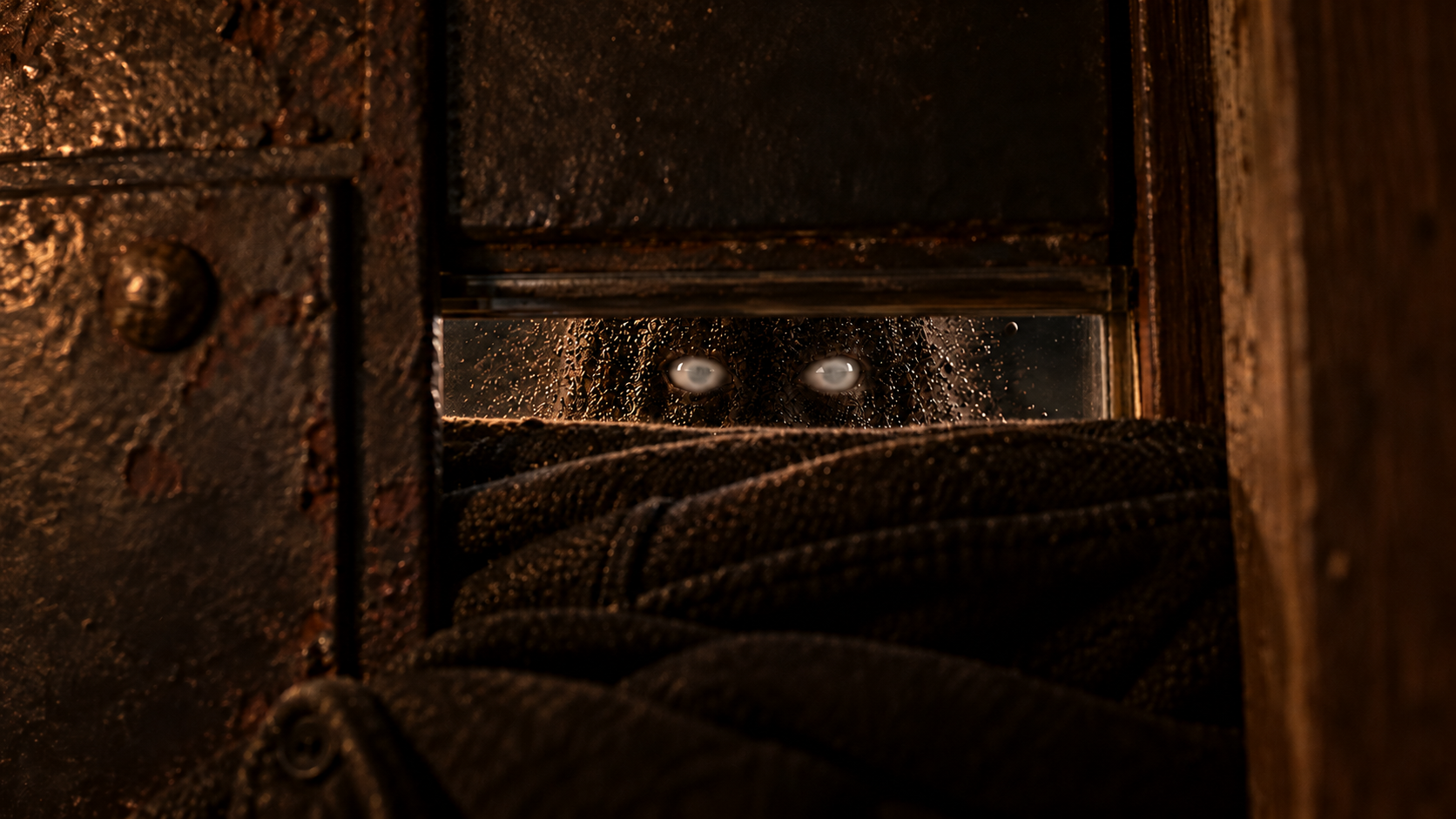
Ned caught the coat in my fingers, tore it out of my hand and packed it back into the gap with his fist. Iron moved over stone, and the scraping went on up the road.
He kept his hand flat against the coat until it had passed.
At the end of the next shift, I stood at the clinic window and counted the lamps coming up from the mine. When the men were close enough to know, I counted them again.
All of them.
Two mornings later, the writing on a bottle label blurred. I held it at arm's length, then carried it to the window, and for a moment I could read it there.
By the end of the week, pale rings were forming around the centers of my eyes. I brought the lamp close to the washstand mirror and watched my pupils close against it, the way they should. It made no difference to what I could read.
I learned my shelves by touch and position: the small bottle beside the tall one, the rough stopper, the chipped lip of the jar. Before a patient came, I set out what I might need on the desk, with the labels toward the light.
Once, footsteps sounded on the stair while I had a bottle almost against my nose. I put it down so quickly that it rang against the others.
"Come in," I said, and opened my ledger.
Caleb came back for his last examination. He climbed onto the table without help and pulled up his shirt before I asked. When I set the stethoscope against him, he took an enormous breath, proud to show me.
I listened longer than I needed to.
"Again?" he asked.
"No. That's enough."
I asked Hattie to hold the lamp closer, then closer still. She looked from the flame to my face.
"Is something wrong, Doctor?"
"He's well," I said.
That was true. Caleb was already watching the door. I let him go and listened to his shoes running down the stair while his mother gathered his coat.
After they left, I opened the desk drawer. The spectacles lay beside the dried ink. I unfolded them and put them on, and the ledger sharpened under my hands, every turn of every letter.
I took them off. The page blurred.
I put them on again.
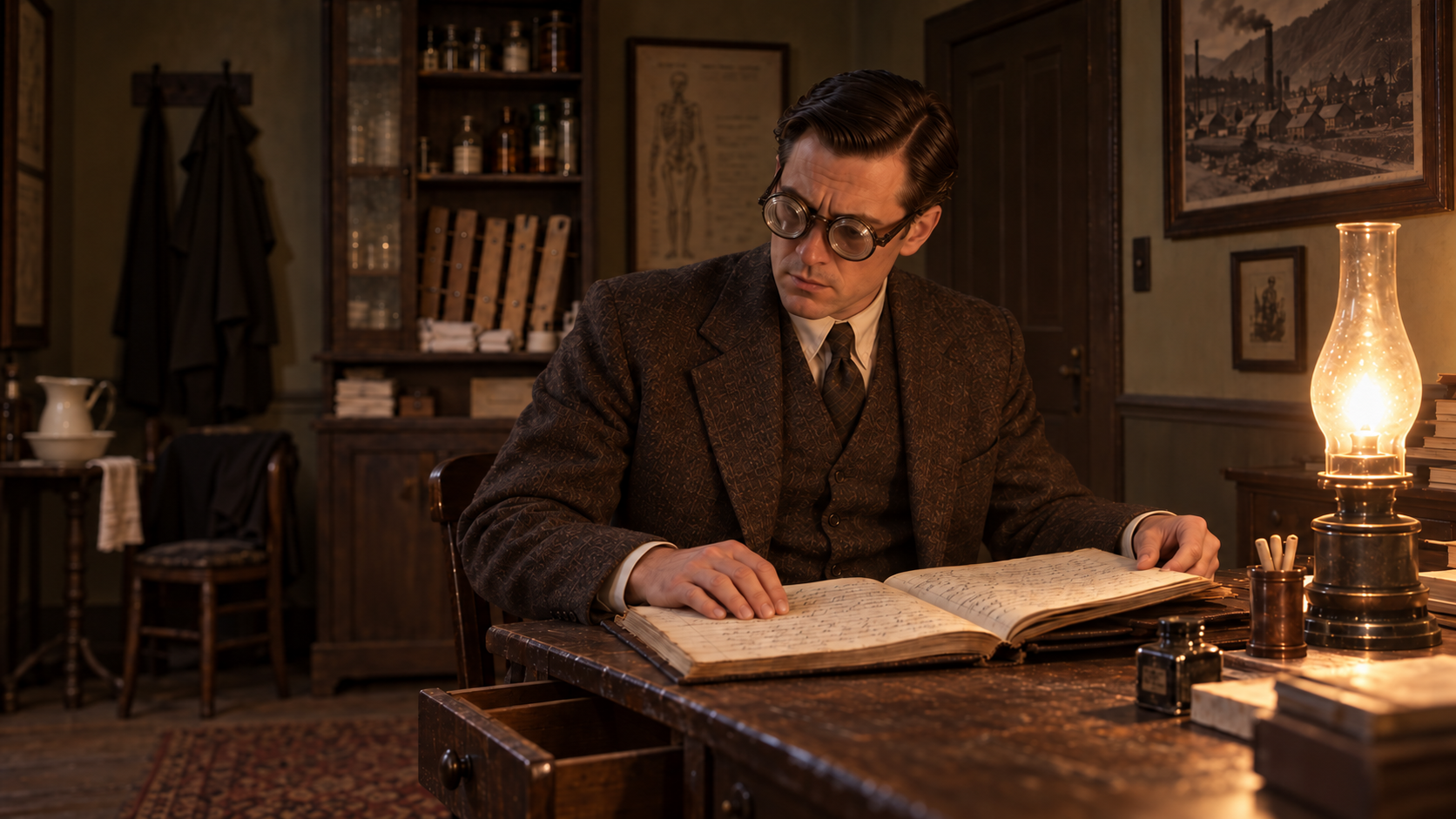
My bag is packed. In the morning, I'll go down to Thurmond and find a physician who can tell me what is happening to my eyes. I have written the dates out for him on a clean sheet: Caleb's illness, the first blurred label, the rings. I have drawn a line through nothing.
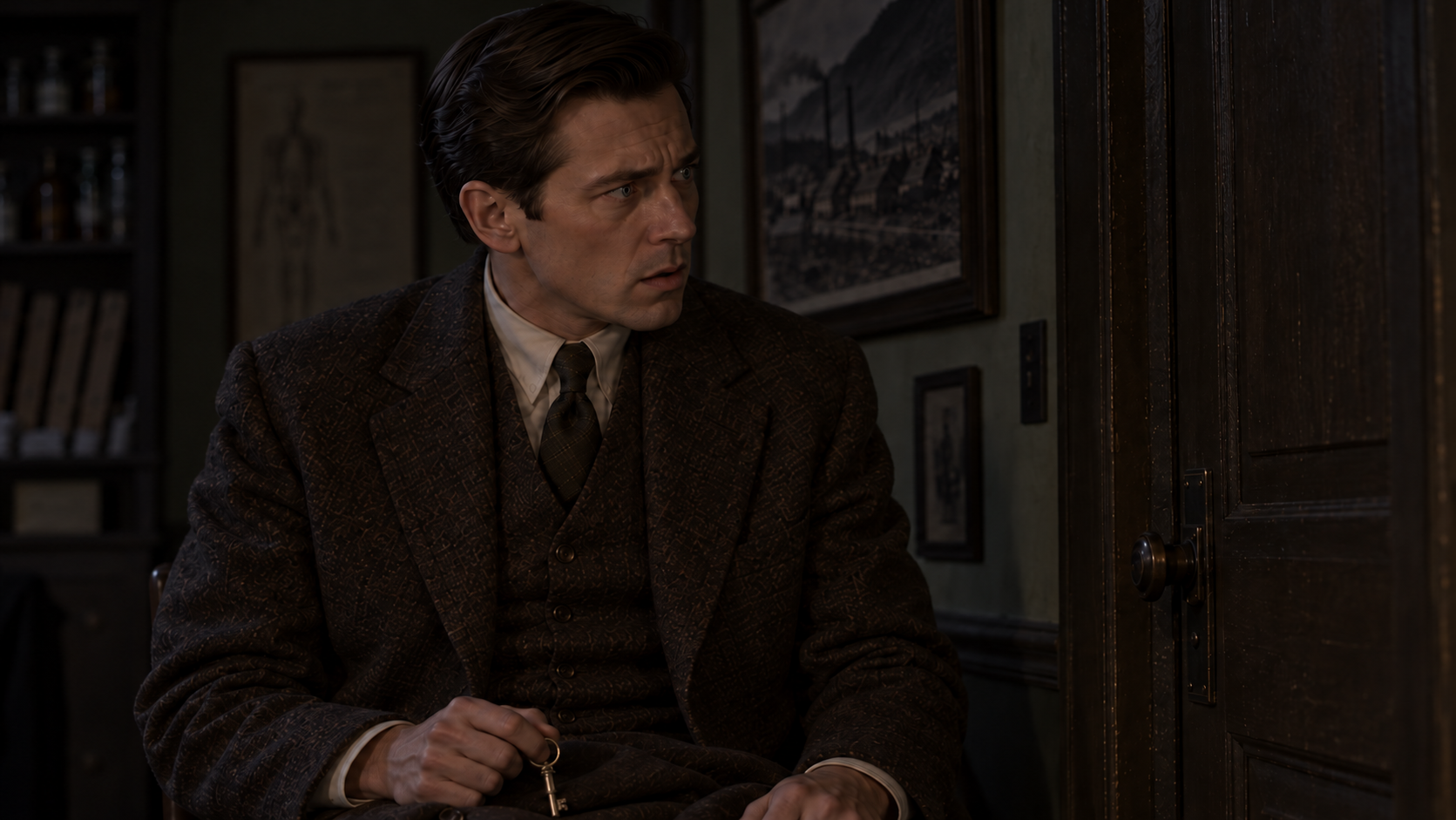
Tonight I've set a chair beside the clinic door, with my coat across my knees and the key in my hand. The spectacles lie folded on the desk behind me.
The siren has sounded. The lights are out.
Below the town, the ventilation fan keeps turning. I listen past it for the first scrape at the mine mouth, and for the pauses that will tell me how far up the road it has come.
It begins on the bottom step outside my door.
The iron moves once, then stops. I wait for the breathing that always comes between the scrapes.
The wet breath comes out of me.
The darkness doesn't end here. All our social links, TikTok, YouTube, Instagram, and more, are waiting for you at the bottom of this page. Just click the "Social Links" button below to find us on our other platforms. Make sure to bookmark this page and subscribe to our "Midnight Alerts" so you never miss a deep dive into the unknown.