
Mario's Damp Glove Reveals the Night Luigi's Mansion Broke Its Hero
Mario followed a fake mansion prize into Boo Woods and left a trail of panic: a damp glove, a missing cap, a worn shoe, and one warning in the dirt. In Luigi's Mansion, those dropped items reveal how King Boo turned Nintendo's fearless hero into a conscious prisoner behind glass.


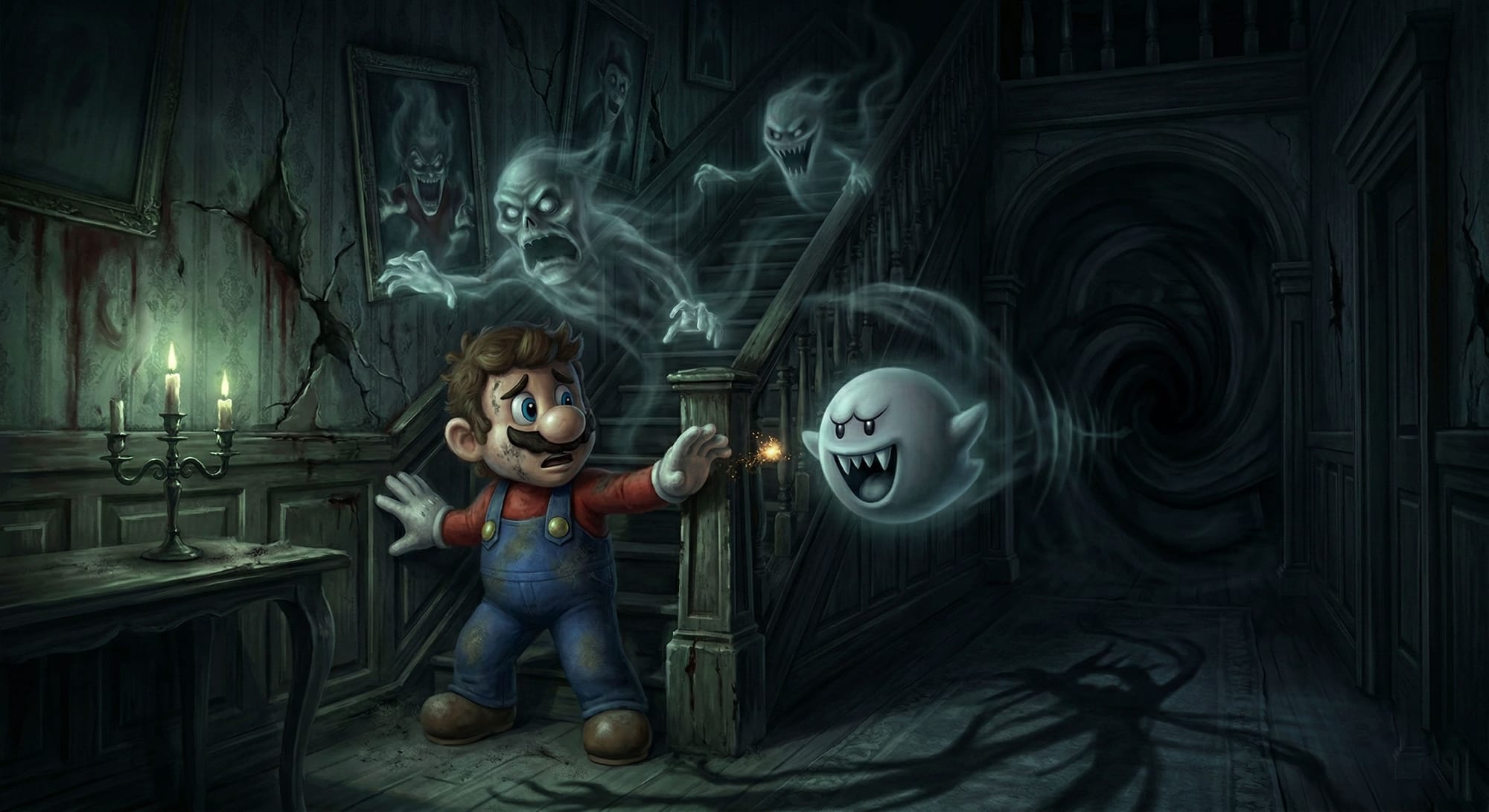
The air in Boo Woods tastes like copper and dead leaves. It is thick, heavy, and suffocating. When the legendary hero of the Mushroom Kingdom steps onto the dead grass of the property, he is not expecting a fight for his soul. He arrives at the towering gothic structure expecting a celebration. A letter arrived in the mail claiming a grand prize had been won. It is a simple premise, but it is drenched in supernatural malice. Mario walks through the heavy iron doors with his usual confident stride, entirely unaware that he is stepping into a meticulously crafted psychological meat grinder. King Boo did not just want to defeat the red clad plumber. He wanted to break his mind, humiliate his spirit, and erase his legacy. The mansion is an illusion woven from pure paranormal energy, specifically tuned to strip the hero of his courage. We never see the initial capture on screen, but the environment tells a harrowing story of his final moments of freedom. The absolute silence of the foyer is broken only by the slamming of the front doors. The trap is sprung. Mario is entirely alone, stripped of his usual power ups, and hunted by entities that defy physical combat.
The Anatomy of a Supernatural Ambush
Mario is a warrior accustomed to physical adversaries. He understands how to dodge a fireball, how to crush a Koopa shell, and how to navigate treacherous physical terrain. But the mansion offers no physical combat. The walls bleed with shadowy apparitions. The floorboards groan under the weight of unseen forces. The ghosts do not fight fair. They pass through solid wood, turn invisible in the darkness, and manipulate the very architecture of the house. Professor Elvin Gadd reveals that King Boo liberated a horde of terrifying Portrait Ghosts from their canvas prisons, unleashing them into the illusionary estate. Mario walked directly into an ambush orchestrated by an army of the dead. The King of the Boos possessed a deep, festering hatred for the plumber, and he channeled that hatred into the very foundation of the estate. When Mario realized his standard jumps and fiery projectiles were utterly useless against ethereal bodies, panic must have set in. The walls closed around him, shifting and warping to block his exit. The ghosts laughed from the darkness, coordinating their strikes to exhaust the hero. It was a calculated, methodical breakdown of a man who had never before tasted true, helpless defeat.
A Desperate Sprint Through the Shadows
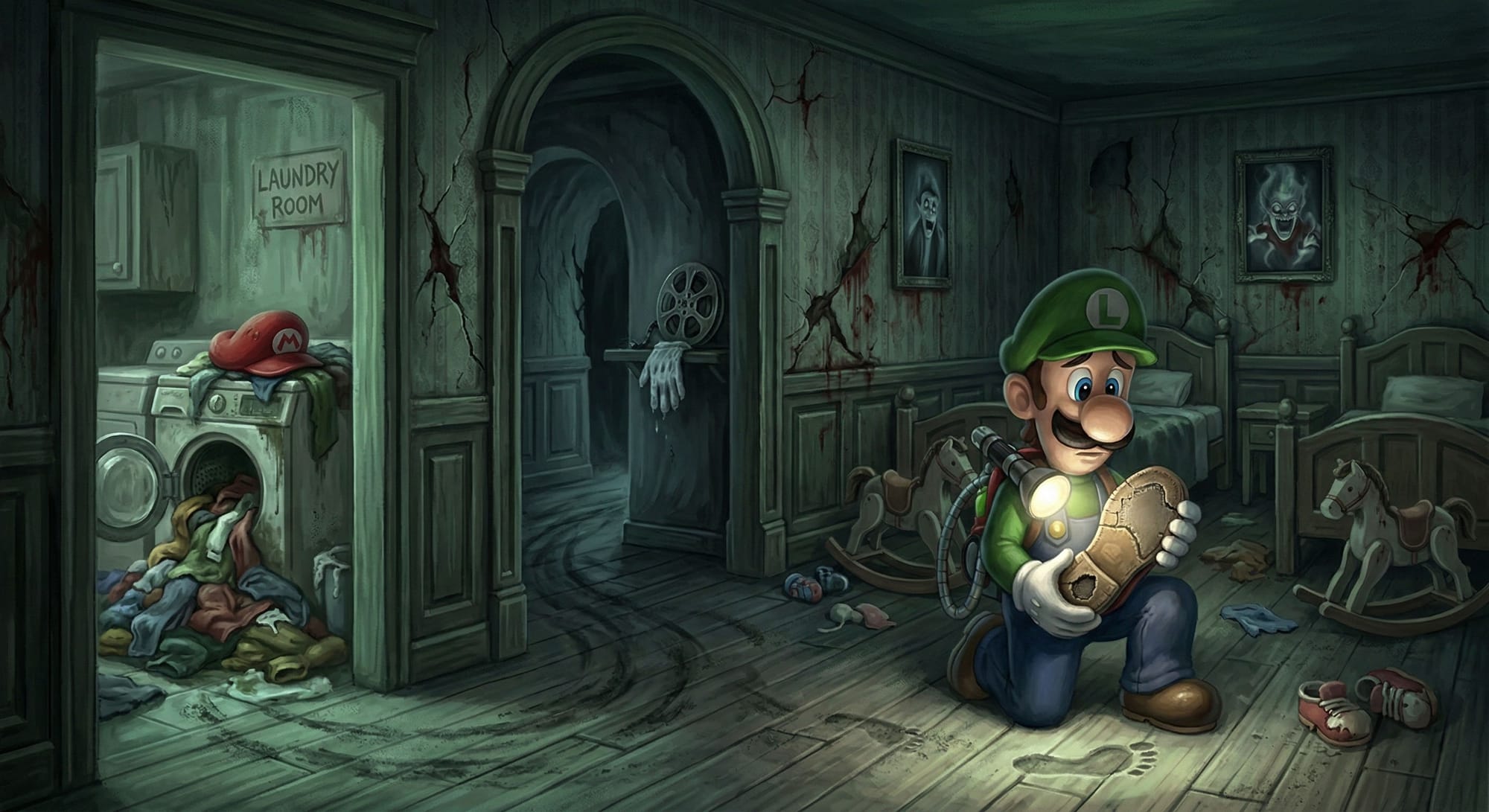
To understand the sheer panic that consumed Mario, we must follow the physical evidence he left behind in the dark. As Luigi explores the rotting corridors of the estate, he discovers five distinct items belonging to his older brother. These are not random collectibles placed for a scavenger hunt. They are the breadcrumbs of a frantic, terrifying chase. The physical toll of the pursuit is staggering. Luigi finds his brothers glove in the Projection Room. The ghostly fortune teller Madame Clairvoya describes it as being damp with the sweat of the living. Mario was terrified. He was sweating profusely as he scrambled blindly through the haunted hallways. He lost his iconic cap in the Laundry Room, leaving his head bare to the freezing drafts of the house. Most disturbingly, Luigi finds one of his brothers shoes in the Twins Room. Clairvoya notes that the sole is incredibly worn, as if he had walked a thousand miles. This detail is a profound environmental storytelling device. Mario did not just surrender. He ran for his life. He sprinted through the twisting labyrinth of the mansion, bursting through doors, his remaining boot and bare foot slamming against the dusty floorboards. He was running so hard and so desperately that the rubber sole of his shoe was ground down to nothing. The invincible hero was reduced to a frightened prey animal, shedding pieces of his identity as he searched for an exit that did not exist.
The Frantic Scribe in the Courtyard
The chase forced Mario out into the overgrown, dead grass of the courtyard. Surrounded by encroaching shadows and screeching bats, the hero realized that his stamina was failing. It is here that Luigi finds a crumpled letter. It is a desperate message from Mario. Clairvoya reads the hurried, sloppy handwriting. "Look out for Boos, Luigi." The fortune teller explicitly notes that Mario is not a novelist and that the note was scribbled in a state of absolute panic. Imagine the visceral reality of this scene. Mario is exhausted, shivering in the cold night air, missing a shoe and his iconic cap. He barricades himself in the courtyard, listening to the guttural laughter of the ghosts echoing from the walls. He knows he cannot escape. He knows the spectral forces are closing in to claim him. In his final moments of freedom, his only thought is to warn his younger brother. He hastily scratches out a warning, drops it in the dirt, and prepares for the end. It is a moment of profound vulnerability. The man who has saved princesses and entire kingdoms is completely powerless, reduced to leaving a pathetic scrap of paper in the mud, hoping against hope that his brother will find it before falling into the exact same snare. Luigi also finds a Star in the Observatory. This implies Mario climbed to the highest points of the mansion, looking up at the night sky, desperately searching for a way to signal for help before being dragged down into the subterranean darkness.
Purgatory Woven in Canvas
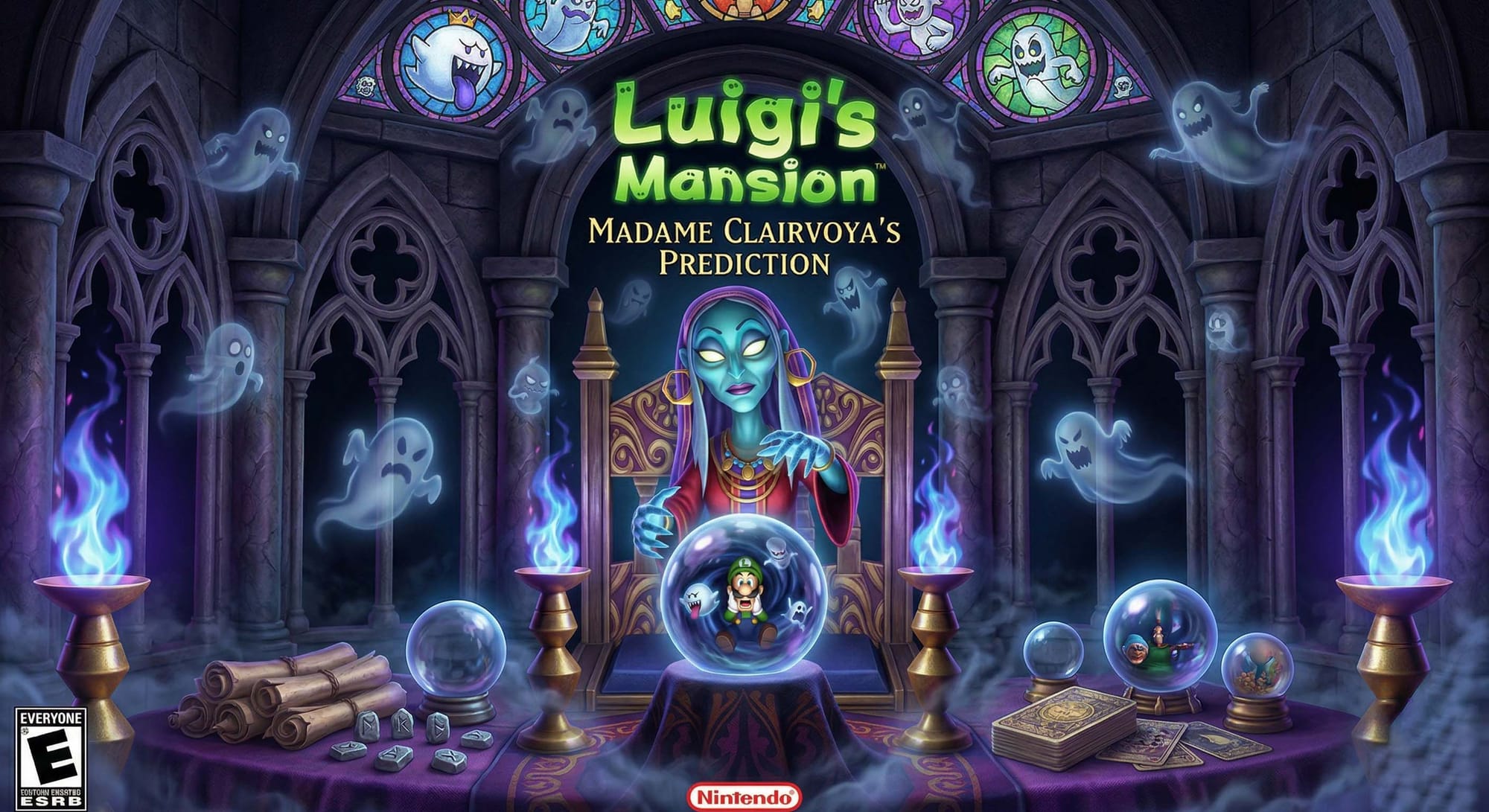
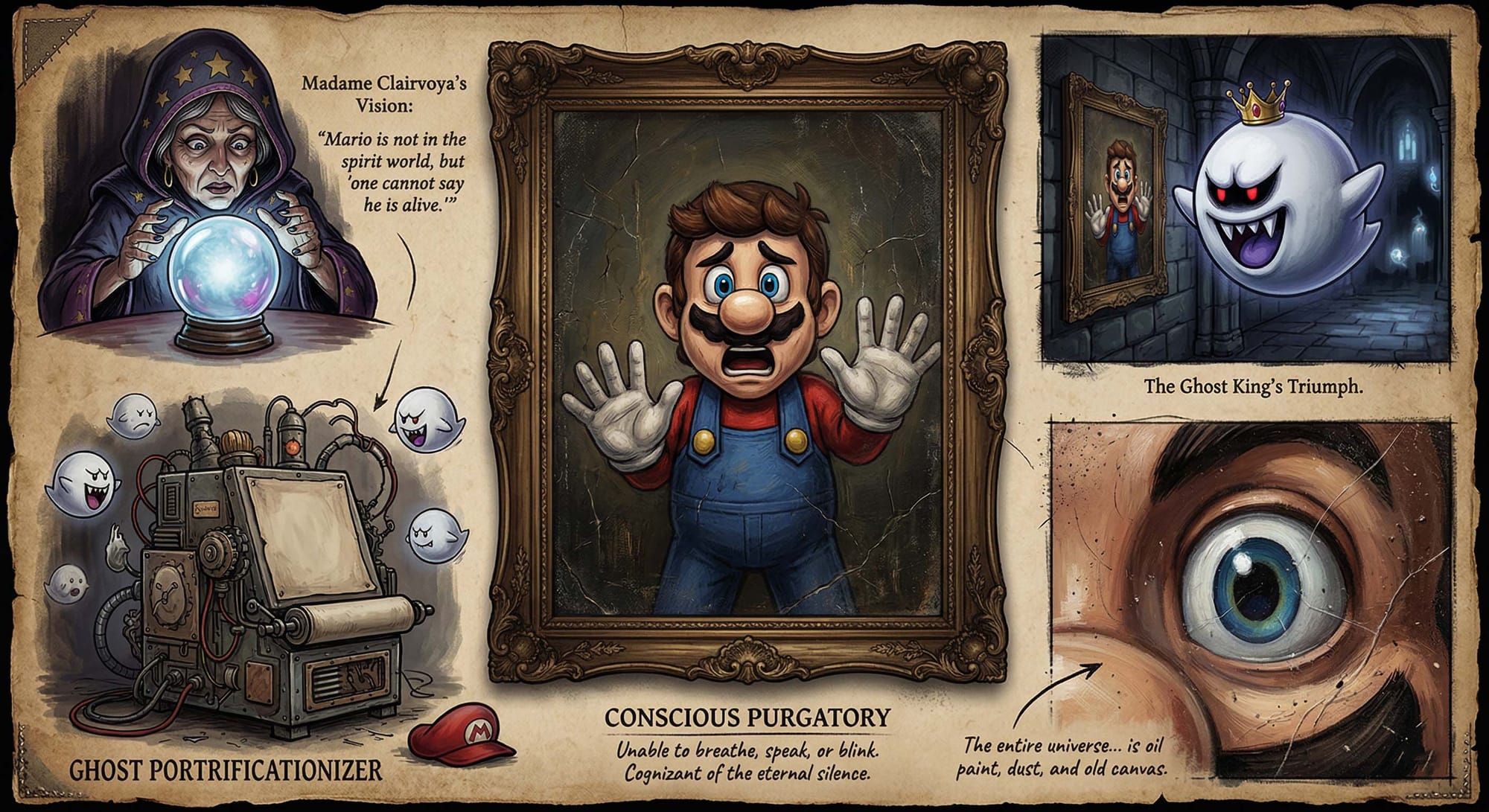
When King Boo finally overpowers Mario, he does not grant him the mercy of a swift demise. Death would be too simple for the Ghost King. Instead, Mario is dragged down into the Secret Altar in the lightless bowels of the estate. He is forced through the Ghost Portrificationizer, a machine originally designed by Professor Elvin Gadd to convert spiritual energy into static artwork. But Mario is not a spirit. He is a living, breathing human being composed of flesh, bone, and blood. The process of having his physical form compressed and flattened into a two dimensional canvas must have been a sensation of unimaginable, mind breaking agony. Madame Clairvoya peers into her crystal ball and delivers a line that chills the blood. She states that Mario is not in the spirit world, but "one cannot say he is alive." Mario is trapped in a state of conscious purgatory. He is completely isolated, unable to blink, breathe, or speak, yet entirely cognizant of the passage of time. The psychological deterioration of being trapped in a single, unmoving moment while malevolent entities roam freely around you is a fate worse than any physical demise. Every second stretches into an eternity of silence. He is forced to dwell on his failure, agonizing over the fact that he led himself directly into a trap and left his younger brother to face the consequences. The smell of oil paint, dust, and old canvas becomes his entire universe. He is a living soul entombed within a static image, screaming silently into the void while his body is suspended in a terrifying state of dimensional stasis.
The Sadistic Gaze of the Ghost King
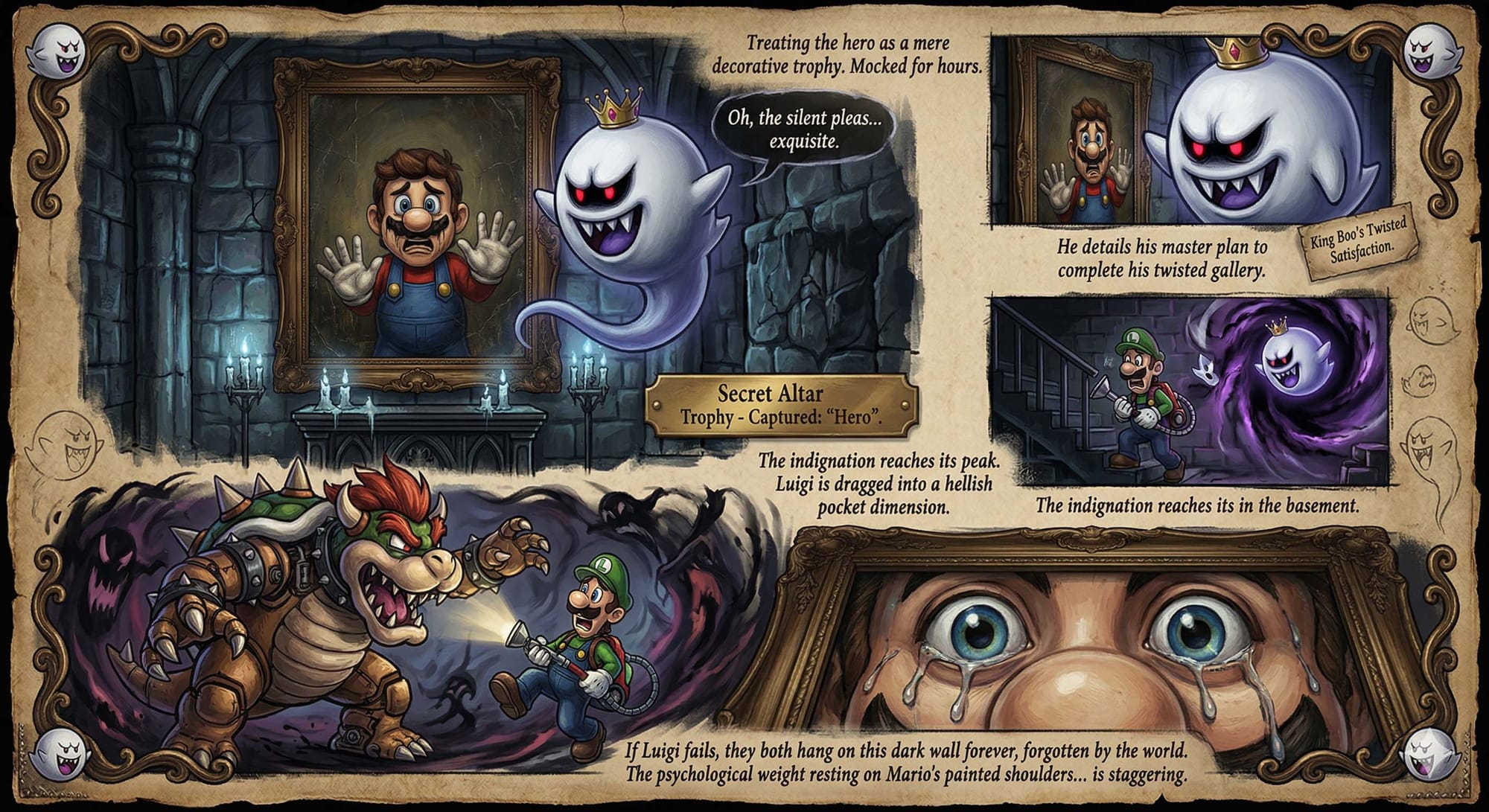
The psychological torture does not end with his imprisonment. King Boo mounts Marios portrait on the cold stone wall of the Secret Altar, treating the hero of the Mushroom Kingdom as a mere decorative trophy. The Ghost King explicitly tells Luigi that he finds Marios silent, painted pleas for help to be deeply satisfying. King Boo spends hours simply staring at the painting, mocking the man who had caused him so much trouble in the past. Mario is forced to watch as the spectral monarch gloats. He is forced to listen as King Boo details his master plan to capture Luigi and complete his twisted gallery. The absolute helplessness of this situation is profoundly cruel. Mario, a man defined by his dynamic action and relentless movement, is reduced to a helpless, paralyzed observer. The indignity reaches its peak when Luigi finally arrives in the basement. King Boo does not just fight Luigi in his normal form. The Ghost King drags Luigi into a hellish pocket dimension and pilots a grotesque, life sized replica of Bowser. Mario must watch from his canvas prison as his younger, more cowardly brother faces a nightmarish manifestation of their greatest enemy. If Luigi fails, Mario knows they will both hang on that dark wall forever, forgotten by the world. The psychological weight resting on Marios painted shoulders in those final moments is staggering.
A Violent and Traumatic Rebirth
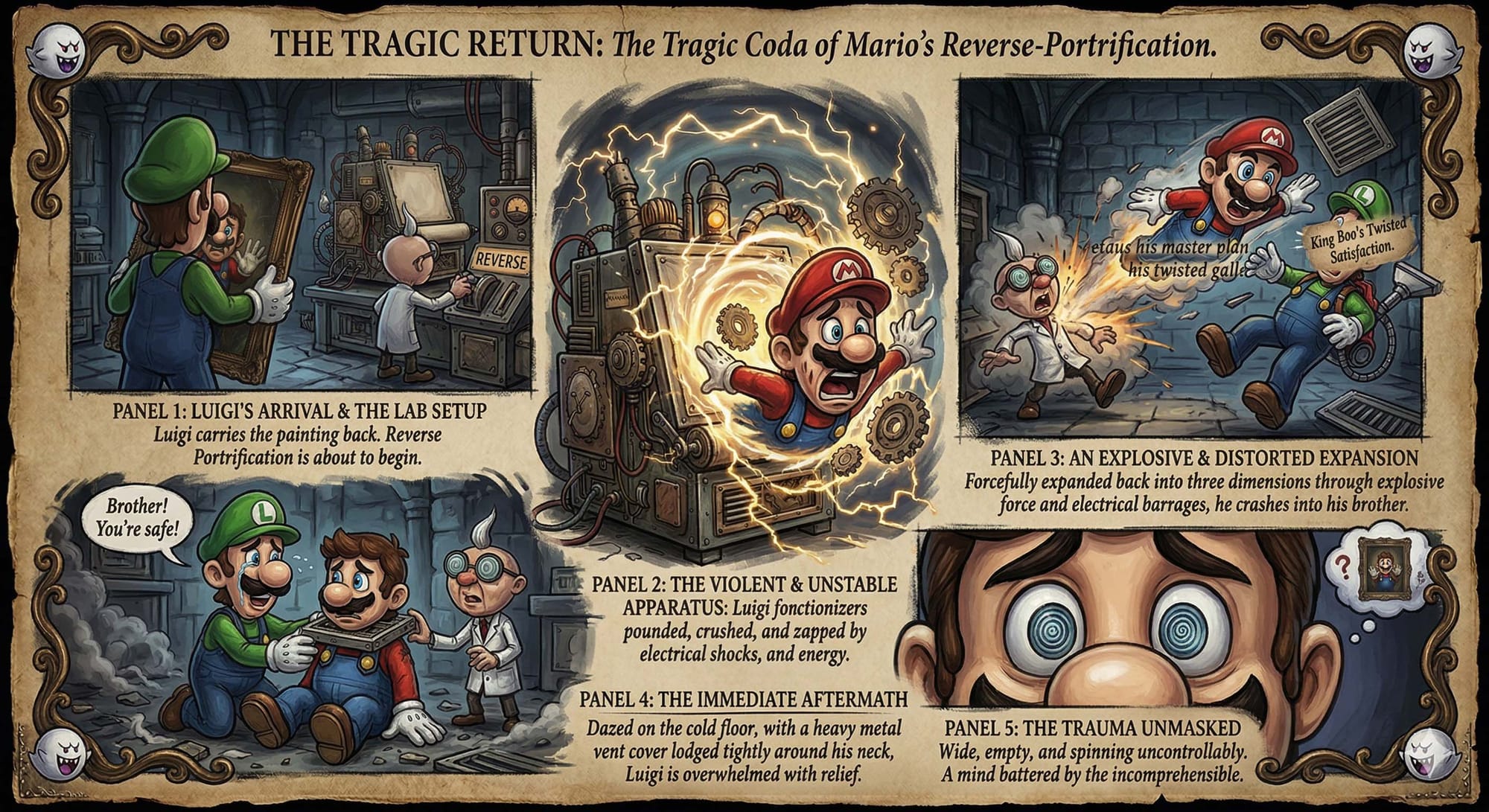
When Luigi finally triumphs and sucks the screaming Ghost King into the cold metal nozzle of the Poltergust 3000, the nightmare is technically over. But the trauma of Marios extraction is a violent coda to his suffering. Luigi carries the painting back to the laboratory. Professor Elvin Gadd throws the switch, running the Portrificationizer in reverse. The machine was designed to compress entities into art, not expel living humans back into the physical plane. Mario is violently pounded, crushed, and zapped by the mechanical apparatus. His flattened body is forcefully expanded back into three dimensions through a barrage of electrical shocks. He rockets out of the machine with explosive force, crashing heavily into his brother. When the smoke clears, Mario is sitting on the cold floor of the lab, completely dazed, with a heavy metal vent cover lodged tightly around his neck. Luigi laughs with tears in his eyes, overwhelmed with pure relief that his brother is safe. But one must look closely at Marios eyes in that final scene. They are wide, empty, and spinning uncontrollably. He has survived a sensory and psychological ordeal that defies human comprehension, returning to the world of the living through a process that battered his body as much as the mansion battered his mind.
The Invisible Scars of Boo Woods
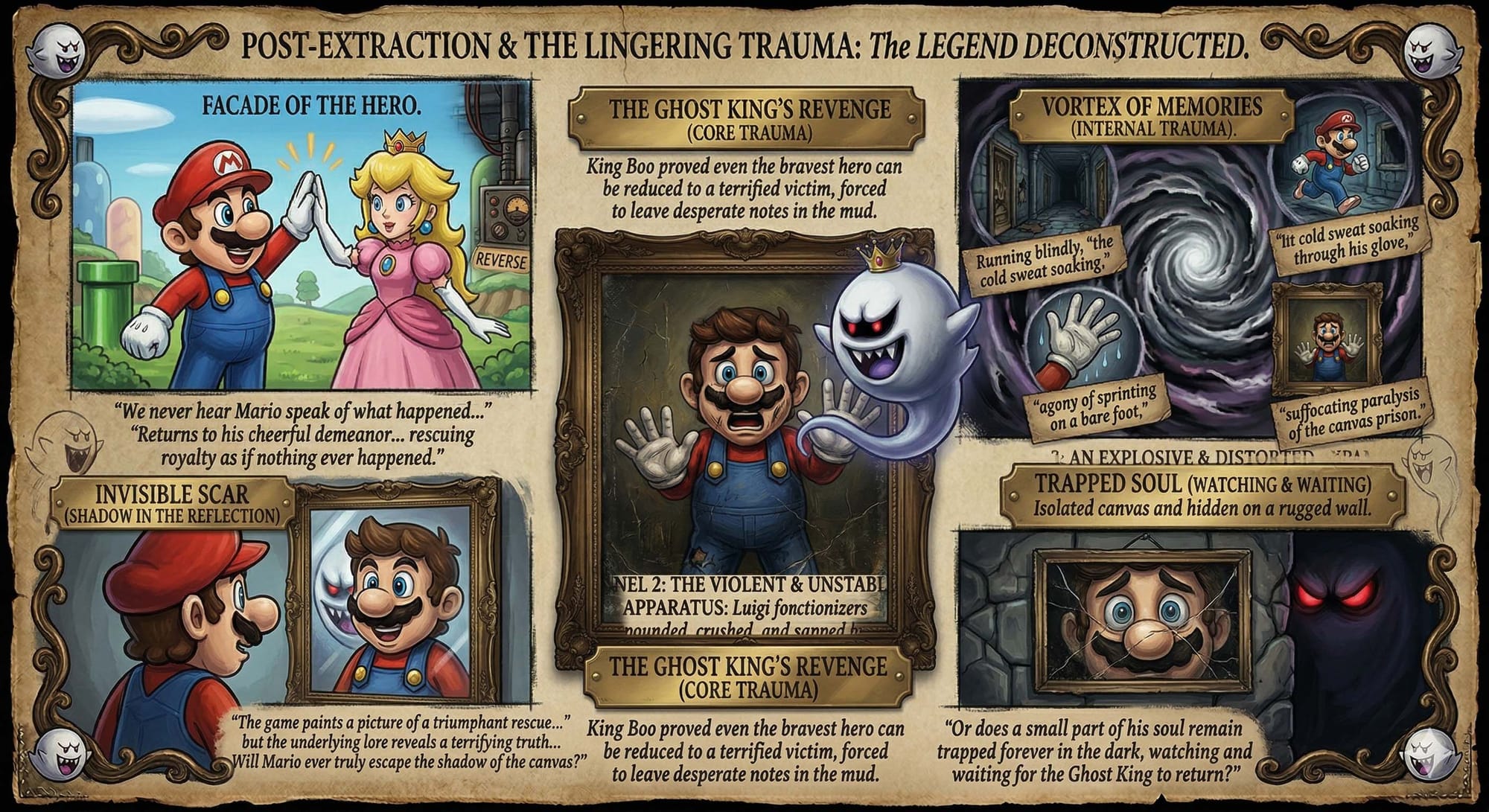
We never hear Mario speak of what happened to him in the dark corners of that illusionary estate. He returns to his cheerful demeanor in subsequent adventures, stomping enemies and rescuing royalty as if nothing ever happened. But trauma of that magnitude does not simply vanish into the ether. The memory of running blindly through those rotting hallways, the cold sweat soaking through his glove, the agony of sprinting on a bare foot, and the suffocating paralysis of the canvas prison. These are invisible, permanent scars. King Boos revenge was not just physical imprisonment, it was the total deconstruction of a legend. The Ghost King proved that even the bravest hero can be reduced to a terrified victim, forced to leave desperate notes in the mud. The game paints a picture of a triumphant rescue, but the underlying lore reveals a terrifying truth about the fragility of our heroes.
Will Mario ever truly escape the shadow of the canvas, or does a small part of his soul remain trapped forever in the dark, watching and waiting for the Ghost King to return?
Continue the Mansion File
The mansion works best as a chained dossier. Step back if you missed the previous room, or keep going to follow the next piece of Luigi's Mansion lore.
Previous file: King Boo's Bowser Decoy Turns Luigi's Mansion's Finale Into a Nightmare Next file: Why Toad Can't Stop Crying in Luigi's Mansion