
Vincent Van Gore Painted Rejection Into Luigi's Mansion's Army
Vincent Van Gore failed to sell a painting for thirty years, then died with the world still refusing to look. In Luigi's Mansion, his studio, seven waves of painted ghosts, and final blank canvas reveal an artist who turned rejection into an army that could finally make people afraid.


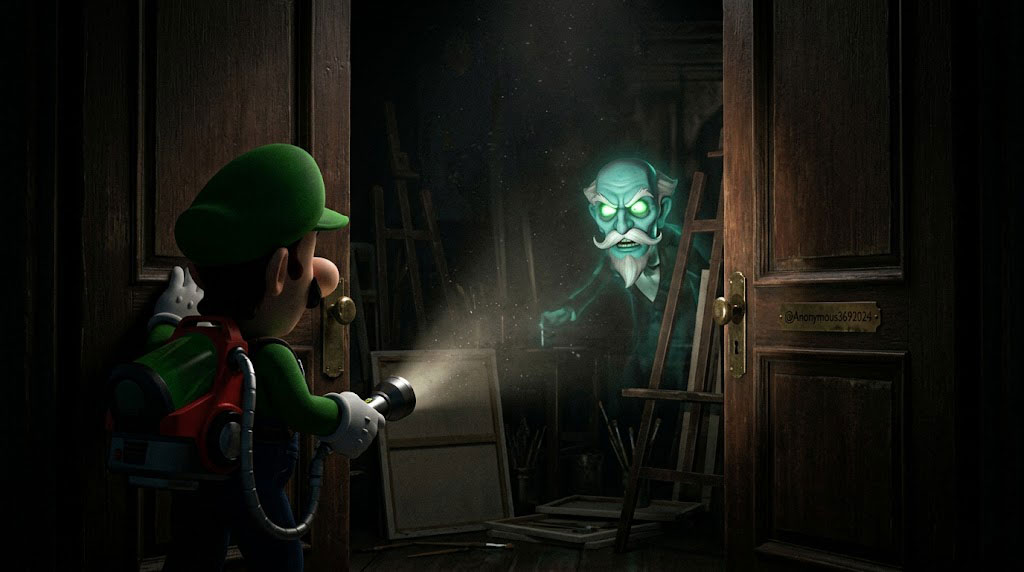
The air on the third floor of the towering gothic estate is incredibly suffocating. It does not carry the scent of stale perfume or rotting wood like the lower levels of the haunted property. Instead, it reeks of chemical turpentine, drying oil paints, and the sharp, metallic tang of old blood mixed with canvas dust. When the trembling green clad plumber slowly pushes open the heavy wooden doors to the Artists Studio, he does not step into a mere bedroom or a storage closet. He steps into the literal factory of his own nightmares. The pitch black room is cluttered with wooden easels, blank canvases, and scattered paint brushes. In the center of the gloom stands an old man with pale teal skin, a stark white mustache, a pointed beard, and glowing green eyes that burn with a manic, unhinged obsessive energy. This is Vincent Van Gore, the Starving Artist. For over two decades, casual players of the two thousand and one GameCube masterpiece viewed this encounter as just another mini boss fight before the grand finale. But a forensic dissection of the environmental storytelling, his internal biography, and his supernatural abilities reveals a profoundly disturbing psychological thriller. Vincent Van Gore is not just a quirky ghost holding a paintbrush. He is the sole architect of the mansions spectral army, a man utterly destroyed by thirty years of human rejection, who weaponized his own artistic failure to wage a terrifying war against the living.
Thirty Years of Bitter Rejection
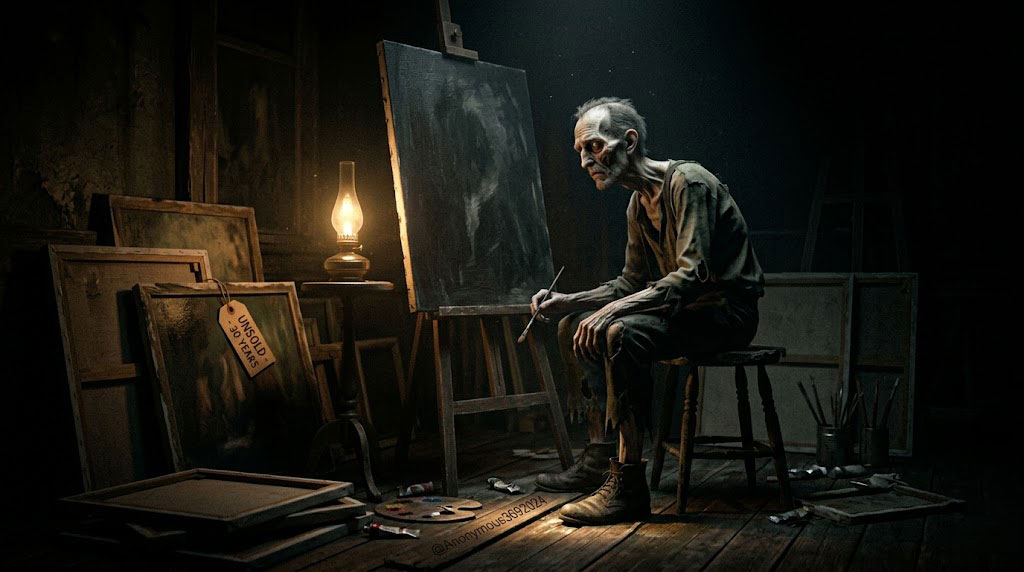
To understand the sheer psychological horror of this undead painter, we must first examine the agonizing, pathetic history he left behind in the mortal realm. The internal data registered within Professor Elvin Gadds Game Boy Horror scanner unlocks a deeply tragic reality regarding his existence. The device explicitly states that despite failing to sell a single painting in thirty years, this stubborn man refuses to let his art die. This single sentence paints a harrowing picture of a life consumed by profound, crushing inadequacy. Vincent Van Gore is fifty nine years old. This means that for over half of his adult life, he poured his entire soul, his sweat, and his fading sanity onto blank canvases, desperately seeking validation from a world that completely ignored him.
Every single brushstroke was met with silence. Every gallery showing ended in mockery or absolute indifference. He watched as lesser artists achieved fame and wealth while he rotted away in a dusty studio, his body withering from malnutrition. The title of Starving Artist is not a romantic metaphor in this dark lore. It is a literal description of his demise. Driven mad by isolation and the crushing weight of his own perceived mediocrity, Vincent Van Gore locked himself away from humanity. He refused to compromise his artistic vision to make a living, choosing instead to physically starve to death surrounded by his own unsold, unwanted masterpieces. He died alone, cold, and incredibly bitter. But death was not the end of his artistic journey. It was the terrifying beginning.
The Dark Art of Paranormal Necromancy
When King Boo unleashed his spectral army upon the valley and conjured the towering illusionary mansion, he did not just need foot soldiers to protect his newly claimed territory. He needed a general. He needed a creator. The dark magic of the Ghost King fused perfectly with the festering, unresolved rage of the deceased painter. In the afterlife, Vincent Van Gore was granted a terrifying, god like ability. He became a master of paranormal necromancy. He could finally give true, physical life to his art.
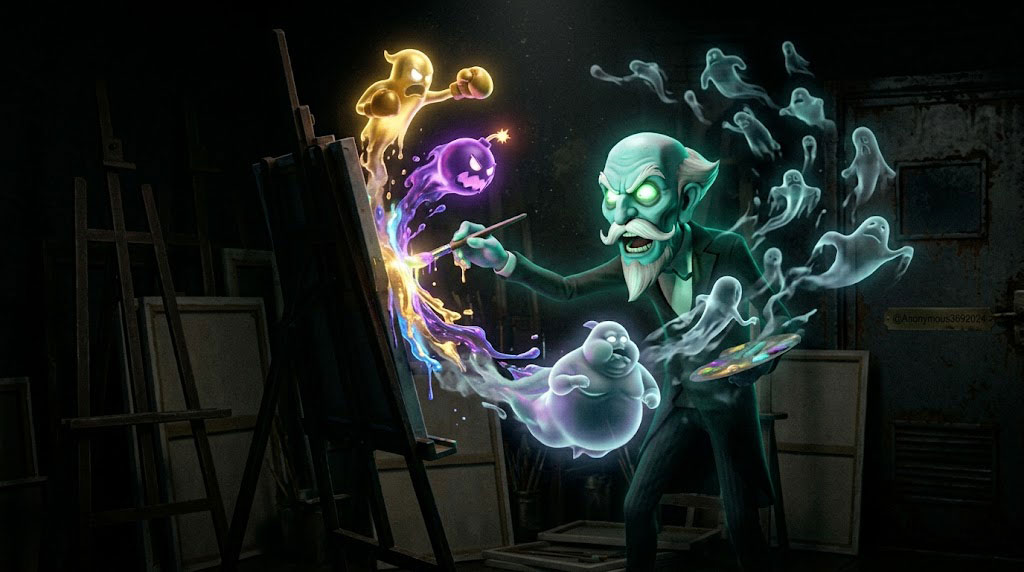
The profound lore implications of this ability completely recontextualize the entire game. Every single generic ghost that Luigi encounters in the dark hallways, the punching Gold Ghosts, the ceiling dropping Purple Bombers, the floor shaking Blue Twirlers, the garbage eating gluttons, they are not the souls of dead humans. They are the physical manifestations of Vincent Van Gores wet paint. He sits in his pitch black studio on the third floor, frantically brushing ethereal pigments onto his canvases, bringing wave after wave of spectral monsters to life to terrorize the green clad intruder. He is the mother of the swarm. The entire ghostly ecosystem of the accursed estate relies entirely on his tireless, manic wrists. For the first time in his miserable, fifty nine years of existence, his art finally has an impact on the world. His paintings are no longer ignored. They are actively hunting, punching, and terrifying the living, forcing humanity to finally acknowledge the sheer, overwhelming power of his creations.
The French Imposter and the Mutilated Name
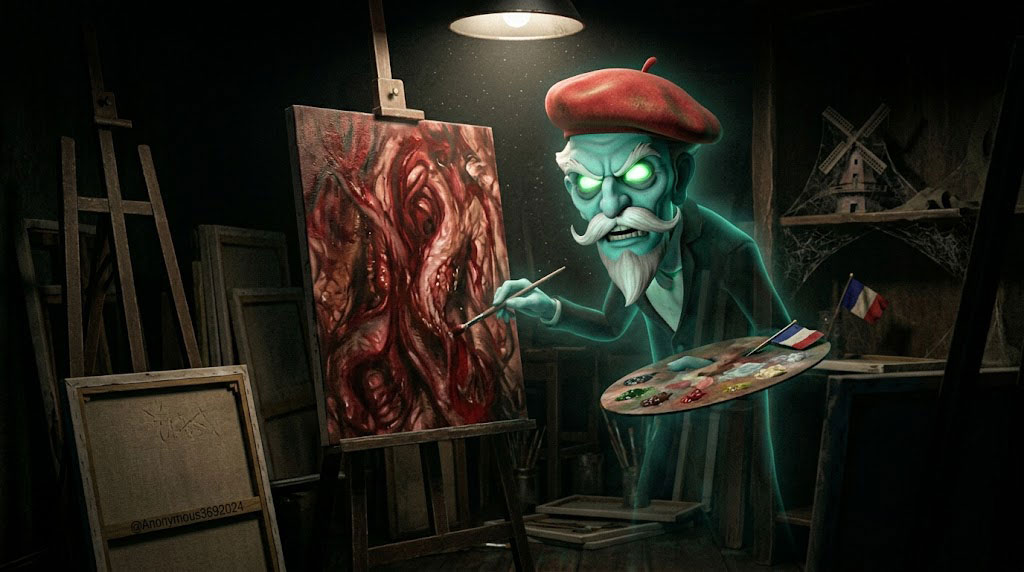
The identity of the Starving Artist is layered with macabre historical irony and a deep seated psychological delusion. His name, Vincent Van Gore, is a blatant, dark parody of the legendary post impressionist painter Vincent van Gogh. Just like his real world counterpart, Van Gore suffered from severe mental illness, lived a life of profound isolation, and failed to achieve commercial success before his tragic death. However, the game introduces a deeply unsettling contradiction to this persona.
When Van Gore speaks, his voice echoes through the studio with a heavy, stereotypical French accent. He calls Luigi a filthy swine and uses theatrical French phrases to mock the trembling plumber. But the real Van Gogh was Dutch. Why does the ghost possess a French accent. The psychological profiling suggests that Van Gore was an imposter, a man so desperate for artistic legitimacy that he adopted a fake European persona to sound more sophisticated and cultured to his potential buyers. He built an entire fake identity, clinging to the romanticized ideal of the French artisan, but the public saw right through his pathetic charade. Furthermore, the surname Gore literally translates to blood and mutilated tissue shed in a violent event. His very name implies that his art is not beautiful or serene. It is grotesque. It is born from suffering, pain, and the shedding of his own humanity. He is a twisted, bleeding shadow of true genius, hiding behind a fake accent and a red beret.
The Masterpiece of the Execution Squad
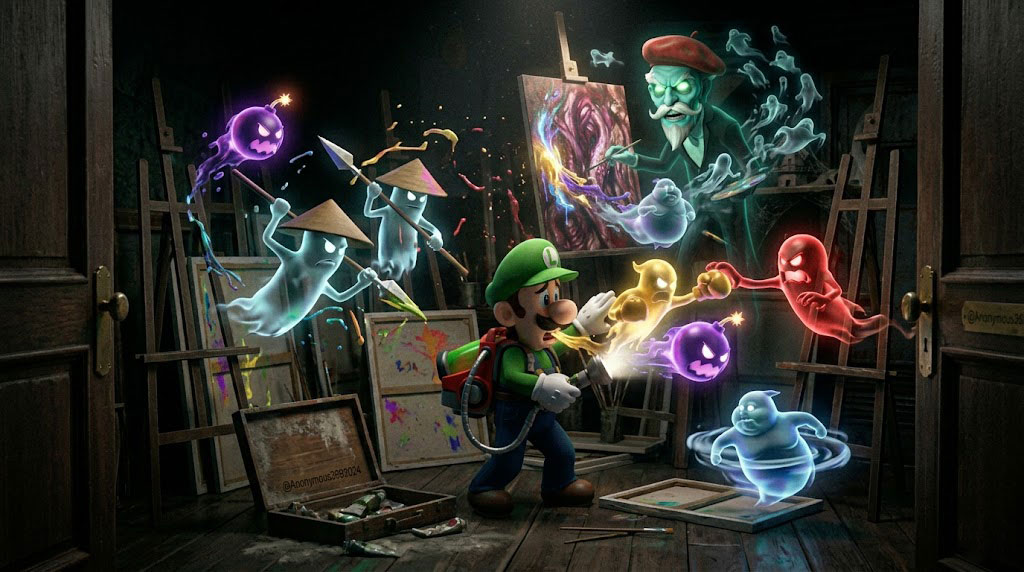
When Luigi finally breaches the heavy wooden doors of the studio, the confrontation is utterly unique within the architecture of the mansion. Vincent Van Gore refuses to attack the trembling plumber directly. He views physical combat as entirely beneath him, an act reserved for common thugs. Instead, he floats behind his wooden easel, his green eyes burning with malicious pride, and declares that he will show Luigi the true mastery of his art. What follows is the most grueling, exhausting test of endurance in the entire game.
Van Gore unleashes his ultimate masterpiece, a gauntlet of twenty one distinct ghosts, spawned directly from his magical canvases in seven consecutive waves of three. The room becomes a chaotic, suffocating battlefield of flying paint and ethereal violence. Luigi must survive a coordinated execution squad consisting of Gold Ghosts, Purple Punchers, Blue Twirlers, red Grabbing Ghosts, spear wielding Ghost Guys, Garbage Can Ghosts, and explosive Purple Bombers. The sensory overload is intense. The mechanical roar of the Poltergust three thousand threatens to overheat as Luigi is forced to systematically dismantle every single brushstroke the madman has ever painted. Van Gore watches from the shadows, treating the violent slaughter of his own creations as a beautiful, moving theatrical performance. He forces the player to destroy his lifes work right in front of his eyes, stroke by agonizing stroke.
The Devastation of the Blank Canvas
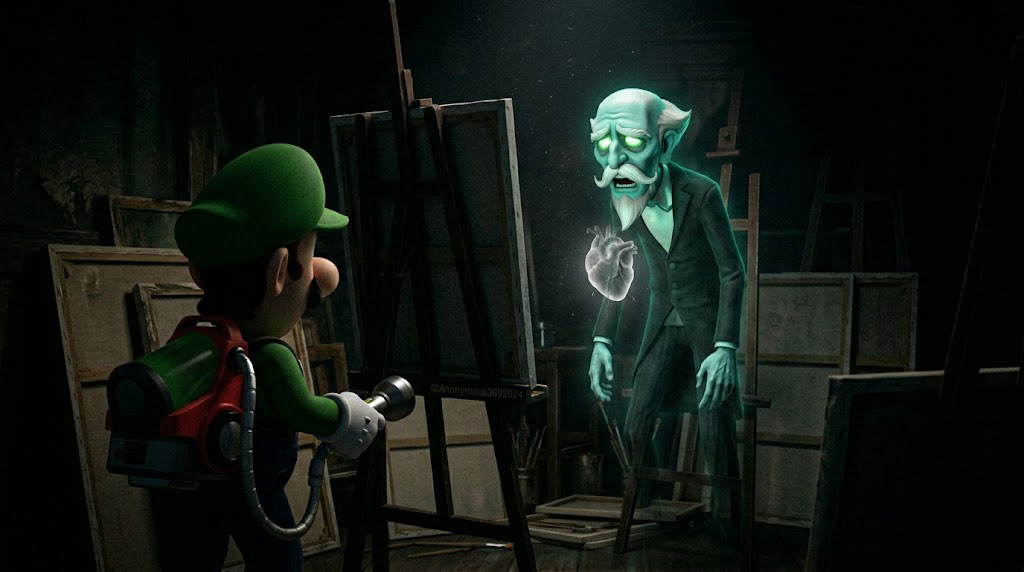
Through sheer, unyielding determination, Luigi manages to survive the gauntlet. He vacuums the final explosive Purple Bomber from the air, leaving the studio in absolute, deafening silence. It is in this profound moment of emptiness that the illusion of the arrogant, powerful creator is violently and permanently shattered. Vincent Van Gore looks at his blank canvases, and the horrifying reality of his situation crashes down upon his fractured mind.
His voice loses its confident, theatrical flair. He stammers in absolute disbelief, asking how it is possible that none of his creations are left. For thirty years in life, his art was rejected and destroyed by the indifference of the world. Now, in death, his ultimate, living masterpieces have been systematically eradicated by a terrified plumber armed with a household cleaning appliance. The psychological devastation is absolute. His heart physically breaks a second time. The grief, the crushing inadequacy, and the overwhelming realization that he is, and always will be, an absolute failure forces his spectral heart to manifest in the open air. He does not fight back. He does not summon weapons. He simply hovers in the dark, entirely consumed by the exact same despair that killed him in the mortal realm.
A Capture Devoid of Resistance
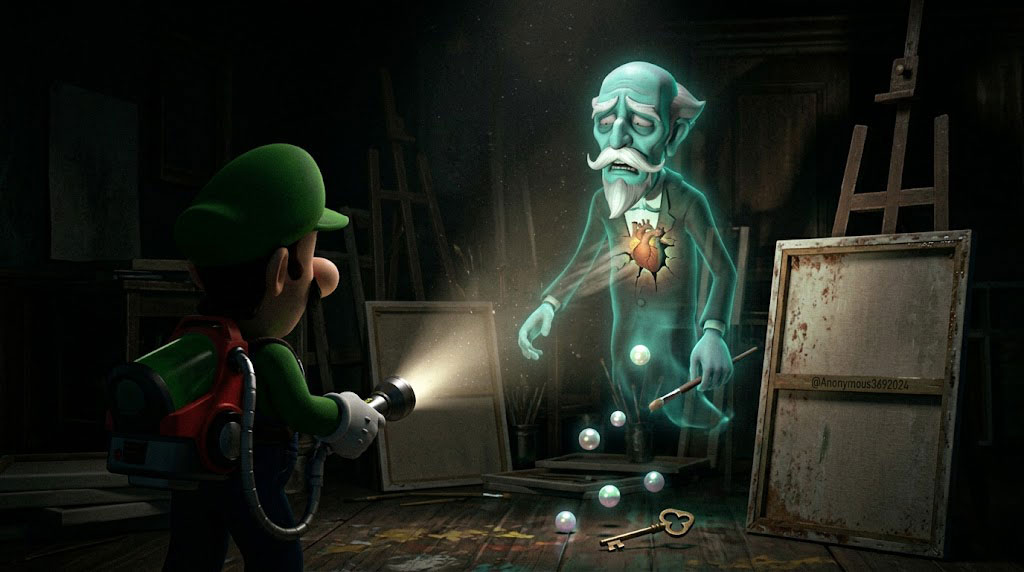
When the blinding beam of the flashlight pierces the gloom and strikes his exposed, broken heart, the roar of the ghost hunting machine fills the empty studio. The capture of Vincent Van Gore is arguably the most pathetic and depressing struggle in the entire accursed estate. He possesses one hundred health points, but he offers virtually zero resistance to the crushing suction of the vortex. He simply floats limply in the air, his long face twisting in sorrow, his paintbrush slipping from his pale, ethereal fingers.
He allows himself to be dragged across the dusty floorboards. He has no reason left to fight. His art is gone, and without his art, he is nothing. He drops a cluster of valuable spectral pearls onto the ground, along with the spade shaped key to the Secret Altar, before being violently ripped from the physical plane. He is sucked screaming into the suffocating, lightless containment chamber on Luigis back. The studio falls dead silent. The smell of drying paint slowly fades into the ether. By capturing Van Gore, Luigi effectively cuts off the central artery of King Boos army. The generic ghosts immediately stop spawning in the dark hallways of the mansion. The factory has been permanently shut down.
The Ultimate Irony of the Golden Frame
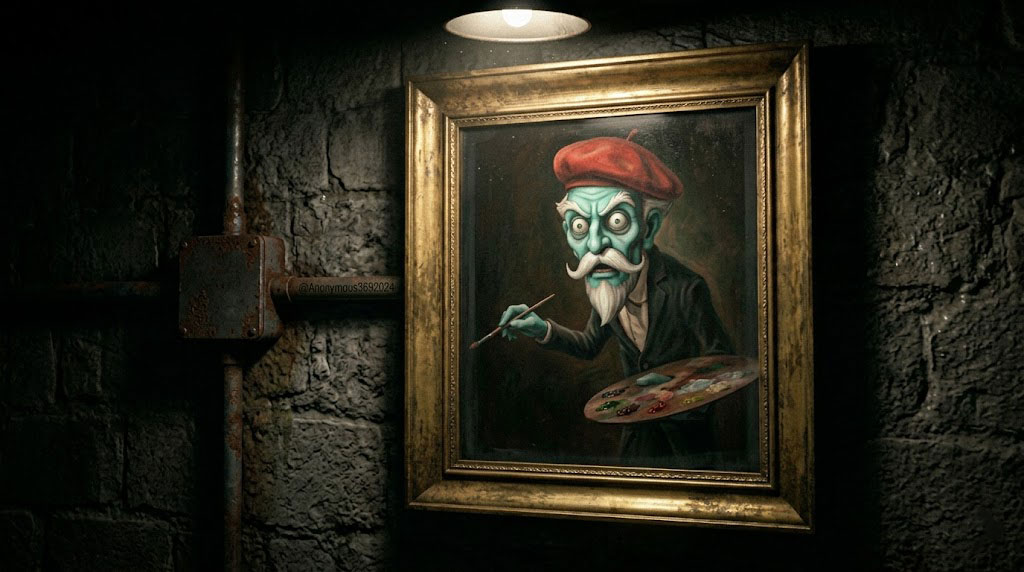
The psychological torment of the Starving Artist concludes deep underground, in the cold, sterile laboratory of the eccentric Professor Elvin Gadd. The ending drops below the mansion, where Luigi feeds the heavy vacuum into the grinding gears of the Ghost Portrificationizer. The machine, maliciously engineered to compress sentient souls into static oil paintings, subjects the painter to a flattening, agonizing paralysis. His wandering afterlife is pressed into a flat painted prison behind museum glass.
In his ultimate, golden frame, Vincent Van Gore is depicted holding his palette and brush, his face frozen in a state of eternal, silent shock. The irony of this punishment is staggeringly cruel. He spent his entire living existence desperately trying to create paintings that people would want to hang on their walls and admire. Now, he himself has been reduced to a painting, hanging silently on a wall in a dark, subterranean gallery for a mad scientist to study. He has become the very medium he failed to master. He is denied the ability to ever lift a brush or mix a color again. He is perfectly preserved in his state of ultimate failure, a permanent monument to a man whose desire to create only led to his own total destruction.
What happens to the mind of a mad artist when he is forced to spend eternity trapped beneath a layer of oil paint, fully aware that he is the only masterpiece he will ever actually sell?
Continue the Mansion File
The mansion works best as a chained dossier. Step back if you missed the previous room, or keep going to follow the next piece of Luigi's Mansion lore.
Previous file: Why Sir Weston Chose the Ice in Luigi's Mansion Next file: Luigi's Mansion's Generic Ghosts Were Never Alive